Skip to page content

PE Mechanical: HVAC and Refrigeration

In development · Free study preview

Understand the system.
Choose the right method.

Connect the load, the air or water process, and the equipment decision. Build a method you can use with the NCEES handbook and carry into an unfamiliar problem.

ReasonSpan™ focuses your study time on the reasoning behind each decision: when an equation applies, how to find it, and how to catch the error before it costs you another attempt.

Foundation lessons and sampler need no account. Sign in for the free diagnostic, mocks and saved study studio. Paid enrollment is not open.

One connected system. Two ways to understand it.Connect the equipment to the calculation

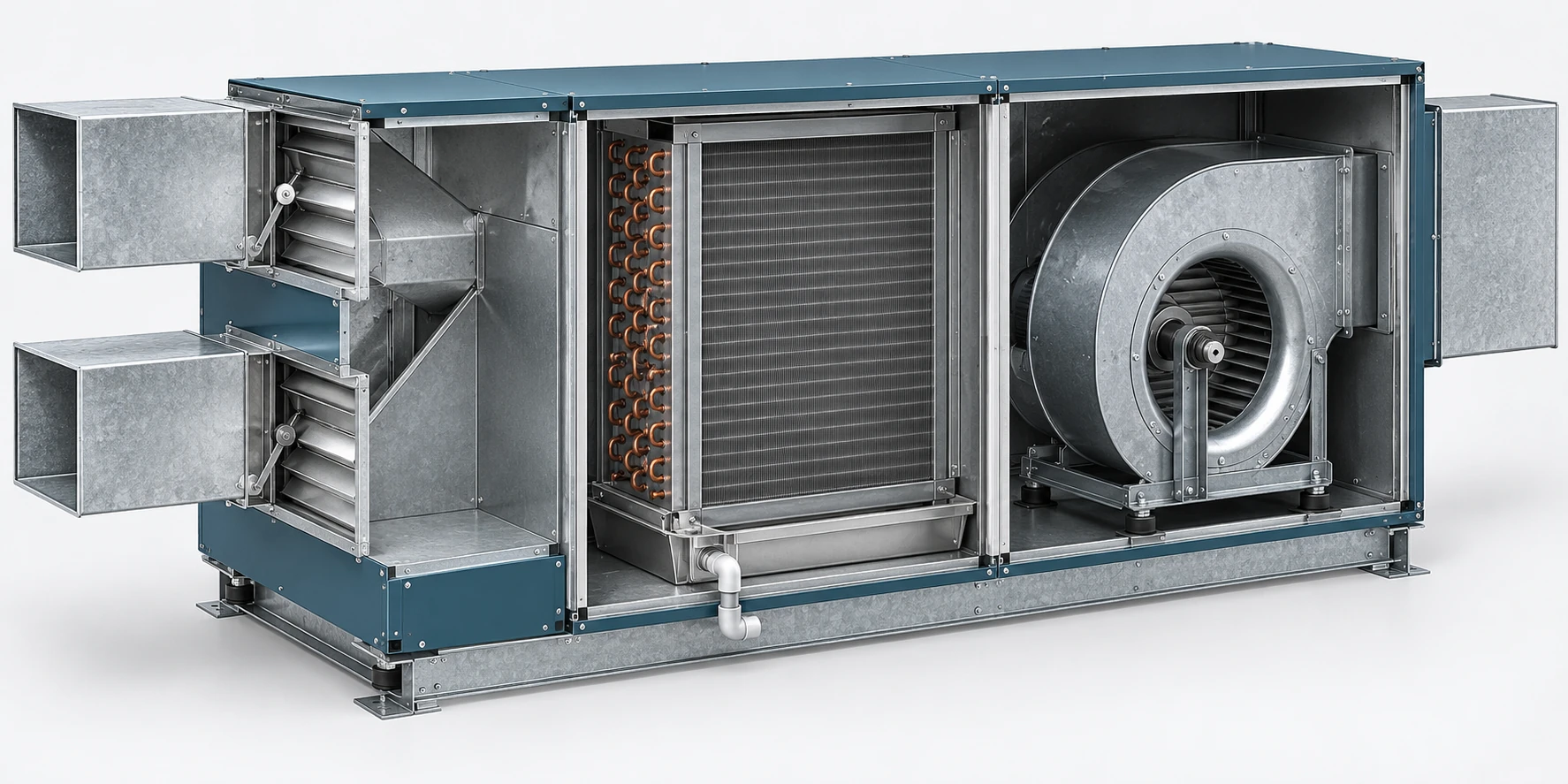
01 · Equipment view

A realistic cutaway air handler shows a two-inlet mixing plenum, cooling coil with drain pan, and downstream supply fan.

Mixing plenum → cooling coil → supply fan

Follow the same components in the schematic, then extend the air path into the room boundary.

02 · Exam-style model

Zoom in to read every label.

One connected system. Two ways to understand it.

100%Open in a new tab

Scroll or swipe inside the viewport. Read the units and assumptions with the labelled components.

Outdoor and recirculated return air mix upstream of a cooling coil and supply fan. Supply enters the room; return splits into recirculation and exhaust.

Identify the mixing plenum, coil and fan in the equipment view. Then follow the supply, return and exhaust paths in the schematic. Define the room or coil boundary before adding loads.

Original teaching figure. The schematic and stated givens define the model; the 3D view illustrates the hardware. These are not actual examination exhibits.

80Exam questions
8 hoursWorking exam time
4 domainsOctober 2025 specification
One handbookSupplied exam reference

Train with the right reference boundary

The handbook helps. Your understanding supplies the method.

The supplied PE Mechanical Reference Handbook v2.1 says it is the only reference resource permitted during the exam. The current PE Mechanical: HVAC and Refrigeration specification lists no separate design-standard PDFs. It still includes codes and standards as a knowledge area.

The handbook also says some expected theories, conversions, formulas and definitions are omitted. Each lesson therefore distinguishes the relationship you can locate, the concept you should understand, and any criteria an original practice question explicitly supplies.

Check official NCEES examination information ↗

Read the PE Mechanical: HVAC and Refrigeration exam and handbook guide →

Your preparation map

Four domains. Twenty-four focused modules.

Study all 24 foundation lessons, each with a worked example and a new practice decision. Official question ranges describe possible exam coverage, not fixed percentages.

L

HVAC Loads and Psychrometrics

18–27 questions on the NCEES specification

Distinguish sensible and latent loads, follow air processes, and apply the right pressure and temperature basis.

D

HVAC and Refrigeration Distribution and Systems

20–30 questions on the NCEES specification

Trace air, water, steam, fuel, refrigerant and control paths through a complete system.

Use the study hour well

A familiar ReasonSpan™ learning path.

Recognize the decision

Define the boundary, conditions, requested quantity and governing behavior before searching for an equation.

Find and apply

Use a specific handbook search term. Confirm units, air or fluid basis, and the assumptions behind the relationship.

Work and verify

Follow a complete example, check the result against physics, and identify the common wrong route.

Transfer the method

Try a different original question. Review the explanation for each choice to see which reasoning needs attention.

Six deeper application workshops

Change the condition. Check whether your method still works.

Work through exchanger arrangement, VRF operating limits, recovery-device penalties, control latches, cold-air mass and frost, and code applicability. Record a prediction before inspecting the complete method. The private notebook preserves your first saved response beside your revised reasoning.

Original teaching cases, separate from the diagnostic and timed forms. Free to try; sign in before starting to save across devices.

Available today · No payment required

Know what to study next. Understand why it works.

Start with a sampler question and inspect every answer explanation. When you want a saved study path, sign in for the diagnostic. Use its module results to choose a lesson, practice the method and try a separate transfer check. Your first transfer response stays visible after you record a correction.

What you can use in the free development preview
ResourceWhat it helps you doAccess
8 sampler questionsInspect the method and every choice explanation across four domains.No account
24 theory lessons + 24 lesson checksStudy typeset equations, unit definitions, worked examples, specialist cases, readable figures and handbook search drills.No account
6 Decision Lab workshops · 12 learning decisions + 6 delayed fresh checksChoose a method, work a targeted repair, then check fresh work after 24 hours. Retain first responses and study-reference logs.No account to try; free sign-in to save
80-question diagnosticFind module errors, confident mistakes and pacing concerns.Free candidate sign-in
Chart and Exam Skills Lab28 saved exercises: psychrometrics, system curves, references and alternative response formats.Free candidate sign-in
144 targeted questionsPractice six applications per module with worked reasoning.Free candidate sign-in
24 independent transfer checksApply the method to a multi-step problem; retain first-response evidence and corrected reasoning.Free candidate sign-in
Two 80-question timed mocksRehearse timing with 48 multi-step problems per mock, shorter questions for pacing, section locking and the scheduled break. Review after submission.Free candidate sign-in
Saved path and calendarChoose the next task, save progress and export planned study sessions. Calculator, notepad and scratch whiteboard support practice.Free candidate sign-in

All questions are original educational material. Lesson reading and correction completion are self-reported. Small practice samples guide study; they do not establish mastery or predict an NCEES result. An AI-assisted technical audit is complete; independent PE specialist review remains pending. Paid enrollment is closed; launch pricing and access terms have not been announced. Inspect dated review status and corrections.

Emailing your interest opens a draft in your email application. It does not enroll you or add you to a mailing list.

Program Q&A

Know what this preview includes.

Are separate ASHRAE or NFPA standards provided on the examination?

The supplied handbook identifies itself as the sole reference for the PE Mechanical: HVAC and Refrigeration exam, and the October 2025 PE Mechanical: HVAC and Refrigeration specification does not list separate design-standard PDFs. Codes and standards remain in the tested scope. Check your current authorized handbook and exam specification for your examination date.

Does the handbook contain everything I need to know?

No. Its introduction explicitly says some expected theories, conversions, formulas and definitions are omitted. The course teaches those concepts alongside handbook navigation. It does not assume that every code requirement appears in the handbook.

Do the books used for lessons become examination references?

No. Mechanical and Electrical Equipment for Buildings, Heating, Cooling, Lighting, Sun, Wind & Light, and the ASHRAE Pocket Guide (SI, 9th edition, 2017) support the theory and physical explanations. The older guide supports fundamentals; it is not a current-code authority or examination reference. The lessons are original educational material; the books are not provided inside this program or available as examination references.

What happens after targeted practice?

Each module has an independent transfer check with complete original givens, including multi-step calculations, data reading and system-boundary decisions. Your first submitted response stays in the account record. A missed response can receive a saved correction note, while the original result remains visible. The study calendar includes pending transfer checks and unresolved corrections. These are small samples for study decisions; the two timed mocks remain separate.

Can I enroll in the full program now?

Enrollment is not open. You can use the foundation lessons and eight-question sampler free, and sign in to use the diagnostic, targeted practice, mocks and saved studio at no charge during this development preview. A launch date, price and access terms will be announced when the complete offer is ready.

Which response formats are in the sampler?

The sampler contains single-answer multiple choice, one numeric-entry item and one multiple-response item. It does not reproduce the complete NCEES testing interface. The candidate diagnostic and each mock also include numeric-entry and multiple-response questions. New mock attempts additionally include point-and-click diagrams and drag-and-drop matching, with keyboard alternatives. Timed mocks use one eight-hour working clock and a scheduled break of up to 50 minutes. Their response-format mix is our practice design; NCEES does not publish fixed counts for each format. They are original ReasonSpan™ practice forms, with no claim to reproduce actual examination questions.

How challenging are the mocks, and how do I see the revised questions?

Each mock combines 48 multi-step problems with shorter decisions for pacing. Independent difficulty calibration is still pending, so the score is a study signal rather than a passing prediction. Saved attempts retain their original questions; start a fresh mock after submitting an older attempt to use the revised form. Compare mock practice with the exam process.