L5 · HVAC Loads and Psychrometrics
Foundation lesson · 25 minute study sessionTrack moisture removal before adding reheat
A wet cooling coil changes enthalpy and humidity ratio. Reheat then raises temperature without restoring the moisture removed by the coil.
By the end of this lesson
- Calculate condensate using a dry-air mass balance.
- Distinguish coil duty from reheat duty.
- Explain direct evaporation and steam humidification.
Condensation requires a wet process
Cooling alone does not guarantee dehumidification. Moisture condenses when air contacts sufficiently cold surfaces and leaves at a lower humidity ratio. Calculate condensate from the dry-air mass flow multiplied by the change in humidity ratio. Reheat increases while leaving unchanged in a dry coil.
Reheat changes temperature
After dehumidification, sensible reheat raises dry-bulb temperature at essentially constant humidity ratio. The resulting lower RH reflects warmer air, not additional water removal. Coil leaving condition and final supply condition must be kept separate.
Choose the humidification model
Direct evaporative cooling generally lowers dry bulb while increasing humidity ratio, with nearly constant enthalpy under common approximations. Steam injection adds both moisture and energy. Use the complete energy balance when water or steam enthalpy is supplied. For a wet coil, condensate carries some energy out; neglect it only when the problem permits that approximation.
A decision map for this lesson
Cooling removes moisture; dry reheat changes temperature
Track the drain and the enthalpy change separately. Dry reheat does not undo the moisture removal.
01 · Equipment view
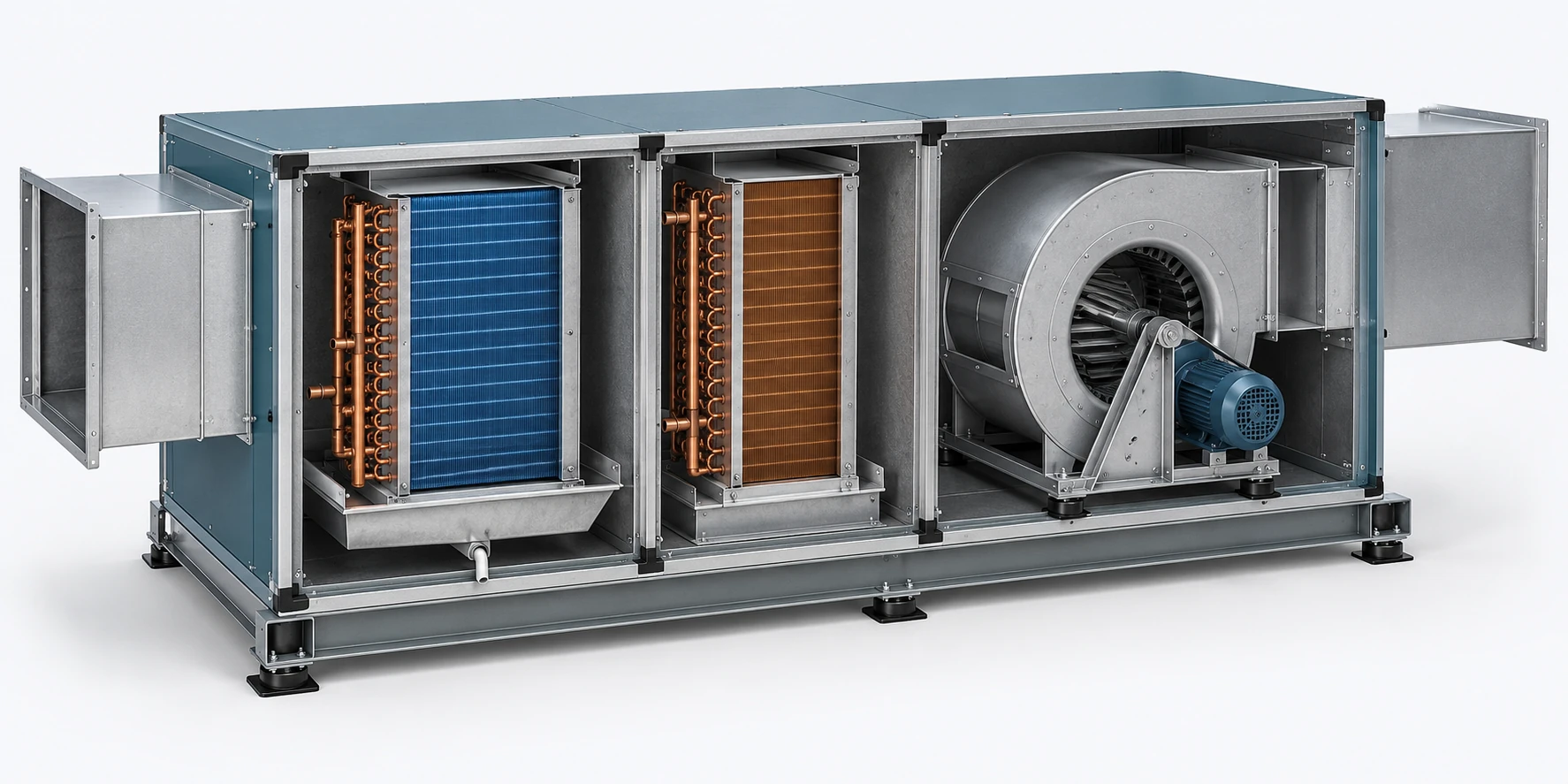
Cooling coil → dry reheat coil
Track the states across the two coils. The downstream fan is outside this two-coil calculation.
02 · Exam-style model
Dry reheat adds 27,000 Btu/h while keeping W fixed. Gross coil removal is 126,000 Btu/h; net cooling across both devices is 99,000 Btu/h under the stated approximation.
Original teaching figure. The schematic and stated givens define the model; the 3D view illustrates the hardware. These are not actual examination exhibits.
| Condition or question | Governing decision | Error to avoid |
|---|---|---|
| Cooling coil with a falling W | Find condensate from . | Using the drop in RH as the water-removal rate. |
| Coil thermal duty | Use the air enthalpy decrease; include condensate enthalpy when the specified model requires it. | Omitting an outlet energy stream when the question has not authorized that approximation. |
| Dry reheat after the coil | Increase h while keeping W fixed when no moisture transfer occurs. | Assuming that a lower leaving RH means more water was removed. |
| Net cooling across coil plus reheat | Subtract the heat added by reheat from the cooling-coil removal. | Calling gross coil duty the net duty across both devices. |
On a narrow screen, scroll across the table to compare the decision and the error.
Relationships and their limits
Condensate flow
Dry-air mass flow and humidity ratios must have matching time and mass units.
Cooling duty with condensate
Use a compatible enthalpy datum. A problem may authorize neglecting the condensate enthalpy term.
Sensible reheat
Humidity ratio is unchanged across a dry reheat coil.
| Symbol | Meaning | Units or basis |
|---|---|---|
| Condensate mass flow | lb water/h | |
| Dry-air mass flow | lb dry air/h | |
| Humidity ratio | lb water/lb dry air | |
| Moist-air enthalpy | Btu/lb dry air | |
| Condensate enthalpy on compatible datum | Btu/lb water |
One decision, fully worked
Apply the method.
Air flows at 9,000 lb dry air/h through a cooling coil. Inlet h = 36 Btu/lb and W = 0.014; leaving h = 22 Btu/lb and W = 0.008. Neglect condensate enthalpy. Reheat increases enthalpy to 25 Btu/lb without adding moisture.
- Calculate water removal from the humidity-ratio difference.
- Use inlet and coil-leaving enthalpy for cooling duty.
- Use coil-leaving and final-supply enthalpy for reheat duty.
- Keep the final humidity ratio at the coil-leaving value.
The coil removes 54 lb/h of water and 126,000 Btu/h. Reheat adds 27,000 Btu/h; final W remains 0.008.
Independent checkNet air-stream energy removal is 99,000 Btu/h, matching 9,000 × (36 − 25).
Specialist extension
Separate cooling, moisture removal and reheat
Cooling below the entering dew point can remove moisture. A subsequent dry reheat coil changes enthalpy and dry-bulb temperature without changing humidity ratio. For a wet-coil energy balance, distinguish a simple air-enthalpy approximation from a full balance that includes liquid condensate energy. Apply the explicitly supplied model and boundary.
A new applied case
Air at 6,000 lb dry air/h leaves a cooling coil at h = 22 Btu/lb dry air and W = 0.008. Dry reheat adds 24,000 Btu/h.
Decision. Supply enthalpy is 26; water-vapor flow remains 48 lb/h.
Cross-check. A dry reheat step cannot by itself solve an excessive supply humidity ratio.
Unit basis. h is Btu/lb dry air; W is lb water/lb dry air; mass rate is lb dry air/h; heat input is Btu/h.
NCEES PE Mechanical Reference Handbook v2.1; see the module reference path.
Open targeted practice in the study studio →Transfer the method
Catch the common errors
- Using final supply h to calculate the gross cooling-coil duty.
- Assuming reheat adds moisture because dry bulb rises.
- Applying an enthalpy approximation without checking the stated condensate assumption.
Handbook navigation drill
Find it, then explain it.
Search: Moist-Air Cooling and Dehumidification
Find the water and energy balances, then trace cooling and reheat as two separate steps.
Check your navigation
You can state which quantities change and which remain constant in each step.
Reference path: §9.2.2–9.2.6, pp. 480–482; §9.3.10–9.3.11, pp. 525–526. These are printed handbook page numbers; section names and search terms remain the primary navigation method. See technical review status.
Theory sources
- NCEES handbook v2.1, §§9.2.2 and 9.2.4.
- Grondzik and Kwok, Mechanical and Electrical Equipment for Buildings, 12th ed., ch. 12.
- Lechner, Heating, Cooling, Lighting, 4th ed., §§10.12 and 10.15.
Worked examples and lesson prose are original ReasonSpan™ material. Obtain authorized publications separately; this preview does not reproduce the supplied books or handbook.