L4 · HVAC Loads and Psychrometrics
Foundation lesson · 25 minute study sessionMix air on a dry-air mass basis
Two air streams combine through conservation of dry air, moisture and energy. A volume fraction is a mass fraction only under suitable density assumptions.
By the end of this lesson
- Calculate dry-air mass flow from actual airflow and specific volume.
- Mix enthalpy and humidity ratio independently.
- Check that a mixed state lies between the inlet states.
Establish flow basis
Psychrometric enthalpy and humidity ratio are expressed per pound of dry air. If actual cfm and specific volume are given, calculate dry-air mass flow for each inlet separately. Equal cfm does not mean equal dry-air mass when the specific volumes differ. Mix and using , not uncorrected actual volume.
Conserve three quantities
For an adiabatic mixing box with no condensation, dry-air flow leaving equals the inlet total. The outlet enthalpy and humidity ratio are weighted averages using dry-air mass fractions. Read the resulting state from the appropriate chart or property relationship.
Use temperature averaging carefully
A flow-weighted dry-bulb average is a useful approximation when humidity and heat capacities are close. It is not a replacement for the enthalpy and moisture balances when the problem supplies detailed moist-air properties. A mixed state should fall on the straight line between inlet states on a compatible chart.
A decision map for this lesson
Mix properties on the conserved mass basis
The illustration uses the lesson’s adiabatic, no-condensation example. Check those assumptions before applying a simple weighted average.
01 · Equipment view
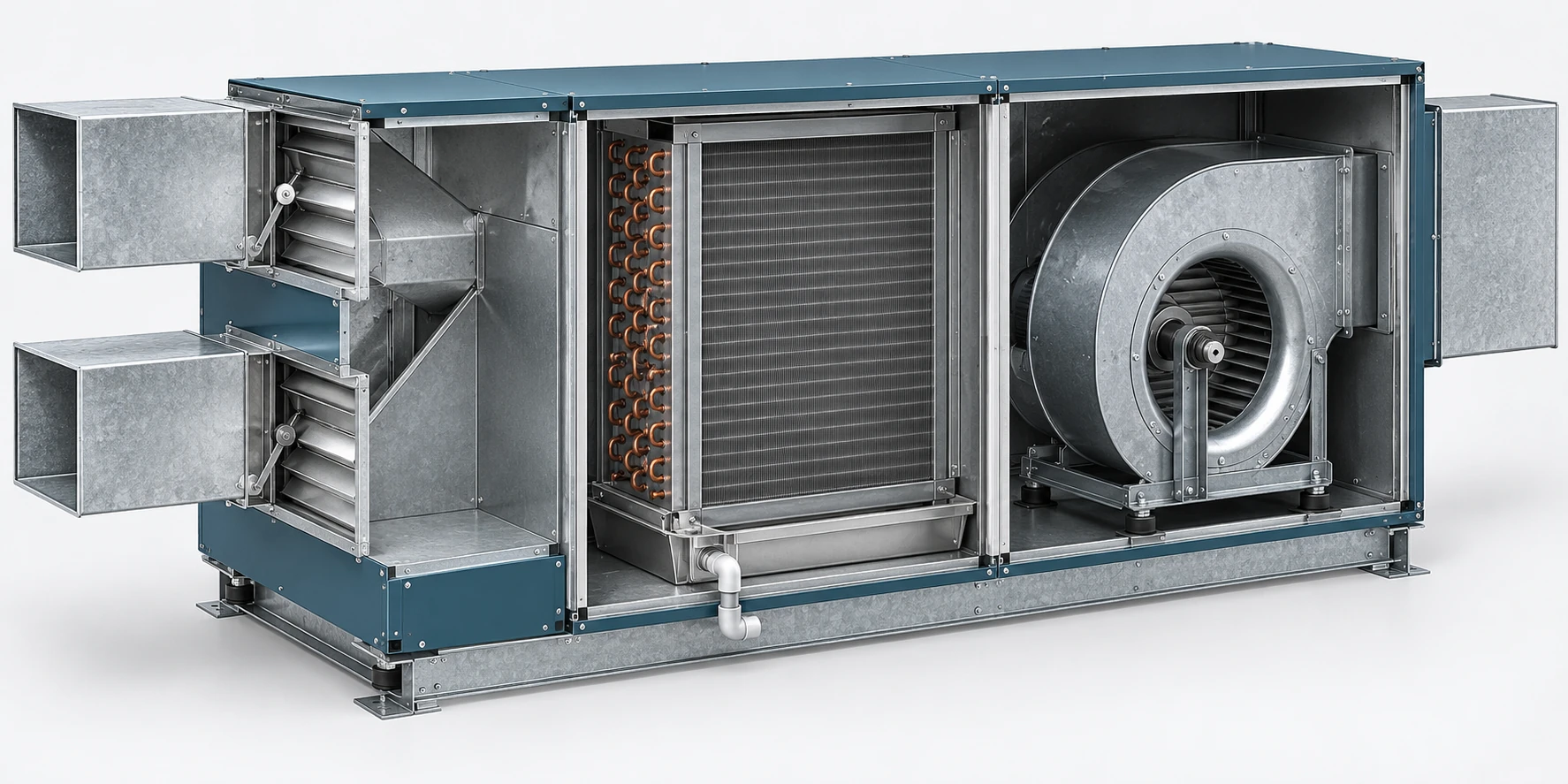
Outdoor air + return air → mixing plenum
For this lesson, isolate the two-inlet mixing plenum. The downstream coil and fan are outside the mixing-box balance.
02 · Exam-style model
A 25% outdoor dry-air mass fraction gives the same weights for enthalpy and humidity ratio in this adiabatic, no-condensation example.
Original teaching figure. The schematic and stated givens define the model; the 3D view illustrates the hardware. These are not actual examination exhibits.
| Condition or question | Governing decision | Error to avoid |
|---|---|---|
| Dry-air mass flows are supplied | Use each dry-air flow divided by their sum as the weight for h and W. | Using equal weights when the supplied dry-air flows differ. |
| Actual cfm and specific volume are supplied | Convert each stream with before weighting hourly flows. | Treating equal actual cfm as equal dry-air mass at different specific volumes. |
| Adiabatic mixing without condensation | Mixed h and W lie between the corresponding inlet values. | Accepting a mixed enthalpy above both inlets without investigating the balance. |
| A liquid drain or added heat is present | Add that mass or energy stream to the control-volume balance. | Continuing to use the no-condensation, no-heat-input model. |
On a narrow screen, scroll across the table to compare the decision and the error.
Relationships and their limits
Convert actual flow
V is actual ft³/min and v is ft³/lb dry air. Result is lb dry air/h.
Mix the streams
Assumes steady, adiabatic mixing, no condensation and a common pressure basis.
| Symbol | Meaning | Units or basis |
|---|---|---|
| Dry-air mass flow | lb dry air/h | |
| Actual volumetric flow | cfm | |
| Specific volume per dry-air mass | ft³/lb dry air | |
| Mixed-air enthalpy | Btu/lb dry air | |
| Mixed-air humidity ratio | lb water/lb dry air | |
| Stream enthalpy | Btu/lb dry air | |
| Stream humidity ratio | lb water/lb dry air |
One decision, fully worked
Apply the method.
An AHU mixes 1,200 lb dry air/h of outdoor air at h = 40 Btu/lb and W = 0.014 with 3,600 lb dry air/h of return air at h = 28 Btu/lb and W = 0.009. The box is adiabatic and no condensation occurs. Find the mixed h and W.
- Add the two dry-air mass flows.
- Find the outdoor-air dry-mass fraction, 0.25.
- Weight the two enthalpies using the dry-air mass fractions.
- Weight the two humidity ratios using the same fractions.
Mixed-air enthalpy is 31 Btu/lb dry air and humidity ratio is 0.01025 lb/lb dry air.
Independent checkBoth results lie between the respective inlet values and nearer the return-air state, which supplies 75% of the dry-air mass.
Specialist extension
Equal actual volumes need not be equal mass weights
Mixing balances require a common dry-air mass basis. If stream specific volumes differ, equal actual cfm deliver different dry-air mass rates. For an adiabatic mixer without liquid transfer, mass-weight enthalpy and humidity ratio separately. Use compatible pressure and state definitions; a direct temperature average is not a substitute for the energy balance.
A new applied case
Two streams each deliver 900 actual cfm at a common 14.7 psia. Stream 1 has specific volume 13 ft³/lb dry air and h = 20 Btu/lb dry air; stream 2 has 14 ft³/lb dry air and h = 35. Mixing is steady and adiabatic without condensation. Use the stated vapor-only air states.
Decision. Use mixed enthalpy about 27.222 Btu/lb dry air; retain unrounded mass weights.
Cross-check. It lies between the entering enthalpies and closer to stream 1, which has the larger dry-air mass flow. At the stated pressure, the approximate inlet states are 50.1°F with W = 0.00736 and 84.0°F with W = 0.01351; both are below saturation. Check physical state consistency as well as the weighted average.
Unit basis. Specific volume is ft³/lb dry air; actual volume is cfm; dry-air mass rate is lb/h; h is Btu/lb dry air.
NCEES PE Mechanical Reference Handbook v2.1; see the module reference path.
Open targeted practice in the study studio →Transfer the method
Catch the common errors
- Averaging relative humidity directly.
- Using cfm weights when inlet specific volumes differ materially.
- Including fan heat in a mixing box explicitly defined as adiabatic.
Handbook navigation drill
Find it, then explain it.
Search: Adiabatic Mixing of Two Moist Airstreams
Find all three balances and identify which mass basis they use.
Check your navigation
You can calculate both outlet h and W without averaging RH.
Reference path: §9.2.1, p. 479; §9.2.3, p. 481. These are printed handbook page numbers; section names and search terms remain the primary navigation method. See technical review status.
Theory sources
- NCEES handbook v2.1, §9.2.3.
- Grondzik and Kwok, Mechanical and Electrical Equipment for Buildings, 12th ed., ch. 12, Active Climate Control.
Worked examples and lesson prose are original ReasonSpan™ material. Obtain authorized publications separately; this preview does not reproduce the supplied books or handbook.