L2 · HVAC Loads and Psychrometrics
Foundation lesson · 25 minute study sessionSeparate sensible, latent and equipment loads
A coil can meet a temperature target and still fail its moisture duty. Separate sensible, latent and total heat before sizing airflow or equipment.
By the end of this lesson
- Separate dry-bulb change from moisture removal.
- Match load coefficients to elevation and flow basis.
- Locate lights, people, fan and motor heat within the chosen boundary.
Sensible and latent duty
Sensible heat changes temperature. Latent duty accompanies moisture addition or removal. People and outside air may contribute both; lighting is principally sensible. A ventilation rate is a volume rate, but an energy balance requires mass flow and the appropriate inlet and outlet properties. Keep , and on the same boundary.
Use the handbook coefficient
The supplied v2.1 handbook uses a sea-level sensible coefficient of 1.10 Btu/(h·cfm·°F) in §9.1.7. Other references commonly use rounded constants such as 1.08. Keep a calculation consistent with the stated problem data and the examination reference instead of mixing constants.
Keep the loads distinct
A room load does not automatically equal a cooling-coil load. Outdoor-air conditioning, fan heat, duct gains and simultaneous load diversity may change the coil duty. When using an enthalpy difference for total air-side duty, do not add the same sensible duty a second time.
A decision map for this lesson
Keep the load and the boundary together
A temperature target, a moisture target and a coil selection answer different questions.
01 · Equipment view
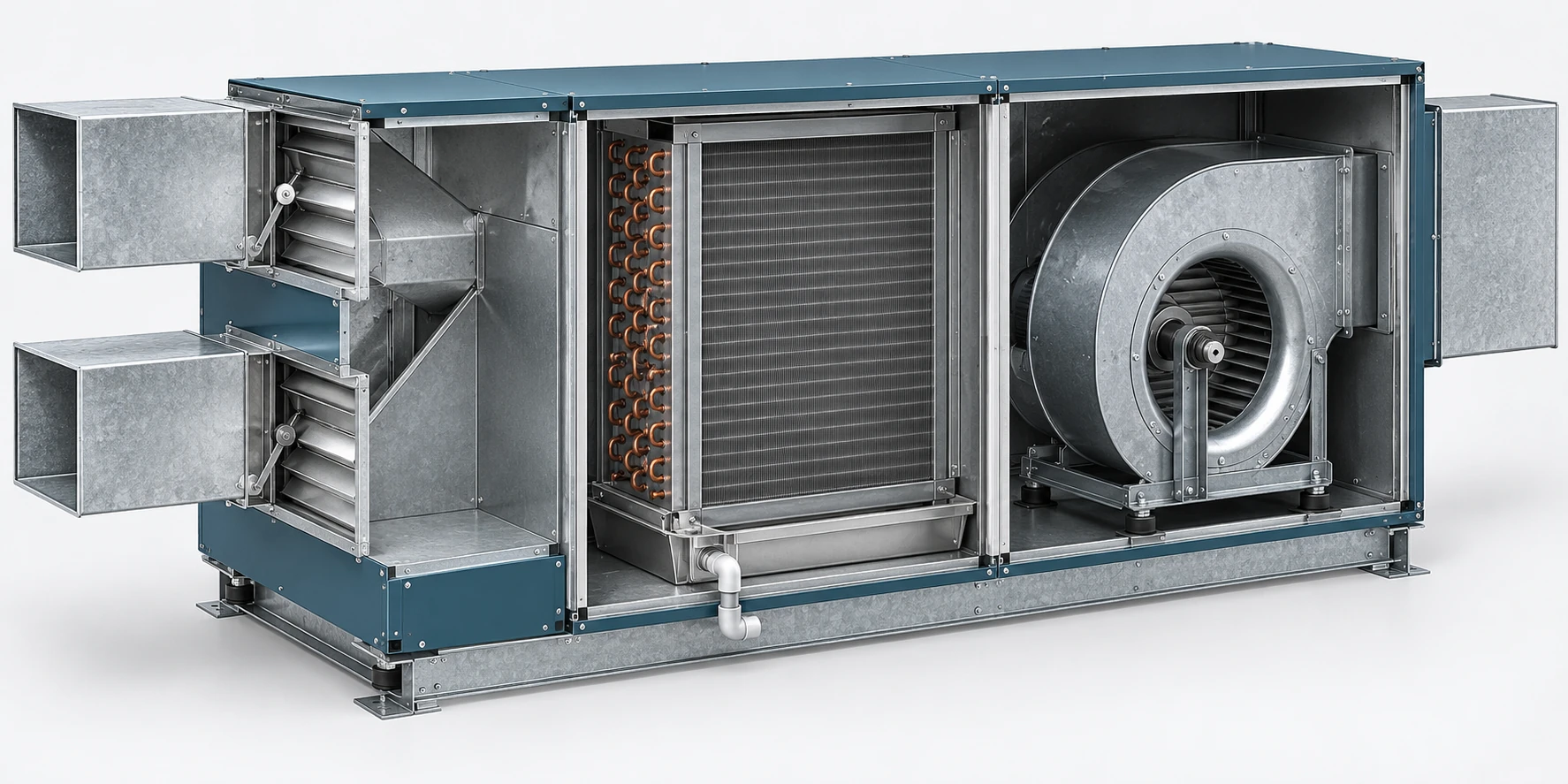
Mixing plenum → cooling coil → supply fan
Follow the same components in the schematic, then extend the air path into the room boundary.
02 · Exam-style model
The room example totals 43,000 Btu/h. Coil duty requires its own balance, including the specified outdoor-air, fan and other system contributions.
Original teaching figure. The schematic and stated givens define the model; the 3D view illustrates the hardware. These are not actual examination exhibits.
| Condition or question | Governing decision | Error to avoid |
|---|---|---|
| Room sensible duty | Use the room-to-supply dry-bulb difference with . | Using total load to calculate sensible supply airflow. |
| Room latent duty | Track the water-vapor balance and the stated latent-energy model. | Assuming that meeting dry bulb also meets moisture removal. |
| Sensible heat ratio | Use on one boundary. | Dividing sensible duty by latent duty, or mixing room and coil quantities. |
| Coil duty | Include the air states and energy streams crossing the coil/system boundary. | Equating coil duty with room load when outdoor air or fan heat adds a separate contribution. |
On a narrow screen, scroll across the table to compare the decision and the error.
Relationships and their limits
Sensible airflow duty
Use = 1.10 for the handbook sea-level approximation. Confirm whether flow is actual or standard.
Total air-side duty
The approximation uses the handbook standard sea-level air basis. Enthalpy is in Btu/lb of dry air.
Sensible heat ratio
Use the same system boundary and time basis for both loads.
| Symbol | Meaning | Units or basis |
|---|---|---|
| Sensible duty | Btu/h | |
| Total duty on same boundary | Btu/h | |
| Stated sensible air coefficient | Btu/(h·cfm·°F) | |
| Airflow on stated basis | cfm | |
| Moist-air enthalpy | Btu/lb dry air | |
| Sensible heat ratio | dimensionless | |
| Dry-air mass flow | lb dry air/h | |
| Room-to-supply temperature difference | °F difference |
One decision, fully worked
Apply the method.
A sea-level room has a 33,000 Btu/h sensible load and a 10,000 Btu/h latent load. Room air is 75°F and supply air is 55°F. Use the handbook sensible coefficient of 1.10. Find required supply airflow and room SHR.
- Size supply airflow from the sensible duty and dry-bulb difference.
- Add sensible and latent loads to obtain total room load.
- Divide sensible load by total load to obtain SHR.
- Treat moisture control as a separate coil/process requirement.
Supply 1,500 cfm to meet the stated sensible duty; the room SHR is about 0.77. A suitable supply humidity ratio must also satisfy the latent duty.
Independent checkUsing total load in the sensible equation would give about 1,955 cfm and would not establish humidity control.
Specialist extension
Use the actual energy boundary for motor gains
Motor loss and driven-device dissipation can enter different spaces. Start from real electrical input, subtract work or heat that leaves the requested room boundary, and account for storage only when the problem requires it. Motor efficiency and power factor describe different relationships. A nameplate apparent-power rating is not automatically the room heat gain.
A new applied case
A motor receives 12 kW real power at 90% efficiency. All shaft work leaves the room and all motor losses enter it. Use 3,412 Btu/h per kW.
Decision. Assign 4,094.4 Btu/h to the room under the supplied boundary.
Cross-check. If the shaft work instead dissipated inside this room, the steady room gain would be the full 12 kW.
Unit basis. P is real power in kW; efficiency is dimensionless; heat rate is kW or Btu/h.
NCEES PE Mechanical Reference Handbook v2.1; see the module reference path.
Open targeted practice in the study studio →Transfer the method
Catch the common errors
- Using total load to calculate sensible-only airflow.
- Adding sensible duty twice after using an enthalpy difference.
- Ignoring whether motor losses and shaft work enter the conditioned space.
Handbook navigation drill
Find it, then explain it.
Search: Heat Gain Calculations Using Standard Air
Locate sensible and total air heat relationships, including their stated elevation factors.
Check your navigation
You can identify 1.10 and 4.5 and state the units of each required property.
Reference path: §9.1.1–9.1.8, pp. 446–456; §9.1.16, p. 477. These are printed handbook page numbers; section names and search terms remain the primary navigation method. See technical review status.
Theory sources
- NCEES handbook v2.1, §§9.1.1–9.1.8.
- Grondzik and Kwok, Mechanical and Electrical Equipment for Buildings, 12th ed., chs. 4, 7 and 12.
- Lechner, Heating, Cooling, Lighting, 4th ed., ch. 3.
Worked examples and lesson prose are original ReasonSpan™ material. Obtain authorized publications separately; this preview does not reproduce the supplied books or handbook.