E1 · HVAC Equipment and Components
Foundation lesson · 18 minute study sessionSeparate tower range from approach.
Use the water temperatures to find duty and the wet-bulb temperature to judge the cooling boundary.
By the end of this lesson
- Calculate range and approach using their correct temperature pairs.
- Estimate tower heat rejection from water flow and temperature change.
- Distinguish evaporation from total makeup water.
The tower rejects the condenser load.
In a conventional refrigeration system, the condenser rejects evaporator heat plus compressor energy entering that cycle boundary. Tower duty therefore generally exceeds the refrigeration load. A tower rating ton and a refrigeration ton can use different conventions; calculate in explicit heat-rate units first.
Two temperature differences answer two questions.
Range is the water cooling achieved through the tower. Approach is how close cold leaving water comes to entering-air wet-bulb temperature. A small approach can require more tower capability. Do not substitute dry-bulb temperature into the evaporative approach definition.
Water balance adds another boundary.
Evaporation transfers energy and concentrates dissolved solids. Makeup also replaces drift and blowdown. Estimating evaporated mass as duty divided by latent heat assumes all stated heat rejection is latent; an actual tower can also transfer sensible heat to air. A closed-circuit fluid cooler keeps the process fluid separate from the spray water.
A decision map for this lesson
Range and approach use different temperature pairs
The diagram uses the lesson’s water and entering wet-bulb temperatures. Approach is not the water temperature drop.
01 · Equipment view
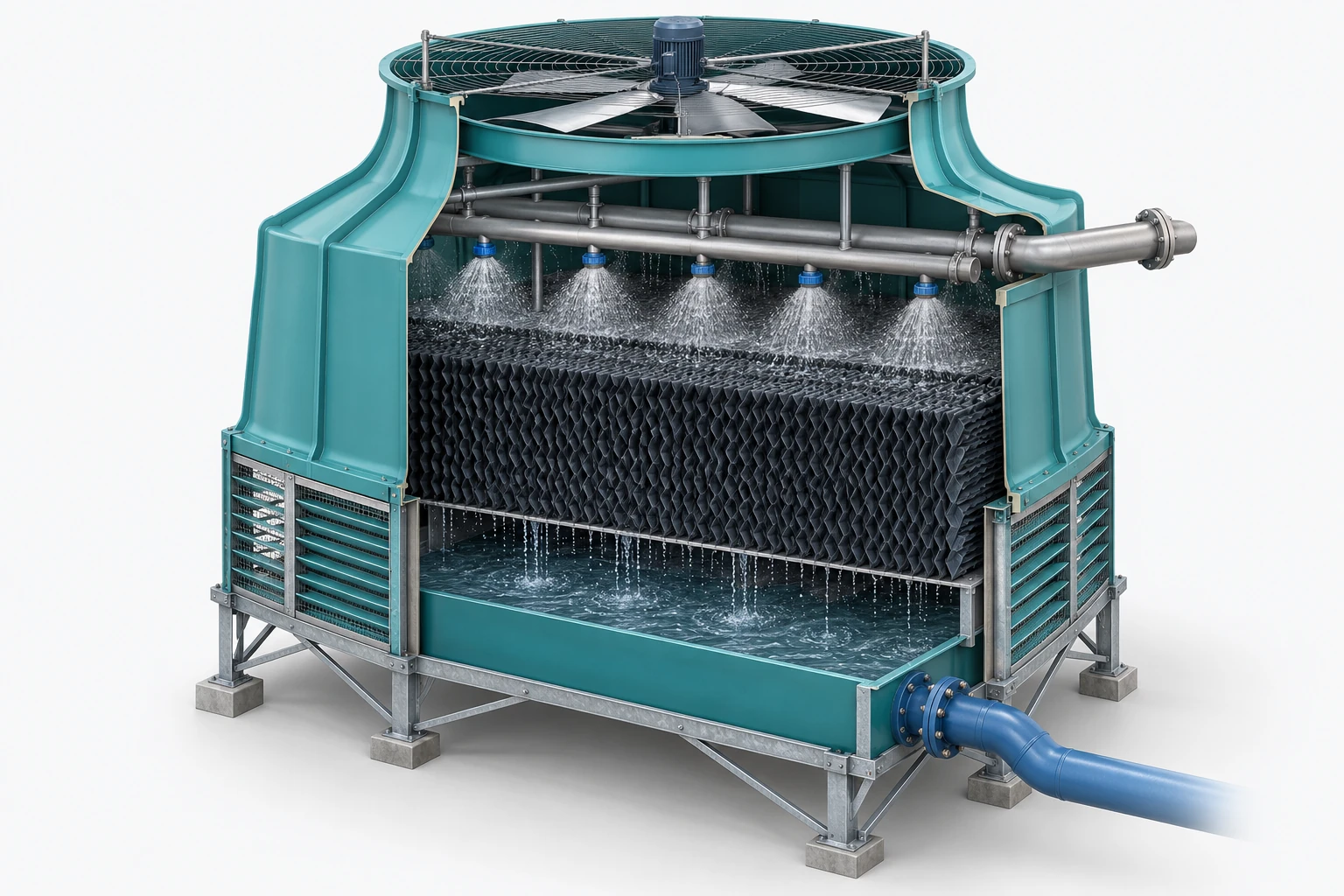
Hot-water inlet → fill → cold-water basin
Match the hot-water and cold-water states to the entering-air wet bulb shown in the temperature model.
02 · Exam-style model
Range uses the two water temperatures. Approach compares leaving water with entering-air wet bulb; dry bulb is not the evaporative reference.
Original teaching figure. The schematic and stated givens define the model; the 3D view illustrates the hardware. These are not actual examination exhibits.
| Condition or question | Governing decision | Error to avoid |
|---|---|---|
| Tower range | Use ; this is the water-side temperature change. | Subtracting entering wet bulb from hot-water temperature and calling it range. |
| Tower approach | Use . | Substituting entering dry bulb for the evaporative wet-bulb boundary. |
| Tower heat rejection | Use water flow and range on the stated thermal-factor basis. | Using approach as the water-side temperature change. |
| Makeup water | Balance evaporation, blowdown, drift and any other stated water transfers. | Treating an all-latent evaporation estimate as a complete tower performance rating. |
On a narrow screen, scroll across the table to compare the decision and the error.
Relationships and their limits
Range and approach
Temperatures refer to the stated tower inlet/outlet water and entering-air wet-bulb conditions.
Water-side heat rejection
Ordinary-water approximation, Btu/h, gpm and °F. Use supplied density and heat capacity when different.
Simplified evaporation
Only with the stated all-latent assumption. It excludes drift, blowdown and sensible air heating.
| Symbol | Meaning | Units or basis |
|---|---|---|
| Tower range | °F difference | |
| Tower approach | °F difference | |
| Entering-air wet-bulb temperature | °F | |
| Water flow | gpm | |
| Supplied latent heat | Btu/lb | |
| Inlet and outlet tower-water temperatures | °F | |
| Water-side heat rejection | Btu/h | |
| Evaporation mass rate under supplied model | lb/h |
One decision, fully worked
Apply the method.
A tower cools 300 gpm of water from 100°F to 88°F. Entering-air wet-bulb temperature is 80°F. Use the water factor 500 Btu/(h·gpm·°F). For an illustrative evaporation estimate only, assume all rejection is latent with = 1,050 Btu/lb.
- Use water inlet minus water outlet for range.
- Use leaving-water minus wet-bulb for approach.
- Calculate water duty; apply the explicitly simplified evaporation model separately.
The tower has a 12°F range, an 8°F approach and 1.80 million Btu/h water-side duty. The simplified evaporation result is not a total makeup-water requirement.
Independent checkCold water remains above entering wet-bulb in the stated operating condition, and reducing the water temperature by 12°F gives a positive heat-rejection rate.
Specialist extension
Separate evaporation from drift and blowdown
A tower range is hot-water minus cold-water temperature; approach is cold-water minus entering wet bulb. Neither is the evaporation rate. Under a supplied simple dissolved-solids balance with negligible drift and evaporation carrying no solids, cycles of concentration link evaporation and blowdown. Include drift or other losses when the problem states them. Tower heat duty includes the condenser rejection boundary, which differs from evaporator refrigeration capacity.
A new applied case
A tower evaporates 12 gpm. Drift is negligible and supplied cycles of concentration are 4. Use the stated balance B = E/(C − 1), with makeup M = E + B.
Decision. Blowdown is 4 gpm and makeup is 16 gpm under this model.
Cross-check. A makeup rate of only 12 gpm would not replace the stated blowdown.
Unit basis. E, B and M are gpm; concentration cycles C are dimensionless; the simplified balance is explicitly supplied.
NCEES PE Mechanical Reference Handbook v2.1; see the module reference path.
Open targeted practice in the study studio →Transfer the method
Catch the common errors
- Using entering dry-bulb temperature for tower approach.
- Equating condenser rejection with evaporator load while omitting compressor input.
- Reporting evaporative loss as total makeup while ignoring drift and blowdown.
Handbook navigation drill
Find it, then explain it.
Search: Cooling Towers
Locate the tower range and approach definitions and compare the temperature pairs. Note the tower rating convention.
Check your navigation
Section 9.3.9 distinguishes range from approach. Keep any rating-ton convention separate from the 12,000 Btu/h refrigeration ton.
Reference path: §9.3.9, p. 524. These are printed handbook page numbers; section names and search terms remain the primary navigation method. See technical review status.
Theory sources
- NCEES PE Mechanical Reference Handbook v2.1: §9.3.9, p. 524
- Mechanical and Electrical Equipment for Buildings, 12th ed.: mechanical systems and energy principles. Supporting theory; not an examination reference.
Worked examples and lesson prose are original ReasonSpan™ material. Obtain authorized publications separately; this preview does not reproduce the supplied books or handbook.