PMP Training and Exam Preparation · Complete public sample
Compare response cost with residual expected loss
Include the response's certain cost as well as the risk that remains after it.
Understand the governing concept.
Expected monetary loss is the probability of a threat multiplied by its monetary consequence under a defined model. For a mitigation option, add its certain implementation cost to the residual expected loss. Comparing only the residual probability can hide a response that costs more than the reduction it buys.
Use expected cost within the decision rule the scenario supplies. A single expected value does not describe the worst case, cash-flow exposure, mandatory compliance or stakeholder risk tolerance. A response can still be required for reasons beyond expected cost; identify those constraints before making a recommendation.
By the end of this refresher
- Explain the basis or assumption controlling this decision.
- Apply the method within its stated limits.
- Check the result and choose a related study task.
Compare acceptance's expected loss with mitigation's certain response cost plus residual expected loss under the supplied decision rule.
| Symbol | Meaning | Unit or basis |
|---|---|---|
| Occurrence probabilities before and after mitigation | dimensionless fractions | |
| Loss conditional on occurrence | $ | |
| Certain mitigation expense | $ | |
| Total modeled expected monetary costs | $ on the same stated basis |
When the method applies
- The examples assume one threat, a fixed conditional loss and a certain response cost, with no other impacts or mandatory responses. They supply authority to use the lower expected monetary cost.
- Expected loss is not a guaranteed expenditure or automatically the appropriate contingency reserve. A particular risk will occur or not occur; reserve policy and aggregate uncertainty need separate analysis.
Original teaching case
Work the decision, then cross-check it.
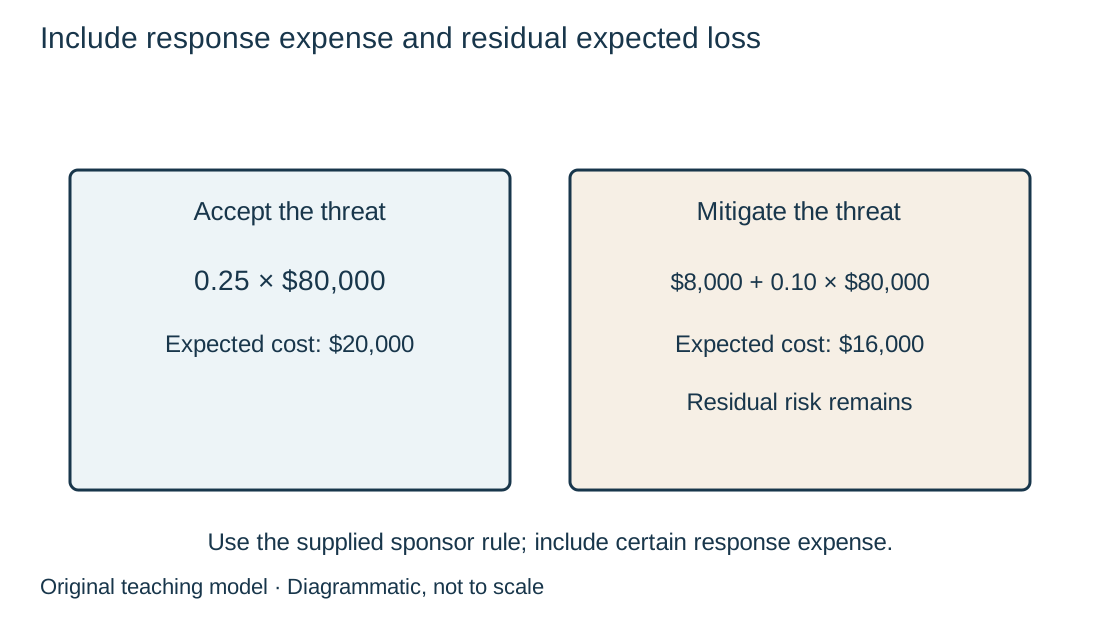
A sponsor authorizes choosing the lower expected-cost option for one threat and can fund the response. Accepting the threat leaves a 25% probability of an $80,000 loss. An $8,000 mitigation expense reduces that probability to 10%, with the same loss if the event occurs. No other impacts or mandatory responses apply.
- Acceptance has expected loss 0.25 × $80,000 = $20,000.
- Mitigation has total expected cost $8,000 + 0.10 × $80,000 = $16,000.
- Mitigation is $4,000 lower under the sponsor's authorized expected-cost rule. The residual $80,000 consequence still needs an owner and monitoring.
Decision
Recommend mitigation under the supplied rule, while documenting its residual risk.
Independent check
The expected-loss reduction is $12,000; subtracting the $8,000 certain response cost leaves a $4,000 expected-cost advantage.
A fresh application
Use the concept under changed conditions.
Choose a response before inspecting the reasoning. This is a learning check, separate from scored diagnostic and mock attempts.
Connect this refresher to your program.
PMP is a closed-book examination; PMBOK and the Certification Handbook are not supplied exam references. Refresh the principles behind stakeholder, delivery, risk, governance and value decisions. This topic is classified as understanding and application; no individual reference omission has been verified.
Supplementary exam preparation. This refresher does not add instructional credit to the 35-hour guided course or change certificate requirements.
Original ReasonSpan™ teaching material. AI-assisted checks are complete; independent specialist review remains pending.