PMP Training and Exam Preparation · Complete public sample
Distinguish a delivered output from a demonstrated benefit
Use an agreed outcome measure to judge value rather than equating activity completion with success.
Understand the governing concept.
An output is something the project delivers, such as a portal, report or training session. An outcome is the resulting change in use or performance; a benefit is a valued effect of that change. Completing all planned activities demonstrates delivery progress, but it does not by itself demonstrate that the agreed value has been achieved.
Establish the baseline, target, measurement method, observation period and accountable benefits owner. Then compare observed performance with the agreed target and investigate gaps. Keep delivery status and benefit status visible together so a completed output does not conceal a need for adoption or process improvement.
By the end of this refresher
- Explain the basis or assumption controlling this decision.
- Apply the method within its stated limits.
- Check the result and choose a related study task.
For a measure where lower is better, compare observed performance with the agreed baseline and target.
| Symbol | Meaning | Unit or basis |
|---|---|---|
| Baseline value on the agreed measurement basis | days in this example | |
| Observed value using the same basis | days in this example |
When the method applies
- Benefits can depend on operations or other stakeholders after project handover. Assign responsibility and measurement timing rather than assuming every benefit must be realized before project closure.
- A missed outcome target does not alone prove the project should be cancelled. Apply the agreed governance and investigate the evidence before recommending a response.
Original teaching case
Work the decision, then cross-check it.
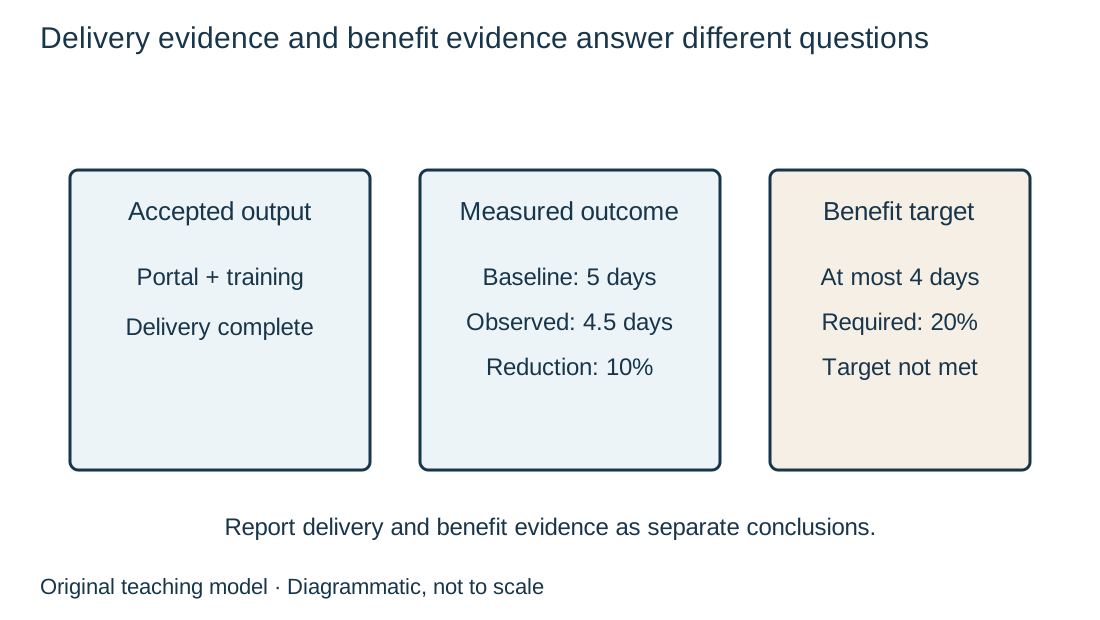
A service portal has been accepted and staff training is complete. The agreed benefit is to reduce average request handling time from 5 days to at most 4 days during the first month, measured on the same type of requests. The observed first-month average is 4.5 days.
- Separate the accepted portal and completed training from the handling-time outcome.
- Calculate the observed reduction: (5 − 4.5)/5 = 10%, while the agreed 4-day target represents 20%.
- Report that delivery is complete but the first-month benefit target is not met, and work with the benefits owner to analyze adoption and process bottlenecks.
Decision
Keep the delivery success visible while addressing the unmet measured benefit through the agreed owner and process.
Independent check
A lower handling time indicates improvement, but 4.5 days is still above the agreed maximum of 4 days.
A fresh application
Use the concept under changed conditions.
Choose a response before inspecting the reasoning. This is a learning check, separate from scored diagnostic and mock attempts.
Connect this refresher to your program.
PMP is a closed-book examination; PMBOK and the Certification Handbook are not supplied exam references. Refresh the principles behind stakeholder, delivery, risk, governance and value decisions. This topic is classified as understanding and application; no individual reference omission has been verified.
Supplementary exam preparation. This refresher does not add instructional credit to the 35-hour guided course or change certificate requirements.
Original ReasonSpan™ teaching material. AI-assisted checks are complete; independent specialist review remains pending.