ARE 5.0 Project Development and Documentation (PDD) · Complete public sample
Choose an integer riser count before sizing the stair
Translate floor-to-floor rise and supplied limits into uniform risers, then check the flight arrangement.
Understand the governing concept.
A stair's total rise is fixed by the finished floor elevations. Its number of risers is an integer, so dividing total rise by a maximum riser height gives a lower bound that must be rounded upward. Divide the actual total rise by that chosen count to obtain the uniform riser height; do not round the count down and compensate with one short or tall riser.
Check the resulting height against every supplied limit and distribute the risers among flights. Riser count is not automatically the number of separate treads in the entire stair: landings and upper floors affect that relationship. Establish the counting convention and geometry before determining a footprint.
By the end of this refresher
- Explain the basis or assumption controlling this decision.
- Apply the method within its stated limits.
- Check the result and choose a related study task.
Round up the total rise divided by maximum riser height, then calculate and verify the actual uniform riser height.
| Symbol | Meaning | Unit or basis |
|---|---|---|
| Finished total vertical rise | in | |
| Integer number of risers | count | |
| Uniform actual riser height | in | |
| Supplied maximum riser height | in |
When the method applies
- The numerical limits below are hypothetical project criteria, not statements of a building code. A real design must also satisfy its governing code and accessibility requirements.
- This check establishes risers and a permissible flight split only. Tread depth, headroom, width, landing dimensions, handrails and travel requirements need their own checks.
Original teaching case
Work the decision, then cross-check it.
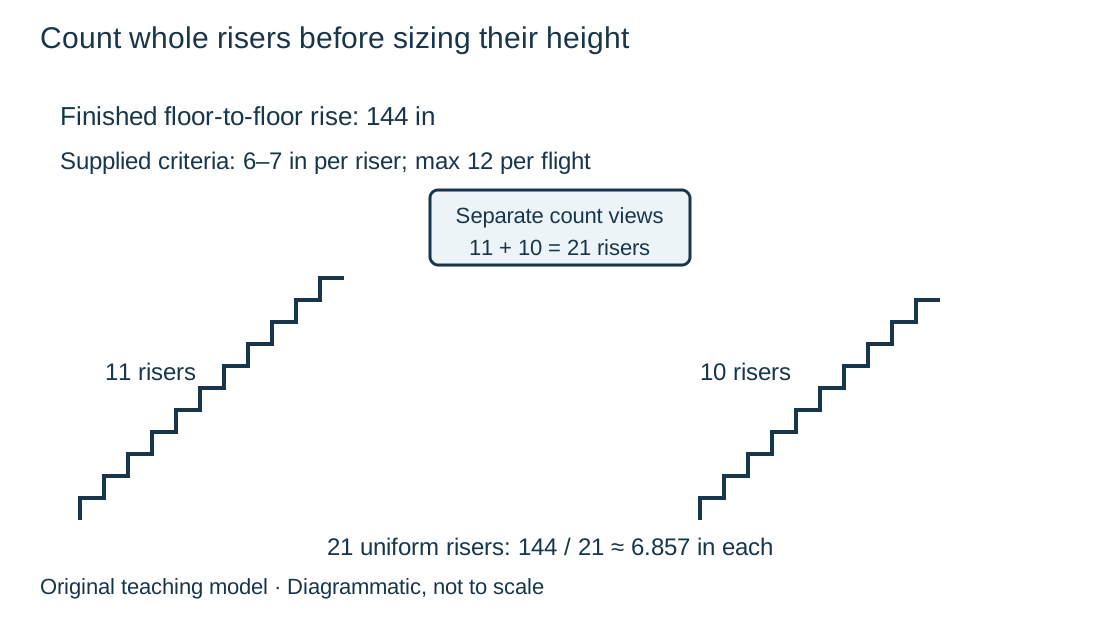
The finished floor-to-floor rise is 144 in. For this teaching case, the project requires uniform risers between 6 and 7 in and no more than 12 risers per flight. Select the fewest total risers and divide them into two flights.
- Compute the minimum integer count: ceiling of 144/7 is 21 risers.
- Calculate the uniform height: 144/21 = 6.857 in, which lies between 6 and 7 in.
- Use 11 risers in one flight and 10 in the other; both counts are at most 12. Keep all 21 risers at the same height.
Decision
Use 21 uniform risers, split 11 and 10 across the two flights.
Independent check
Twenty risers would be 7.2 in each and would violate the supplied maximum. Twenty-one times 6.857 in returns approximately 144 in; retain unrounded values for layout.
A fresh application
Use the concept under changed conditions.
Choose a response before inspecting the reasoning. This is a learning check, separate from scored diagnostic and mock attempts.
Connect this refresher to your program.
NCARB provides examination formulas, structural resources and project-specific case-study material. Refresh assembly behavior, documentation and coordination so you can interpret evidence and choose a defensible detail. This topic is classified as understanding and application; no individual reference omission has been verified.
Original ReasonSpan™ teaching material. AI-assisted checks are complete; independent specialist review remains pending.