ARE 5.0 Project Development and Documentation (PDD) · Complete public sample
Trace the control layers through a window opening
Recognize that a product's properties and the continuity of an installed assembly answer different questions.
Understand the governing concept.
Start with the function: rain must drain outward, air flow must meet a continuous sealed boundary, and thermal control should minimize interruptions. Trace each path across the wall-to-window transition. A membrane that performs two functions still needs the correct connections for each function; an unconnected edge cannot be rescued by a good product rating.
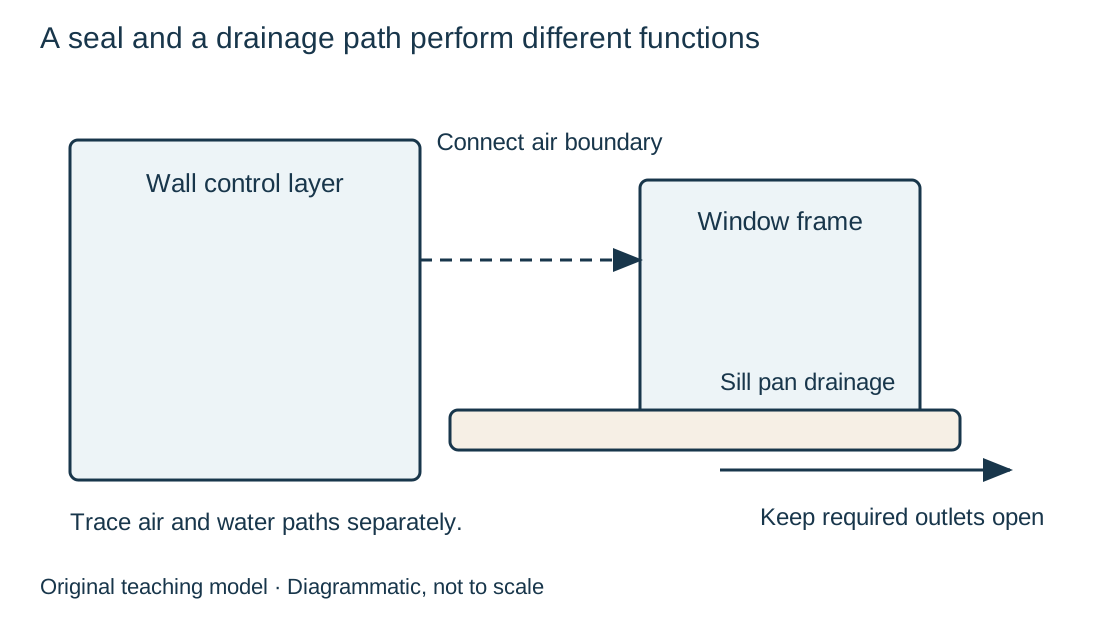
At the sill, ask where incidental water can leave the assembly. At the frame perimeter, ask how the wall air barrier connects to the window's designated air-seal surface. A visible exterior sealant joint alone does not establish that both paths are complete. Detail the interfaces, sequencing, compatible materials and responsibility for making each connection.
By the end of this refresher
- Explain the basis or assumption controlling this decision.
- Apply the method within its stated limits.
- Check the result and choose a related study task.
When the method applies
- The drainage and air-seal details depend on the selected wall, window, exposure and manufacturer's requirements. This is a functional review, not a universal window detail.
- Air control, rain control and vapor diffusion control are distinct functions. Do not assume that an air-barrier connection establishes a suitable vapor-control strategy.
Original teaching case
Work the decision, then cross-check it.
A hypothetical drained wall uses exterior sheathing membrane as its designated air and water-control layer. The window instructions require a sill pan that drains outdoors and a separate air-seal connection between the frame and wall membrane. The drafted sill detail shows the pan, open drainage outlets and exterior sealant, but no frame-to-membrane air connection.
- Trace the drainage path from the sill pan to the open outdoor outlets; that path is shown.
- Trace the designated air boundary from wall membrane to window frame; the drawing leaves that path incomplete.
- Add a compatible continuous transition to the specified frame air-seal surface without closing the drainage outlets, and coordinate its installation sequence.
Decision
Revise the missing air-barrier transition while preserving the manufacturer's drainage path.
Independent check
After the revision, a pencil trace of the air boundary should remain continuous, while a separate water trace should still lead outward.
A fresh application
Use the concept under changed conditions.
Choose a response before inspecting the reasoning. This is a learning check, separate from scored diagnostic and mock attempts.
Connect this refresher to your program.
NCARB provides examination formulas, structural resources and project-specific case-study material. Refresh assembly behavior, documentation and coordination so you can interpret evidence and choose a defensible detail. This topic is classified as understanding and application; no individual reference omission has been verified.
Original ReasonSpan™ teaching material. AI-assisted checks are complete; independent specialist review remains pending.