PMP · Complete public lesson
Choose schedule recovery using current impacts and risk
Compare schedule-recovery options using the current controlling branch, feasibility, cost, quality, risk and approval authority.
Watch the narrated worked example
An original PMP decision scenario addressing current schedule evidence, recovery cost, quality and risk.
The narration uses the same scenario, assumptions and application check as this written lesson.
Read the video transcript
ReasonSpan™. Project Management Professional. Schedule recovery and risk.
A predictive service-rollout project must complete security approval, data migration, and operations preparation before integrated readiness testing can begin. Testing takes two working days, followed by one day for release. The approved finish is day twenty-three. The project manager must evaluate a recovery proposal after a delay. The question is whether the proposal improves the current project finish while respecting cost, quality, and risk constraints.
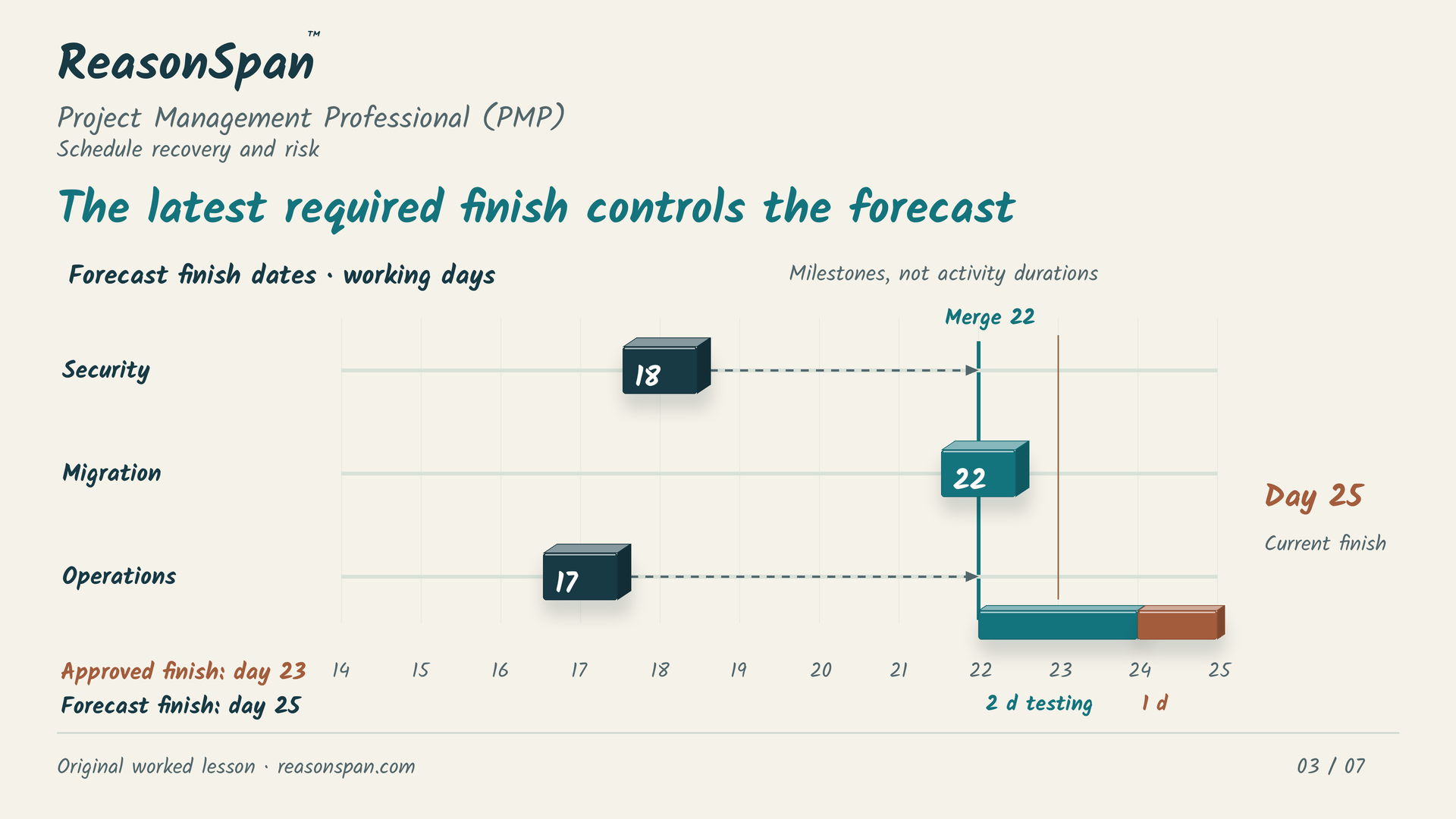
The updated schedule shows security approval finishing on day eighteen, data migration on day twenty-two, and operations preparation on day seventeen. All three are required before readiness testing. The latest finish is day twenty-two, so testing and release move the forecast finish to day twenty-five. Data migration currently controls that merge.
One manager proposes overtime that moves security approval from day eighteen to day sixteen. Migration still finishes on day twenty-two, so the project still finishes on day twenty-five. The proposal buys no project time under the stated dependencies. A second proposal adds qualified migration analysts for six thousand dollars and is forecast to finish migration on day twenty. If that forecast is achievable, testing and release can finish on day twenty-three. A third proposal skips mandatory readiness testing. That would violate the stated release criteria and is not an acceptable recovery option.
The team has not yet validated analyst availability or assessed the additional reconciliation risk. The project manager cannot authorize the added spending under this project's governance. What should the project manager do next? Approve security overtime because it shortens an activity? Commit to the extra analysts and report the original date as guaranteed? Validate the migration recovery plan with the team, assess cost and risk, and take the recommendation to the authorized approver? Or omit readiness testing to recover two days?
Validate the migration recovery plan and seek the required authorization. Confirm resource availability, dependency logic, the duration estimate, quality checks, and risk responses with the people doing the work. Present the supported forecast, uncertainty, cost, and alternatives. Activity savings are useful only when they improve the project result or serve another justified objective. Do not promise the original date from an unvalidated estimate, and do not remove a mandatory quality gate to make a schedule look better.
After approval, coordinate the additional resources, update the forecast and affected plans, and communicate the decision. Follow the project's change process if a baseline change is needed; a revised forecast does not erase the approved baseline. Monitor the controlling branch and the other required branches as the recovery proceeds. If the assumptions fail, reassess the options and communicate the impact promptly. Schedule recovery is a management decision supported by current schedule logic, cost, risk, and delivery requirements.
The situation and givens
A predictive service-rollout project must complete security approval, data migration, and operations preparation before integrated readiness testing can begin. Testing takes two working days, followed by one day for release. The approved finish is day twenty-three. The project manager must evaluate a recovery proposal after a delay. The question is whether the proposal improves the current project finish while respecting cost, quality, and risk constraints.
- Predictive service rollout; approved project finish is working day 23, using a shared day-zero datum and one working calendar.
- Integrated readiness testing waits for all three required predecessor streams: security approval, data migration and operations preparation.
- Baseline predecessor finish forecasts: security day 18, migration day 20, operations day 17.
- Updated predecessor finish forecasts: security day 18, migration day 22, operations day 17.
- Mandatory readiness testing takes two working days; release then takes one working day. Neither duration changes in the stated options.
- Option A: security overtime moves security to day 16 while migration stays at day 22.
- Option B: qualified migration analysts cost $6,000 and are forecast to move migration to day 20. Analyst availability and reconciliation risk have not yet been validated.
- The project manager cannot authorize the additional spending under this project's governance. Skipping mandatory readiness testing is not permitted.
Complete worked method
1. Identify the management decision
A predictive service-rollout project must complete security approval, data migration, and operations preparation before integrated readiness testing can begin. Testing takes two working days, followed by one day for release. The approved finish is day twenty-three. The project manager must evaluate a recovery proposal after a delay. The question is whether the proposal improves the current project finish while respecting cost, quality, and risk constraints.
2. Use the updated schedule
The updated schedule shows security approval finishing on day eighteen, data migration on day twenty-two, and operations preparation on day seventeen. All three are required before readiness testing. The latest finish is day twenty-two, so testing and release move the forecast finish to day twenty-five. Data migration currently controls that merge.
3. Compare the proposed actions
One manager proposes overtime that moves security approval from day eighteen to day sixteen. Migration still finishes on day twenty-two, so the project still finishes on day twenty-five. The proposal buys no project time under the stated dependencies. A second proposal adds qualified migration analysts for six thousand dollars and is forecast to finish migration on day twenty. If that forecast is achievable, testing and release can finish on day twenty-three. A third proposal skips mandatory readiness testing. That would violate the stated release criteria and is not an acceptable recovery option.
4. Explain the choice
Validate the migration recovery plan and seek the required authorization. Confirm resource availability, dependency logic, the duration estimate, quality checks, and risk responses with the people doing the work. Present the supported forecast, uncertainty, cost, and alternatives. Activity savings are useful only when they improve the project result or serve another justified objective. Do not promise the original date from an unvalidated estimate, and do not remove a mandatory quality gate to make a schedule look better.
5. Control the recovery
After approval, coordinate the additional resources, update the forecast and affected plans, and communicate the decision. Follow the project's change process if a baseline change is needed; a revised forecast does not erase the approved baseline. Monitor the controlling branch and the other required branches as the recovery proceeds. If the assumptions fail, reassess the options and communicate the impact promptly. Schedule recovery is a management decision supported by current schedule logic, cost, risk, and delivery requirements.
Common errors and why they fail
- Paying for security overtime solely to recover the finish ignores migration, which still controls the current merge.
- Reporting day 23 as guaranteed before validating analyst capacity treats a proposed estimate as a commitment.
- Removing mandatory readiness testing violates the supplied release criteria.
- Changing the approved baseline to hide a delay prevents a truthful comparison with the current forecast.
- Treating a mathematically useful reduction as automatically feasible omits resource, cost, quality, risk and authority checks.
Apply the method
Analyst availability and reconciliation risk have not been validated, and the project manager lacks spending authority. What should the project manager do next?
Change one condition
After review, both migration and security are forecast to finish on day 20. Operations still finishes on day 17, testing takes two days and release takes one. A new proposal moves migration alone to day 19. What is the schedule effect and next management consideration?
Reveal the worked transfer
The finish remains day 23: max(20, 19, 17) + 2 + 1 = 23. Security now controls the merge, so the additional migration-only reduction yields no project-finish improvement under the supplied assumptions. Reassess all current required branches and weigh any other claimed benefit against its cost and risk. If an earlier release is justified, evaluate feasible options affecting the current constraint, preserve mandatory quality requirements, and obtain any required authorization.
Put the method to work
Try different questions to check whether you can identify the governing condition and explain the next action. The free sampler includes answers and worked explanations.
Continue your preparation
- Evaluate a requested change before authorizing work →
- Work earned-value forecasting assumptions →
- Distinguish outputs, outcomes and benefits →