PMP · Complete public lesson
Evaluate a requested change before authorizing work
Evaluate a requested change using complete impact evidence, alternatives and the project's stated approval authority.
Watch the narrated worked example
An original PMP decision scenario addressing change impact, value, governance and communication.
The narration uses the same scenario, assumptions and application check as this written lesson.
Read the video transcript
ReasonSpan™. Project Management Professional. Change impact and authorization.
A predictive customer-portal project has an approved scope and a release date six weeks away. The sponsor requests an audit-export feature. In this project, the change control board must approve changes to the scope baseline. The sponsor asks the team to begin tomorrow. A request from the sponsor is important, but it is not the approval required by this project's governance.
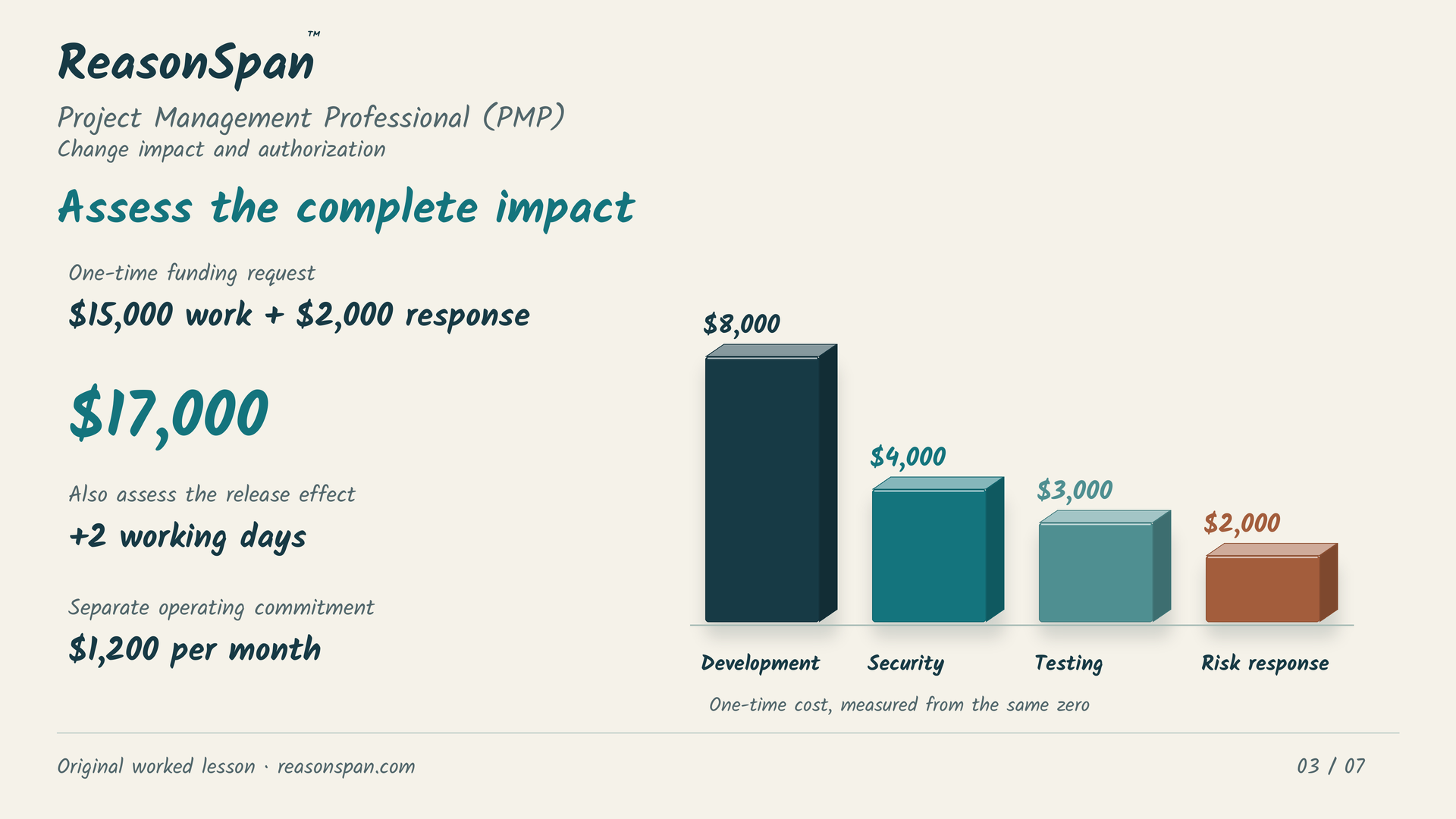
The project manager clarifies the feature's acceptance criteria and expected business value with the sponsor. The team estimates eight thousand dollars for development, four thousand for security review, and three thousand for testing. These work-package estimates total fifteen thousand dollars. A proposed two-thousand-dollar risk response brings the requested one-time funding to seventeen thousand dollars. That response is planned work, not an unexplained contingency percentage. The assessment also identifies two working days of release delay and twelve hundred dollars a month in ongoing support. Keep one-time project funding separate from recurring operating cost.
The project manager has verified these impacts with the team. The review package compares adding the feature now, deferring it to a later release, and exchanging lower-value scope through the same approval process. It states assumptions, uncertainty, acceptance criteria, expected benefit, and the consequences of each option. The sponsor's urgency is a reason to arrange timely review. It is not a reason to omit security testing or promise a date the team has not supported.
The impact assessment is complete, and the change is not yet approved. What should the project manager do next? Start development because the sponsor requested it? Submit the documented options and recommendation to the change control board? Use available reserve without seeking approval for the scope change? Or reject the request solely because the baseline already exists?
Submit the documented assessment through the agreed change process. This lets the authorized decision makers evaluate value, cost, schedule, quality, and risk together. Starting work would bypass the stated authority. Available funds do not authorize new scope. Automatically rejecting the request would skip a legitimate business decision. The correct action depends on the project's stated governance, not a rule that every project uses a change control board.
If the change is approved, update the affected baselines, funding authorization, plans, and change record, then communicate the decision before directing the approved work. If it is deferred or rejected, record and communicate that outcome. After implementation, verify the agreed acceptance criteria and review whether the intended benefit is being achieved. The project manager connects evidence, authority, and value. A cost estimate informs that decision; it does not make the decision by itself.
The situation and givens
A predictive customer-portal project has an approved scope and a release date six weeks away. The sponsor requests an audit-export feature. In this project, the change control board must approve changes to the scope baseline. The sponsor asks the team to begin tomorrow. A request from the sponsor is important, but it is not the approval required by this project's governance.
- Predictive customer-portal project; approved release is six weeks away.
- The sponsor requests an audit-export feature outside the approved scope. This project requires change control board approval for scope-baseline changes.
- The sponsor and team have clarified acceptance criteria and expected value. The team has verified the supplied impact assessment.
- Development: $8,000; security review: $4,000; testing: $3,000. Total base estimate: $15,000.
- Proposed risk-response work: $2,000, making requested one-time funding $17,000. This is planned response work, not an unexplained reserve allowance.
- Forecast release impact: two working days. Ongoing support: $1,200 per month, separate from one-time project funding.
- The impact assessment is complete; the scope change has not been approved. No specialist quantity takeoff is required.
Complete worked method
1. Identify the management decision
A predictive customer-portal project has an approved scope and a release date six weeks away. The sponsor requests an audit-export feature. In this project, the change control board must approve changes to the scope baseline. The sponsor asks the team to begin tomorrow. A request from the sponsor is important, but it is not the approval required by this project's governance.
2. Use a complete impact assessment
The project manager clarifies the feature's acceptance criteria and expected business value with the sponsor. The team estimates eight thousand dollars for development, four thousand for security review, and three thousand for testing. These work-package estimates total fifteen thousand dollars. A proposed two-thousand-dollar risk response brings the requested one-time funding to seventeen thousand dollars. That response is planned work, not an unexplained contingency percentage. The assessment also identifies two working days of release delay and twelve hundred dollars a month in ongoing support. Keep one-time project funding separate from recurring operating cost.
3. Frame the options
The project manager has verified these impacts with the team. The review package compares adding the feature now, deferring it to a later release, and exchanging lower-value scope through the same approval process. It states assumptions, uncertainty, acceptance criteria, expected benefit, and the consequences of each option. The sponsor's urgency is a reason to arrange timely review. It is not a reason to omit security testing or promise a date the team has not supported.
4. Explain the choice
Submit the documented assessment through the agreed change process. This lets the authorized decision makers evaluate value, cost, schedule, quality, and risk together. Starting work would bypass the stated authority. Available funds do not authorize new scope. Automatically rejecting the request would skip a legitimate business decision. The correct action depends on the project's stated governance, not a rule that every project uses a change control board.
5. Implement and verify
If the change is approved, update the affected baselines, funding authorization, plans, and change record, then communicate the decision before directing the approved work. If it is deferred or rejected, record and communicate that outcome. After implementation, verify the agreed acceptance criteria and review whether the intended benefit is being achieved. The project manager connects evidence, authority, and value. A cost estimate informs that decision; it does not make the decision by itself.
Common errors and why they fail
- Starting because the sponsor requested the feature bypasses the approval authority explicitly stated for this project.
- Treating available reserve as authorization for new scope confuses funding availability with scope decision rights.
- Submitting only the $15,000 base estimate omits the proposed response, schedule effect, recurring support and other decision evidence.
- Rejecting every request after baselining prevents legitimate business changes from receiving evaluation.
- Assuming every project must use a change control board ignores the project-specific governance supplied in the case.
Apply the method
The impact assessment is complete and the scope change is not approved. What should the project manager do next?
Change one condition
Instead, the team works in an adaptive product approach. The proposed feature is a new backlog item for a future iteration and does not change an external release commitment or exceed the product owner's delegated authority. How should the project manager adapt the decision process?
Reveal the worked transfer
Support the product owner in clarifying value and acceptance criteria and ordering the backlog with the team's estimates, dependencies and capacity in view. Do not impose the predictive case's change control board on every backlog decision, and do not insert the item into an active iteration unilaterally. If it affects an external commitment or exceeds delegated scope, budget or compliance authority, use the applicable governance and escalation path. The method transfers as informed prioritization and respect for explicit decision rights.
Put the method to work
Try different questions to check whether you can identify the governing condition and explain the next action. The free sampler includes answers and worked explanations.
Continue your preparation
- Choose schedule recovery using current impacts and risk →
- Distinguish outputs, outcomes and benefits →
- Practice Agile Sprint Goal decisions →