ARE 5.0 Project Development and Documentation (PDD) · Complete public lesson
Window-head continuity: keep water, air and thermal control separate
Trace each control function through a window head and document the transition that restores the failed drainage path.
Watch the narrated worked example
Follow a drained window-head assembly from the 3D overview to a control-path check, a decision and a changed assembly.
The narrated decision and the written example use the same supplied drainage-lap failure. The final transfer applies the method to a different facade interface.
Read the video transcript
ReasonSpan™. A R E five point oh. Project Development and Documentation. Window-head control-layer continuity.
Trace four control paths through a window head. Find the failed path before choosing a repair.
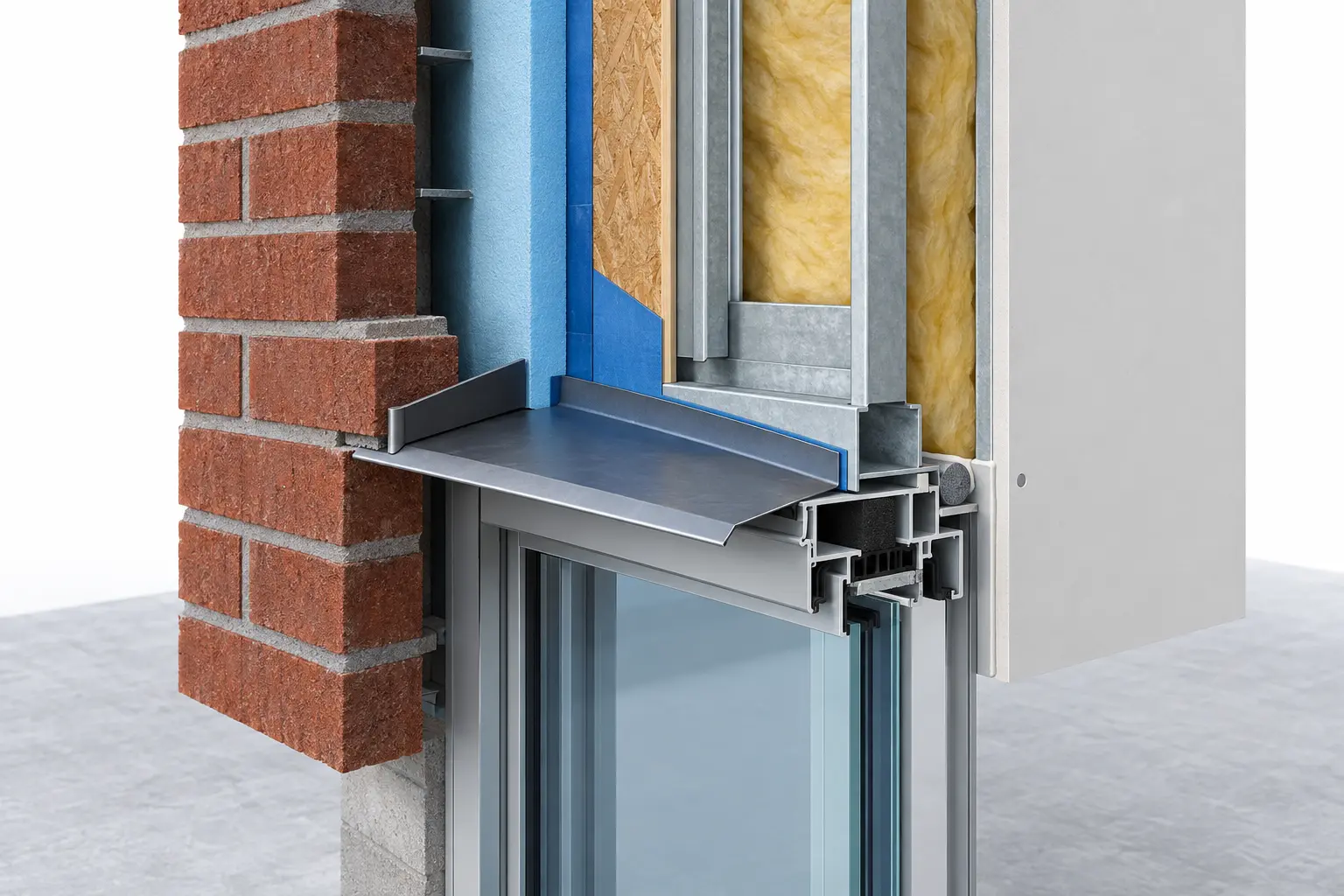
Read the section from exterior to interior. Rain reaches the veneer, cavity, flashing, rough opening, and frame. At each change of plane, the control layer needs a deliberate transition.
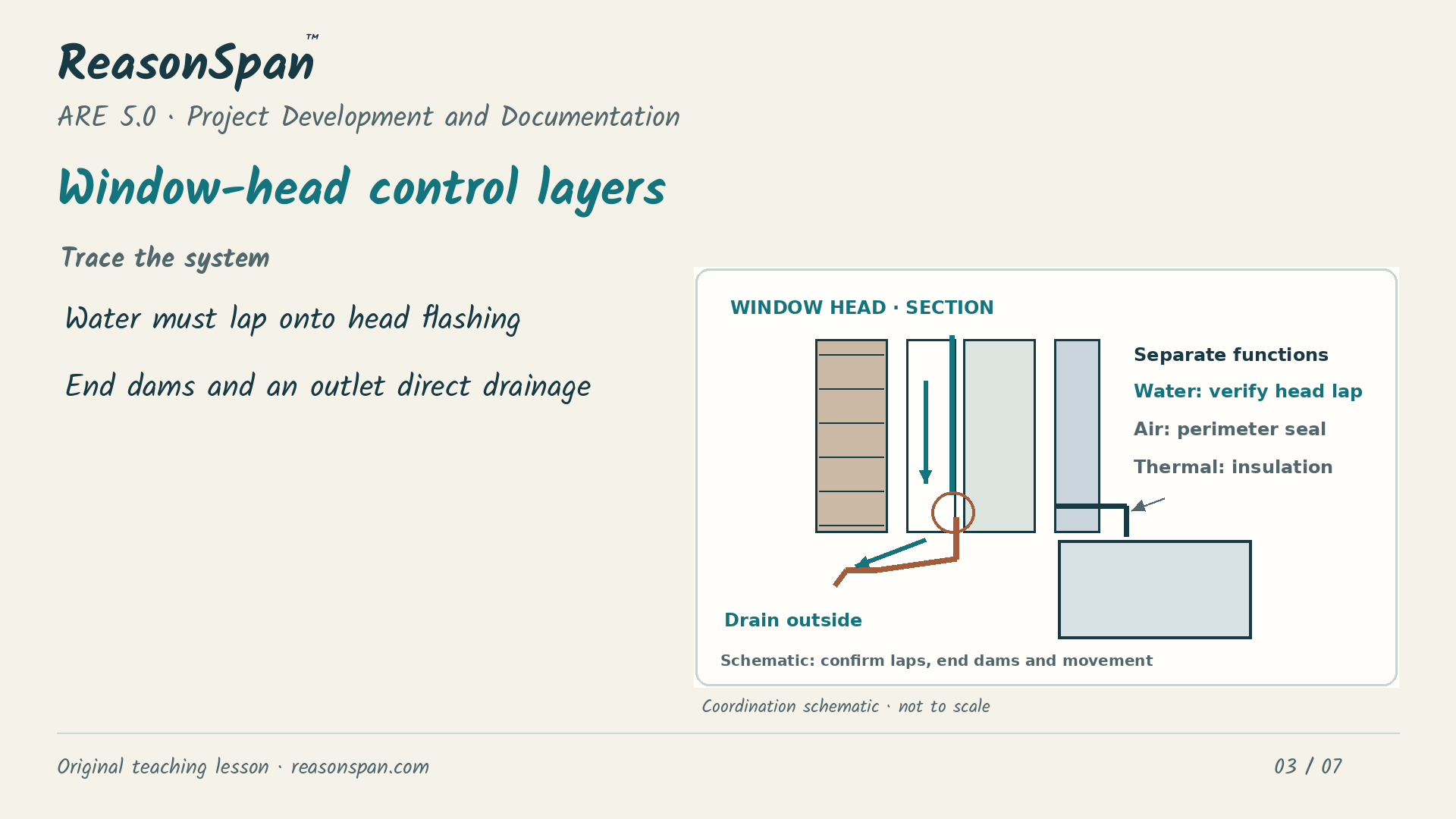
For bulk water, the water-resistive barrier must lap over the flashing back leg. Sloped flashing, end dams, and an outlet carry incidental water outside.
The interior perimeter seal serves air control; insulation serves thermal control. Neither substitutes for a drainage path at the head.
Choose: add an interior vapor membrane, lap the barrier over flashing with end dams, or fill the drainage cavity with sealant? Which restores water control?
The flashing lap with end dams is the supported decision. A vapor membrane targets another mechanism, and sealant in the cavity blocks drainage.
Transfer the method to a curtain wall. Trace rain shedding, internal drainage, the interior air seal, insulation, and fire containment separately.
The situation and givens
A brick-veneer window-head detail shows an exterior water-resistive barrier ending behind the flashing back leg. A separate interior perimeter air seal is continuous. The reviewer must choose a revision before the detail is issued.
- The veneer cavity drains incidental water to head flashing.
- The supplied approved assembly requires the water-resistive barrier to lap over the flashing back leg, with end dams and an exterior drainage outlet.
- The proposed detail reverses that drainage lap.
- The interior air seal and the specified insulation are already shown; neither provides the missing exterior drainage transition.
- All material compatibility, movement and installation requirements must still be coordinated with the approved system.
Complete worked method
1. Name the failed mechanism
The stated defect is a reversed exterior drainage lap. Water arriving at the barrier must be directed onto the flashing and toward the exterior, rather than behind the back leg. Start with that path instead of selecting a product by name.
2. Trace continuity across the opening
Follow the barrier to its transition onto the flashing, then follow the flashing across the head to the exterior outlet. Check the ends as well as the middle of the section. The supplied assembly calls for end dams so the collected water does not escape behind adjacent construction.
3. Keep other functions visible
An interior perimeter seal addresses air leakage at its own plane. Insulation addresses heat flow. A new vapor-control layer or more cavity sealant does not establish the missing drainage connection. A single product may perform more than one function, but each function still needs a continuous, correctly connected path.
4. Revise the coordinated detail
Show the corrected lap, flashing termination, end conditions and outlet. Coordinate the section, jamb/head references, specification and installation sequence. Check compatible materials and movement accommodation rather than issuing an isolated note to add sealant.
Common errors and why they fail
- Adding an interior vapor-control layer treats a different moisture mechanism and leaves the reversed water lap unresolved.
- Filling the drainage cavity with sealant can obstruct the outlet that the assembly needs.
- Approving the detail because the interior air seal is continuous substitutes one control function for another.
- Drawing an exterior arrow without a constructible lap, end condition and outlet does not establish drainage continuity.
Apply the method
Which revision directly addresses the stated failure while preserving the other supplied control functions?
Change one condition
The adjacent opening changes to a curtain-wall slab-edge condition. Which checks transfer, and which details must be reconsidered?
Reveal the worked transfer
Transfer the method: trace exterior rain shedding, internal drainage, the interior air seal and thermal continuity separately. Reconsider the actual curtain-wall anchors, interfaces, drainage provisions and movement details. Review the required perimeter fire-containment system as its own assembly; ordinary insulation or a water seal does not establish that system. Reuse the reasoning, not the masonry window-head detail.
Put the method to work
Try different questions to check whether you can identify the governing condition and explain the next action. The free sampler includes answers and worked explanations.