PE Architectural Engineering · Complete public lesson
Parallel pumps: solve total flow at the system operating point
Combine two identical pump curves at a common head, solve the actual system intersection, and distinguish total system flow from each pump's flow.
Parallel pumps: total flow and flow through each pump
Build the parallel curve at a common head, solve the system intersection, and distinguish total flow from each pump's flow.
This supplementary SI example teaches the governing relationships; the October 2026 Architectural exam specification lists USCS units. The narrated example uses the same individual-pump and system curves as the complete lesson below. Keep total and per-pump flow separate.
Read the video transcript
ReasonSpan™. P E Architectural Engineering. Parallel-pump operating points.
Two identical pumps in parallel do not automatically produce twice the original operating flow. The governing method is to combine flow at a common head, then find the intersection with the system curve. In this example, we will calculate both operating points and keep total flow separate from each pump's flow.
Each pump's head is fifty-five minus zero point zero zero four times its own flow squared. The system head is fifteen plus zero point zero zero one five times total system flow squared. Head is in meters and flow is in liters per second, with coefficients defined for those units. The identical pumps run at the same fixed speed and share total flow equally. These simplified instructional curves are not manufacturer selection data.
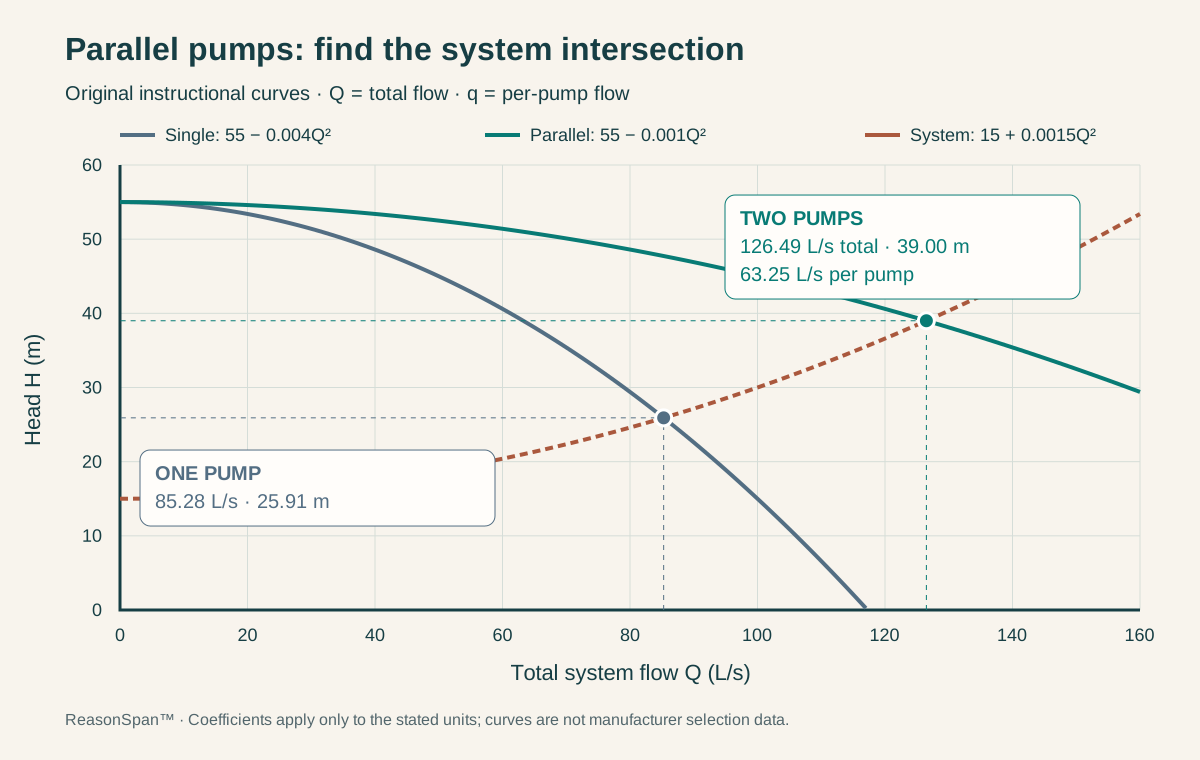
With one pump, its flow is the total flow. Set the pump head equal to the system head. Moving the terms gives forty equal to zero point zero zero five five times flow squared. The positive square root gives eighty-five point two eight liters per second. Substituting into the system curve gives an operating head of twenty-five point nine one meters. Static head alone is not the operating head.
With two identical pumps, each carries half the total flow at the same head. Substitute total flow divided by two into the individual pump equation. The parallel curve becomes fifty-five minus zero point zero zero one times total flow squared. We have added flow at a common head. We have not doubled head; that would confuse parallel operation with head addition in series.
Now intersect the parallel curve with the unchanged system curve.
Forty equals zero point zero zero two five times total flow squared. Total flow becomes one hundred and twenty-six point four nine liters per second, at thirty-nine meters of head. Each pump carries approximately sixty-three point two five liters per second. The total has increased about forty-eight point three two percent, while each pump's flow is lower than the original one-pump flow.
Change the assumption. If system head stayed constant at fifteen meters, with no friction-dependent increase, one pump would supply one hundred liters per second under this model. Two identical pumps would each supply that same flow at the same head, for two hundred liters per second total. So the original result depends on its rising system curve. Do not turn this example into a rule that parallel flow can never double.
For an actual selection, verify manufacturer curves and their published range, controls, minimum flow, efficiency, motor loading and available versus required suction head. When one pump stops, the remaining pump moves to its one-pump intersection. Open the complete ReasonSpan lesson to inspect the exact curves and test your reasoning, then try the separate free Architectural questions. The links are in the description.
The situation and givens
Two identical pumps are available for an open water-transfer system. Each has the original instructional curve Hₚ = 55 − 0.004q². The system curve is Hₛ = 15 + 0.0015Q². Head is in metres and flow is in litres per second; the coefficients are defined for those units. Compare operation with one pump and with two pumps in parallel.
- Each pump: Hₚ = 55 − 0.004q², where q is flow through that pump in L/s.
- System: Hₛ = 15 + 0.0015Q², where Q is total system flow in L/s.
- Identical pumps at the same fixed speed share total flow equally in parallel.
- Assume these supplied curves apply over the calculated range. Ignore control changes, efficiency and suction limitations for this operating-point exercise.
Complete worked method
1. Solve the single-pump intersection
With one pump, q = Q. Equate pump head and system head: 55 − 0.004Q² = 15 + 0.0015Q². Therefore Q² = 40/0.0055. Flow is 85.28 L/s and the shared operating head is 25.91 m. The static head of 15 m and shutoff head of 55 m are not this operating head.
2. Build the parallel curve at a common head
At a given head, add the flows. With two identical pumps, each carries q = Q/2. Substitute that per-pump flow into the pump equation. The combined curve is 55 − 0.004(Q/2)² = 55 − 0.001Q². Parallel operation does not double head.
3. Intersect the combined curve with the same system
Equate 55 − 0.001Q² with 15 + 0.0015Q². The resulting total flow is the square root of 40/0.0025, or 126.49 L/s. Operating head is 39.00 m. Each pump carries half the total, approximately 63.25 L/s.
4. Explain why total flow does not double here
Total flow increases by approximately 48.32%, not 100%. The added flow raises friction head, moving both pumps to a higher shared head and a lower per-pump flow. Twice the one-pump operating flow would be 170.56 L/s; it does not satisfy the unchanged system curve.
5. Check conditions beyond the intersection
Before actual selection, verify manufacturer curves and their published range, motor loading with one and two pumps, controls, minimum flow, efficiency and available versus required suction head. If one pump stops, the remaining pump moves to its one-pump system intersection; it does not necessarily stay at half the two-pump flow.
Common errors and why they fail
- Doubling the original one-pump operating flow without rechecking system head.
- Adding pump heads in parallel; head addition at a common flow describes series operation.
- Reporting 126.49 L/s as the flow through each pump rather than the total.
- Using the total Q in each individual pump equation instead of Q/2.
Apply the method
At the calculated two-pump operating point, what flow passes through each identical pump?
Change one condition
Change only the system curve to a constant 15-m head, with no friction-dependent increase. Under the same idealized pump model, would parallel flow now double?
Reveal the worked transfer
Yes, in this idealized constant-head case. One pump supplies q = √((55 − 15)/0.004) = 100 L/s at 15 m. Two identical pumps each supply that same 100 L/s at the same head, giving 200 L/s total. The original non-doubling result depended on its rising system curve; it is not a universal prohibition on doubling.
Put the method to work
Try different questions to check whether you can identify the governing condition and explain the next action. The free sampler includes answers and worked explanations.
Continue your preparation
- Compare a different supplied pump/system model →
- Check a fan speed change and motor power →
- Separate hydraulic output and electrical input →