PE Civil Construction · Complete public lesson
From pressure and elevation to electrical pump power
Build an SI energy balance, distinguish hydraulic output from electrical input, and test how a changed boundary affects the result.
The situation and givens
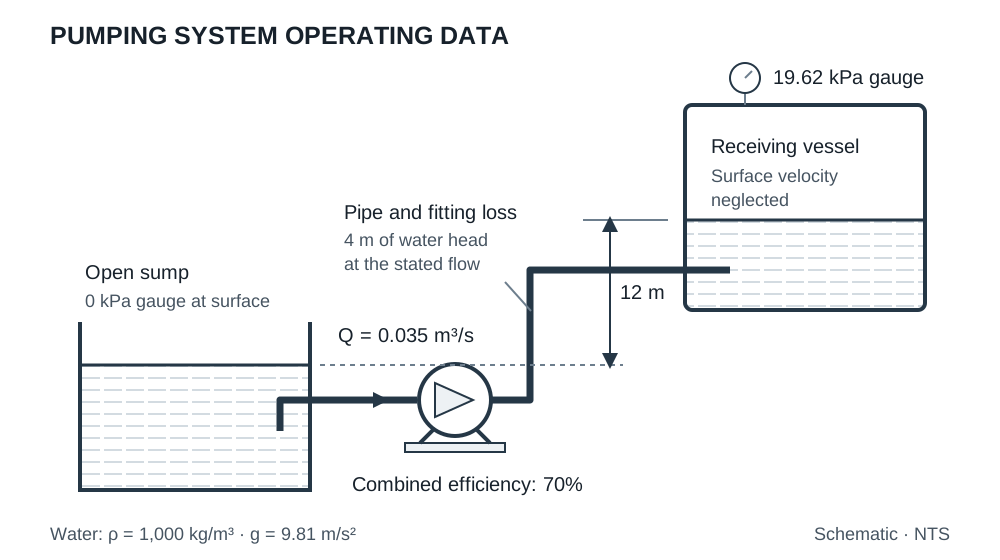
A pump transfers water at 0.035 m³/s from an open sump to a receiving vessel. The vessel water surface is 12 m above the sump surface and its gauge pressure is 19.62 kPa. Pipe and fitting losses total 4 m of water head at this flow. Velocities at both water surfaces are negligible. The combined pump-and-motor efficiency is 70%. Use water density 1,000 kg/m³ and g = 9.81 m/s². What is most nearly the required electrical input power at this operating point?
- Flow Q: 0.035 m³/s
- Surface elevation rise: 12 m
- Discharge vessel gauge pressure: 19.62 kPa; sump gauge pressure: 0
- Pipe and fitting loss: 4 m of water
- Combined pump-and-motor efficiency: 0.70
- Water density: 1,000 kg/m³; g: 9.81 m/s²
Complete worked method
1. Convert pressure to water head
19.62 kPa is 19,620 Pa. Dividing pressure by density times gravity gives metres of water, so it can be combined with elevation and loss head.
2. Assemble the required pump head
Both water surfaces have negligible velocity. The receiving vessel's pressure remains part of the boundary condition; an open sump does not make the other vessel open.
3. Find hydraulic output
Density, gravity, flow and total head produce watts in base SI units. This is the rate of useful energy delivered to the water.
4. Account for combined efficiency
Electrical input must exceed hydraulic output at an efficiency below 100%. Divide once by the combined pump-and-motor efficiency, then convert W to kW.
Common errors and why they fail
- 6.18 kW is the hydraulic power delivered to the water. Electrical input must be larger because combined efficiency is below 100%.
- 7.85 kW includes the 12 m elevation rise and 4 m loss but omits the 2 m pressure head required at the receiving vessel.
- 12.6 kW divides by 0.70 twice. The given 70% already combines pump and motor efficiencies.
Apply the method
Which value is the required electrical input at the stated operating point?
Change one condition
The receiving vessel is vented to atmosphere, with the same flow, elevation, losses and efficiency. What changes? Work it out before revealing the answer.
Reveal the worked transfer
The pressure head falls from 2 m to zero. Total head is 16 m, so input is 1,000 × 9.81 × 0.035 × 16 / 0.70 = 7,848 W = 7.85 kW. Elevation and friction remain. This is a stated fixed-flow exercise; an actual pump's operating point would require its curve.
Put the method to work
Try different questions to check whether you can identify the governing condition and explain the next action. The free sampler includes answers and worked explanations.