ARE 5.0 score reports and retake planning
ARE 5.0 score calculator: how close were you to passing?
Try ReasonSpan™’s free ARE 5.0 score calculator. Estimate missed questions and a possible passing gap, then build a focused retake plan for your division.
Reviewed for the current ReasonSpan™ exam profile · Updated October 30, 2026Free ReasonSpan™ study tool
ARE 5.0 score calculator
Enter Your % Correct from your official failing score report. Explore an estimated missed-question range, a possible gap to passing, and study priorities for all six divisions.
Unofficial study estimate. Your official NCARB result remains authoritative. No account, email, or report upload required. Entries stay in this page’s memory and clear when you reload.
How the estimate works and what it cannot tell you
We use the October 2026 NCARB blueprint: 91 scored items, 9 pretest items, and the section weight ranges below. For planning, we assume scored items follow those blueprint proportions. Your form’s scored-section distribution is unknown and may differ.
- Integration of Building Materials & Systems: 31–37%
- Construction Documentation: 32–38%
- Project Manual & Specifications: 12–18%
- Codes & Regulations: 8–14%
- Construction Cost Estimates: 2–8%
For each entered percentage, we allow ±0.5 percentage point for rounding, bounded by 0 and 100. We find the lowest and highest weighted average with section weights inside the listed ranges and totaling 100%. This continuous model does not reconstruct integer item allocations on your exam.
Estimated missed items = scored items × (1 − modeled percentage / 100), rounded outward. Additional correct answers = scored items × (selected cut percentage − modeled percentage) / 100, rounded up and bounded at zero. The low estimate uses the low cut and high modeled performance; the high estimate uses the high cut and low modeled performance.
Study priorities use section-range midpoints normalized to 100%, multiplied by each section’s incorrect percentage. They are not comparisons with the average passing candidate. The model has not been validated against NCARB candidate records.
Official sources: NCARB ARE 5.0 Guidelines and NCARB’s published cut-score ranges. Inputs reviewed October 30, 2026. ReasonSpan™ is independent of NCARB.
Worked PDD example: turn a score report into a retake plan
This anonymous worked example uses the section percentages from a shared PDD score report. The passing-candidate column is an average for people who passed, not a required score in each section. No scaled score was provided, so we do not infer one or claim an exact distance from passing.
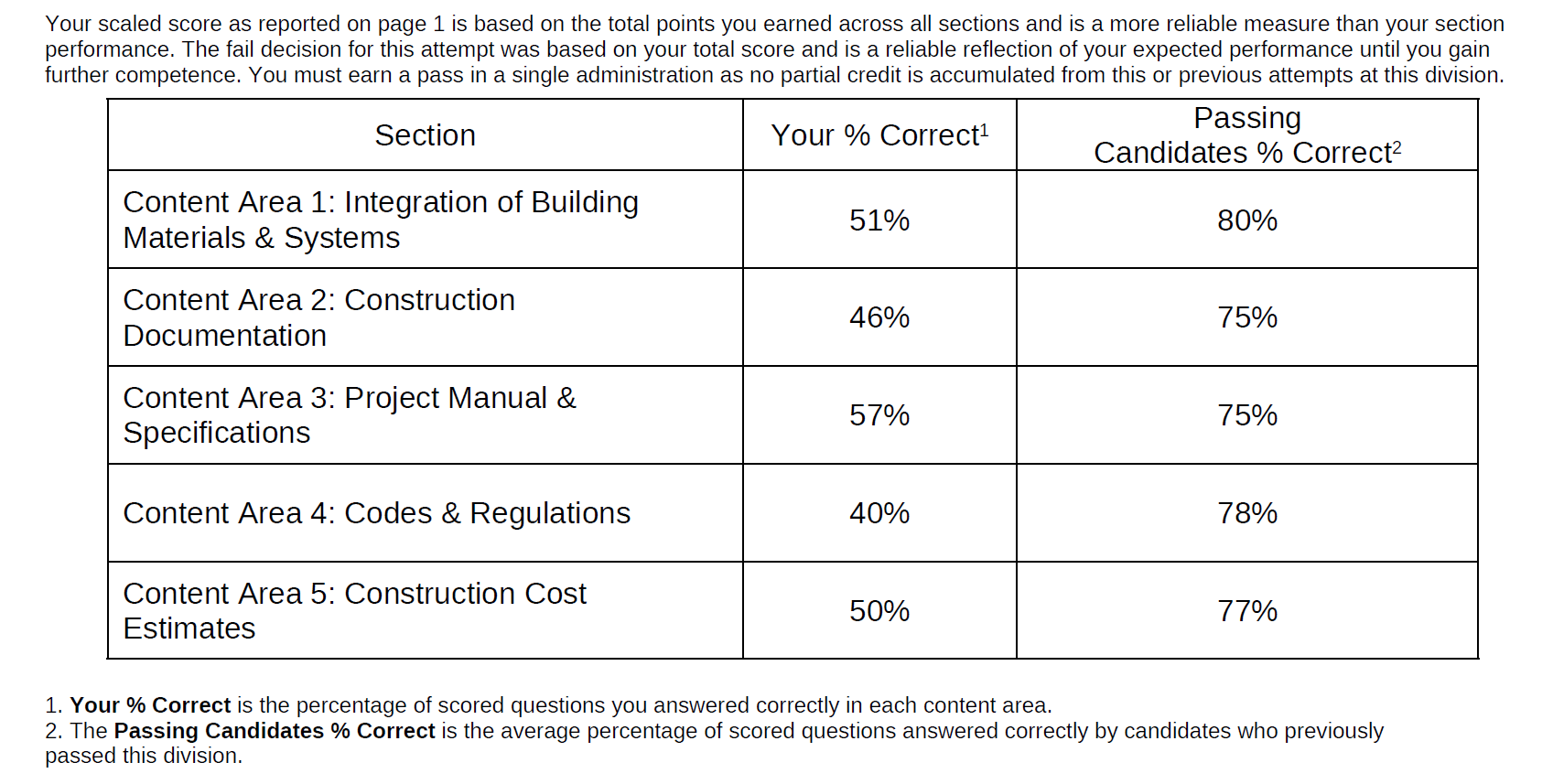
| PDD content area | Your % correct | Passing-candidate average | Blueprint weight |
|---|---|---|---|
| Integration of Building Materials & Systems | 51% | 80% | 31–37% |
| Construction Documentation | 46% | 75% | 32–38% |
| Project Manual & Specifications | 57% | 75% | 12–18% |
| Codes & Regulations | 40% | 78% | 8–14% |
| Construction Cost Estimates | 50% | 77% | 2–8% |
What the calculator indicates for this report
With these inputs, the ReasonSpan™ model estimates 45–48 missed scored items out of 91, and 8–17 additional correct answers across the published PDD cut-score range and the model’s assumptions. This is a planning range, not a reconstruction of the actual examination.
The main opportunity is Construction Documentation and Integration together: their typical midpoint weights total 69%. Codes is the lowest percentage and an important supporting skill, but its smaller share means a codes-only review would leave the two largest areas underprepared. Project Manual & Specifications is relatively stronger in this report, yet 57% still warrants deliberate practice. Cost should remain in the weekly mix.
These section results identify where to investigate. They do not reveal whether the underlying cause was missing knowledge, drawing interpretation, calculation, reference navigation, or time pressure. Fresh practice is needed to distinguish those causes.
Use the online PDD program or the book to repair each priority
Use whichever format you already have. The online program and illustrated book are separate purchases; this plan does not require buying both. Online users can follow feedback into the relevant theory and practice. Book users can work the corresponding subject, workshop, and independent questions before checking the separate explanations. Neither format predicts a passing result.
| Priority | Online PDD program route | PDD book route | Check that the repair transfers |
|---|---|---|---|
| 1. Construction Documentation · 46% | Use the Documentation, specifications, and cost theory lane; practice finding the governing plan, section, detail, schedule, and project record. Use case-study documents to reconcile conflicting or incomplete evidence. | Study Construction Documentation and its workshops. Use the coordinated drawings and project cases to trace detail references, dimensions, and changes across documents. | On a new detail, identify the controlling note and affected documents before answering. Explain why a plausible alternative does not fit. |
| 2. Integration of Building Materials & Systems · 51% | Review enclosure/detail literacy and the relevant structural and building-service lanes. Use visual lessons to trace load paths, water-control continuity, and service clearances. Follow with unfamiliar application questions. | Study Integration of Building Materials & Systems. Work the illustrated assemblies and workshops; explain interfaces between enclosure, structure, and services before doing the calculation. | Change an opening, support, or service route. Show which assumption changes and how the coordinated solution must respond. |
| 3. Codes & Regulations · 40% | Pair code/reference-search practice with the case-study resources. Practice locating the controlling provision and checking applicability, conditions, and exceptions. | Study Codes & Regulations, accessibility geometry, and the dedicated IBC lookup questions and project case. Use the edition and conditions stated in each exercise. | Find a requirement in a different scenario, then explain why it applies. Recheck geometry and exceptions rather than memorizing the prior answer. |
| 4. Project Manual & Specifications · 57% | Use the documentation/specifications lessons and project records to connect product requirements, execution, and drawing intent. | Study Project Manual & Specifications. Use workshops and case exhibits to reconcile material, performance, and execution requirements with the drawings. | Given a new conflict, identify the evidence needed and the appropriate clarification. Avoid assuming one document always controls. |
| 5. Construction Cost Estimates · 50% | Maintain cost practice in the documentation/specifications/cost lane. Check quantity basis, units, scope changes, and total project consequences. | Study Construction Cost Estimates and worked cost decisions. Solve cumulative questions independently and use transfer questions after repair. | Recalculate a changed quantity or allowance and state which cost components change. Keep units and the contingency basis explicit. |
A practical starting allocation for a 10-hour study week
For this report, begin with the allocation below and adjust it after fresh practice. These hours are ReasonSpan™ study guidance, not an NCARB prescription or a claim that one week is sufficient. Include short review, independent application, and error analysis within each allocation.
| Focus | Starting time | Purpose |
|---|---|---|
| Construction Documentation | 3.5 hours | Read and coordinate plans, sections, schedules, details, and project changes. |
| Integration of Building Materials & Systems | 3 hours | Rebuild assembly and system-interface decisions, then test a changed condition. |
| Codes & Regulations | 2 hours | Practice code navigation and application in documentation and integration problems. |
| Project Manual & Specifications | 1 hour | Maintain specification interpretation and reconcile project evidence. |
| Construction Cost Estimates | 0.5 hour | Retain quantity, scope, units, and cost-basis accuracy. |
Repeat a repair-and-check cycle before booking the retake
- Establish a fresh baseline: online, use diagnostic or practice feedback that is already available without resetting completed attempts. With the book, solve a mixed selection independently before opening the explanations. Keep the supplied NCARB report separate from practice scores.
- Repair one recurring decision at a time: review the relevant theory or illustrated workshop, write the governing principle, and explain the distractor or assumption that caused the error.
- Check later on unseen work: online, use different practice, case-study questions, or a mock form not already completed. With the book, reserve cumulative and targeted transfer questions so they remain unfamiliar. If both formats are available, use one for explanation and the other for independent application.
- Rehearse integration and pacing: combine topics and document searches under time limits. Review slow correct answers as well as errors. Book questions are study exercises, not full-length mock examinations; include NCARB’s official practice resources for exam-format rehearsal.
- Reallocate time from evidence: if documentation improves but code application still fails, increase code work within new technical cases. Keep mixed review of all five areas. Schedule only after checking current eligibility rules and seeing consistent improvement across fresh sessions.
Start with NCARB’s official score report
NCARB uses a 100–800 scaled score, with 550 as the passing threshold. This is not a percentage: dividing 550 by 800 does not establish a 68.75% passing requirement. NCARB does not provide a universal scaled-to-raw-score conversion because exam forms differ.
NCARB describes scores of 500 or higher as generally within a few questions of passing. That is broad guidance, not an exact question count for your attempt. Failing reports also show section percentages and average passing-candidate performance. The result is determined across the whole division; the comparison percentage is not a separate passing requirement for each section.
Use the free ReasonSpan™ ARE score calculator
Select your division and enter the section percentages from your official failing report in the calculator above. It estimates a range of scored items missed and additional correct answers across NCARB’s published cut-score range, then suggests where to investigate with fresh practice.
The calculation uses our disclosed assumptions about section weights and rounding. It does not reproduce NCARB scoring, identify your actual exam form, or predict your next result. Open the method explanation beneath the calculator to inspect its inputs and limits.
Questions missed and questions short of passing are different
The total number answered incorrectly is different from the additional correct answers needed to reach a passing threshold. Check which quantity a tool displays. Neither number tells you which specific questions you missed or what the next exam will ask.
Estimates based on section percentages may use assumed section sizes, rounded inputs, or a selected passing target. Those choices can produce different results from the same report. A decimal such as 2.4 questions represents arithmetic in a model, not a literal fraction of an exam question or proof that the official score was wrong.
Do not treat an estimated gap as your probability of passing. A calculation based on a previous attempt does not measure knowledge gained since that attempt, current pacing, or performance on unfamiliar work. The ReasonSpan™ calculator runs in your browser and does not collect your entries or score report.
Why there is no single passing percentage for every ARE division
NCARB’s published cut-score ranges vary by division and exam form. Its June 2025 guidance lists 58–66% of scored items for PDD and CE, 59–71% for PcM and PjM, and 65–71% for PA and PPD. NCARB’s free practice exams instead use approximately 68% across divisions. Check the current official guidance before relying on these ranges.
A range does not identify the cut score on your form. Do not turn its lower bound into a universal practice target or multiply it by every question presented to reconstruct your result; unscored pretest items also appear on the exam.
Our take: use the estimate to choose a better next action
| Evidence | Useful interpretation | Next study action |
|---|---|---|
| Overall score near the passing threshold | Targeted improvement may be appropriate; a close result still leaves uncertainty on the next form. | Investigate recurring errors while keeping mixed review of stronger subjects. |
| Low performance in a heavily represented section | Potentially important review area, but the report alone cannot identify the cause. | Use fresh practice to distinguish missing knowledge from interpretation, calculation, search, or pacing errors. |
| Strong performance only on repeated questions | Familiarity may be masking a gap in application. | Check the same objective with an unfamiliar drawing, constraint, or set of values. |
| The estimate seems inconsistent with your report | The model’s approximate weights and public cut-score range may differ from your form. The official result remains authoritative. | Stop refining the estimated count and test the underlying skills directly. |
What should determine whether you are ready to retake?
These are preparation checks, not a validated pass predictor. Build enough consistency to handle a different exam form rather than aiming to recover only an estimated handful of questions.
- You can explain the governing principle and why competing answers fail on unfamiliar problems.
- The recurring error patterns you identified have improved on new work in more than one session.
- Your reference search and decision pacing fit realistic timed practice, without abandoning breadth.
- Your plan preserves stronger subjects while giving extra attention to demonstrated gaps.
- You have checked current NCARB and jurisdictional retake requirements before scheduling. A calculator does not set eligibility or a booking date.
Try the next decision, then review the reason
Choose the resource for your division. The free PDD preview and PPD practice questions require no payment or account. Use them to inspect your reasoning, then record one specific change to your study plan. A short sample helps you try the method; it does not establish readiness for an entire division.
ReasonSpan™ is an independent exam-preparation provider and is not affiliated with or endorsed by NCARB. The recommendations here are our study guidance. Refer to NCARB for official scoring and examination policies.
Sources and further reading
Exam requirements can change. Confirm current details with the organization that administers your exam and use the cited sources for the preparation principles summarized here.