PE Architectural · structural assumptions
A shared column does not make two beams continuous
Calculate simple-span reactions and moment, trace two reactions into a column, and test whether the connection detail supports a different model.
Reviewed for the current ReasonSpan™ exam profile · Updated October 11, 2026By the ReasonSpan™ editorial team · Our content standards
Let the connection assumption control the model
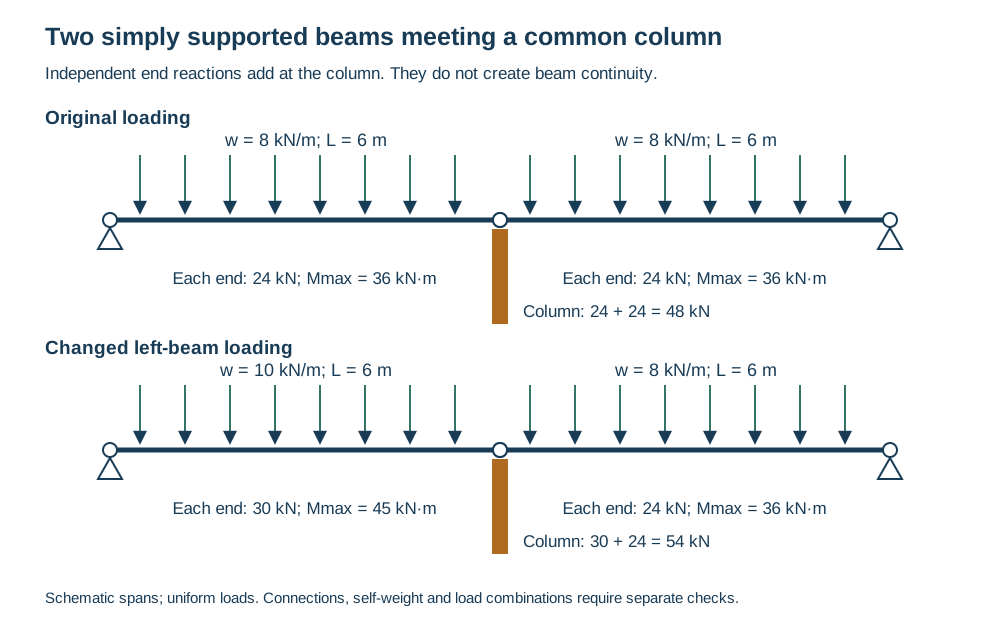
Two separate 6-m simply supported beams meet at a common column through ideal shear connections. Each beam carries a uniform 8-kN/m load. Ignore member self-weight beyond that stated load, column weight and other floors. Find each end reaction, each maximum beam moment and the combined beam load entering the shared column.
Each beam carries 48 kN total. Symmetry gives 24 kN at each end. The maximum simple-span moment is wL²/8 = 8(6²)/8 = 36 kN·m. The common column receives one 24-kN reaction from each beam, or 48 kN total from these two members.
Reject the hidden continuity assumption
Geometric alignment is not evidence of flexural continuity. Using continuous-beam negative support moments would change the stated model. A 24-kN column load would omit the second beam; 96 kN would incorrectly deliver both end reactions of both beams to the center column.
A connection described as moment-resisting would require a compatible frame model and verified strength/stiffness assumptions. The equilibrium result here does not size the connection, beam or column.
Transfer to a changed loading
If the left beam's load increases to 10 kN/m while the right stays at 8, the shared column receives 30 + 24 = 54 kN. The left simple-span maximum moment becomes 45 kN·m. The different loads do not create continuity by themselves.
These are original instructional givens, separate from timed mocks. State assumptions before calculating and check the source edition required for your exam or project.
Sources and further reading
Exam requirements can change. Confirm current details with the organization that administers your exam and use the cited sources for the preparation principles summarized here.