PE Mechanical: HVAC and Refrigeration · Complete public sample
Open and closed system boundaries
Choose a batch-energy balance or a flow-energy balance from what crosses the boundary.
Understand the governing concept.
A closed system retains the selected mass while energy can cross its boundary. Heating a fixed batch of water therefore produces a finite energy change. An open control volume permits mass flow; at steady state, a heater must add energy at the rate carried by the moving water, with no accumulation.
Draw the boundary before naming an energy term. A thermal coil transfers heat across a water-only boundary; if the boundary instead encloses an electrical resistance element, electrical input is work crossing that boundary. State the sign convention and distinguish Btu from Btu per hour before comparing batch energy with equipment capacity.
By the end of this refresher
- Explain the basis or assumption controlling this decision.
- Apply the method within its stated limits.
- Check the result and choose a related study task.
Q is heat into the selected system and W is work out. The flow relation is the one-inlet/one-outlet steady form with kinetic and potential changes neglected.
| Symbol | Meaning | Unit or basis |
|---|---|---|
| Closed-system internal-energy change | Btu | |
| Heat into system and work out of system | Btu | |
| Heat-input and work-output rates | Btu/h | |
| Water mass flow for the rate equation | lb/h | |
| Specific enthalpy | Btu/lb | |
| Approximate liquid-water specific heat | Btu/(lb·°F) |
When the method applies
- The simplified water calculations use constant specific heat, negligible kinetic and potential energy changes, and negligible environmental heat loss.
- For the batch, liquid internal-energy change is approximated by m c ΔT. For steady flow, liquid enthalpy change is approximated by c ΔT with pressure effects neglected.
01 · Equipment view
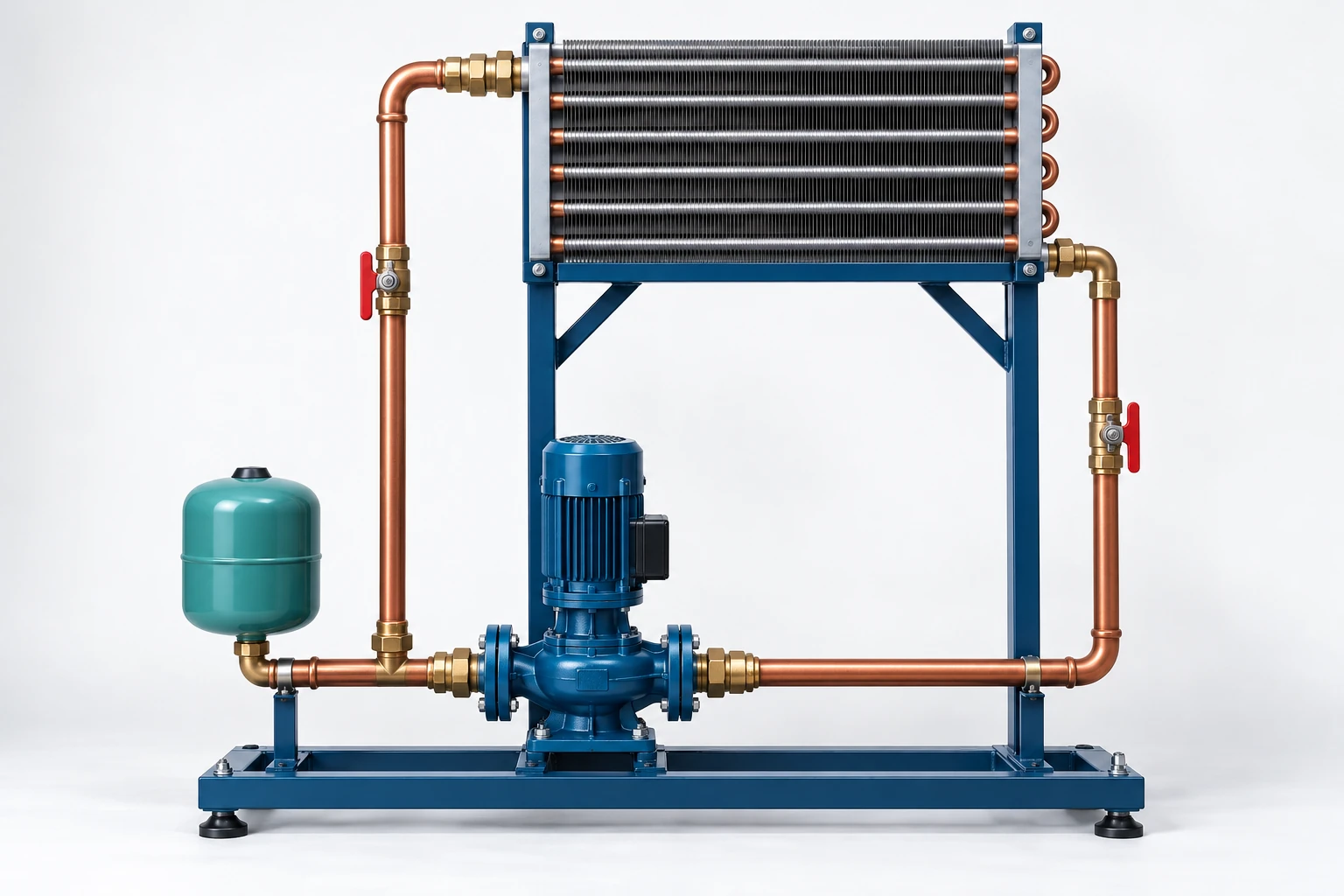
Water piping · heat-transfer component · loop
An entire closed hydronic loop and the local open component boundary are different choices of system.
02 · Exam-style model
Choose an energy amount or an energy rate. Use the worked-case givens and limits below.
Original teaching figure. The schematic and stated givens define the model; the 3D view illustrates the hardware. These are not actual examination exhibits.
Original teaching case
Work the decision, then cross-check it.
Compare a sealed 40 lb water batch heated from 60°F to 100°F with water flowing steadily at 4 lb/min through a thermal heating coil over the same temperature rise. Use c = 1 Btu/(lb·°F); neglect losses, pressure effects, and shaft work.
- For the closed batch, energy added is 40 × 1 × (100 − 60) = 1,600 Btu.
- For the flow heater, heating rate is 4 × 1 × 40 = 160 Btu/min.
- Convert the flow heating rate to hourly capacity: 160 × 60 = 9,600 Btu/h.
Decision
The batch requires an energy amount; the steady-flow heater requires a continuing heating rate. A batch-energy value cannot be used directly as an equipment-capacity value.
Independent check
In 10 min the flow heater processes 40 lb and adds 160 × 10 = 1,600 Btu, matching the batch mass and temperature rise.
A fresh application
Use the concept under changed conditions.
Choose a response before inspecting the reasoning. This is a learning check, separate from scored diagnostic and mock attempts.
Connect this refresher to your program.
The NCEES PE Mechanical Reference Handbook is the supplied examination reference. No separate design standards are listed for PE Mechanical: HVAC and Refrigeration. Refresh physical behavior, modeling choices and equation applicability alongside handbook navigation. This topic is classified as understanding and application; no individual reference omission has been verified.
Original ReasonSpan™ teaching material. AI-assisted checks are complete; independent specialist review remains pending.