PE Mechanical: HVAC and Refrigeration · Complete public sample
Dry-air mass and actual volume flow
Carry conservation on the dry-air basis when air density and measured volume flow change.
Understand the governing concept.
Actual cubic feet per minute describes volume flow at the measurement state. Heating, cooling, and pressure changes alter specific volume, so the same dry-air mass flow can occupy different actual volumes. Two inlet ACFM values do not necessarily sum to outlet ACFM after a downstream state change.
Psychrometric specific volume is commonly expressed per pound of dry air. Divide each measured volume flow by its own specific volume to obtain dry-air mass flow. Add those dry-air mass flows across the boundary, then multiply by the outlet specific volume. State the dry-air basis explicitly instead of mixing it with total moist-air mass.
By the end of this refresher
- Explain the basis or assumption controlling this decision.
- Apply the method within its stated limits.
- Check the result and choose a related study task.
Convert each inlet to dry-air mass flow before reconstructing outlet actual volume flow.
| Symbol | Meaning | Unit or basis |
|---|---|---|
| Dry-air mass flow | lb dry air/min | |
| Actual air volume flow at the stated state | ft³/min | |
| Specific volume on a dry-air basis | ft³/lb dry air |
When the method applies
- Use actual flow and specific volume evaluated at the same state; do not combine standard cfm with a local-state specific volume without conversion.
- The balance assumes no dry-air leakage, addition, or removal. Water-vapor or condensate flows require their own moisture balance.
01 · Equipment view
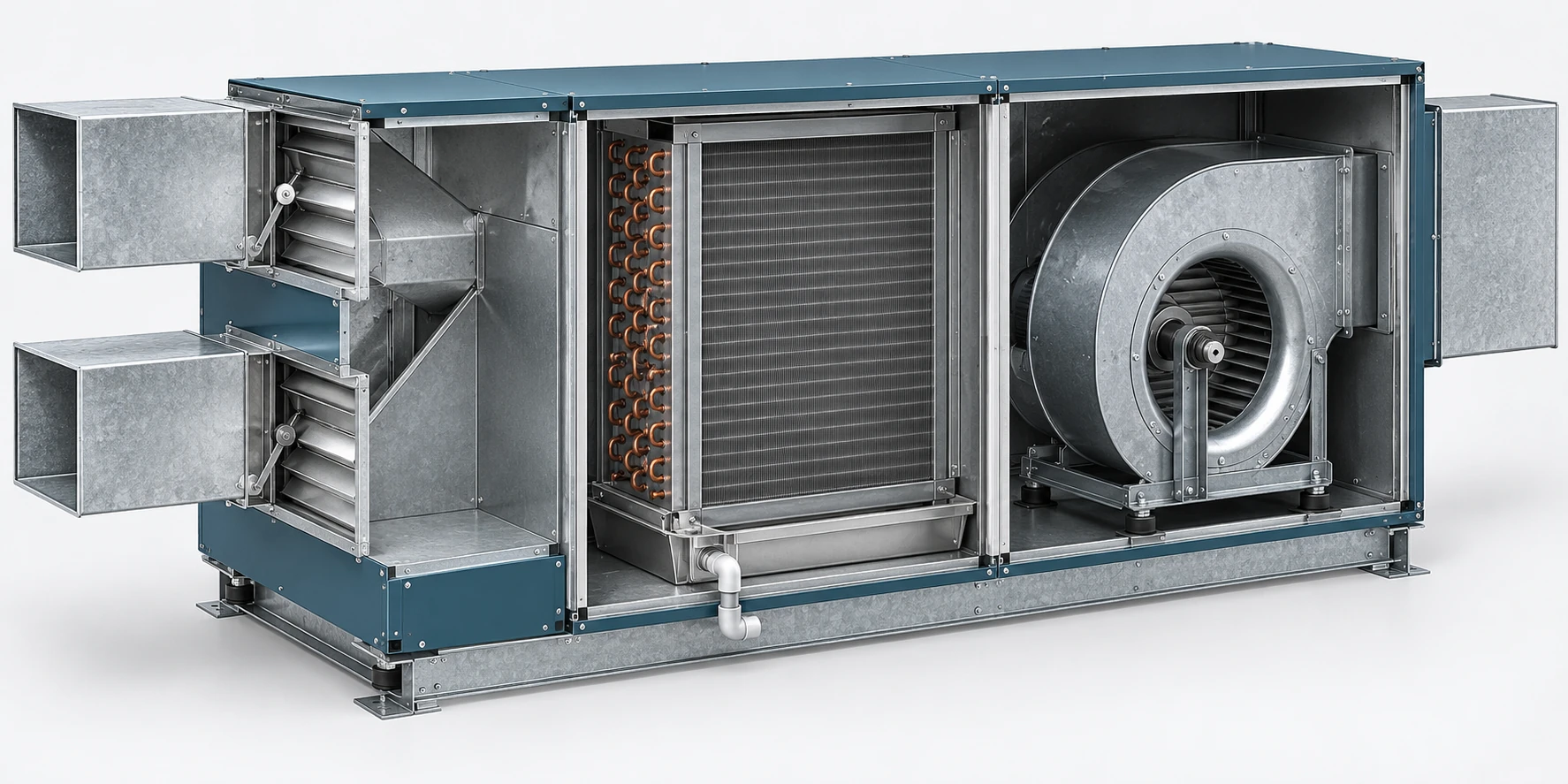
Inlet streams · mixing section · coil · outlet
The diagram supplies the measured local air states; equipment illustration is not dimensioned.
02 · Exam-style model
Actual volume changes; dry-air mass is conserved. Use the worked-case givens and limits below.
Original teaching figure. The schematic and stated givens define the model; the 3D view illustrates the hardware. These are not actual examination exhibits.
Original teaching case
Work the decision, then cross-check it.
Two measured air streams enter a mixing box followed by a heating coil. Inlet 1 is 2,800 actual ft³/min at v₁ = 14 ft³/lb dry air; inlet 2 is 1,600 actual ft³/min at v₂ = 16 ft³/lb dry air. After the coil, measured outlet specific volume is 15 ft³/lb dry air. There is no dry-air leakage.
- Inlet 1 dry-air mass flow is 2,800/14 = 200 lb dry air/min.
- Inlet 2 dry-air mass flow is 1,600/16 = 100 lb dry air/min.
- Outlet dry-air mass flow is 300 lb dry air/min.
- Outlet actual flow is 300 × 15 = 4,500 actual ft³/min.
Decision
Use 4,500 ACFM at the outlet state. The 4,400 ACFM inlet sum does not account for the changed specific volume after heating.
Independent check
4,500/15 returns 300 lb dry air/min. Conserved mass agrees even though the actual volume flow differs from the inlet-volume sum.
A fresh application
Use the concept under changed conditions.
Choose a response before inspecting the reasoning. This is a learning check, separate from scored diagnostic and mock attempts.
Connect this refresher to your program.
The NCEES PE Mechanical Reference Handbook is the supplied examination reference. No separate design standards are listed for PE Mechanical: HVAC and Refrigeration. Refresh physical behavior, modeling choices and equation applicability alongside handbook navigation. This topic is classified as understanding and application; no individual reference omission has been verified.
Original ReasonSpan™ teaching material. AI-assisted checks are complete; independent specialist review remains pending.