PE Architectural Engineering · Complete public sample
Energy, power, and operating time
Use power to describe the rate, energy to describe the accumulated amount, and coincidence to describe peak demand.
Understand the governing concept.
Power is the rate at which energy is used or transferred. Energy accumulates over time. A kilowatt-hour is an energy quantity even though its name includes a power unit. A nameplate in kilowatts cannot be compared directly with a monthly energy total in kilowatt-hours.
Multiply each constant input power by its actual operating time, then add the resulting energies. To find peak demand, instead identify which loads operate at the same time. A duty fraction changes operating hours or average power; apply it once. If a stated value is already electrical input, do not divide by motor efficiency again.
By the end of this refresher
- Explain the basis or assumption controlling this decision.
- Apply the method within its stated limits.
- Check the result and choose a related study task.
For constant on-state power, duty fraction f over elapsed time t produces energy E. kW multiplied by hours gives kWh.
| Symbol | Meaning | Unit or basis |
|---|---|---|
| Energy used | kWh | |
| Electrical input power while on | kW | |
| Fraction of elapsed time operating | decimal | |
| Elapsed time | h |
When the method applies
- The simple calculation assumes constant input power while operating. Variable loads require integration or a suitable time-step estimate.
- Energy totals do not determine billed demand, load diversity, circuit sizing, or code-required sizing factors. Those require their own stated conditions.
01 · Equipment view
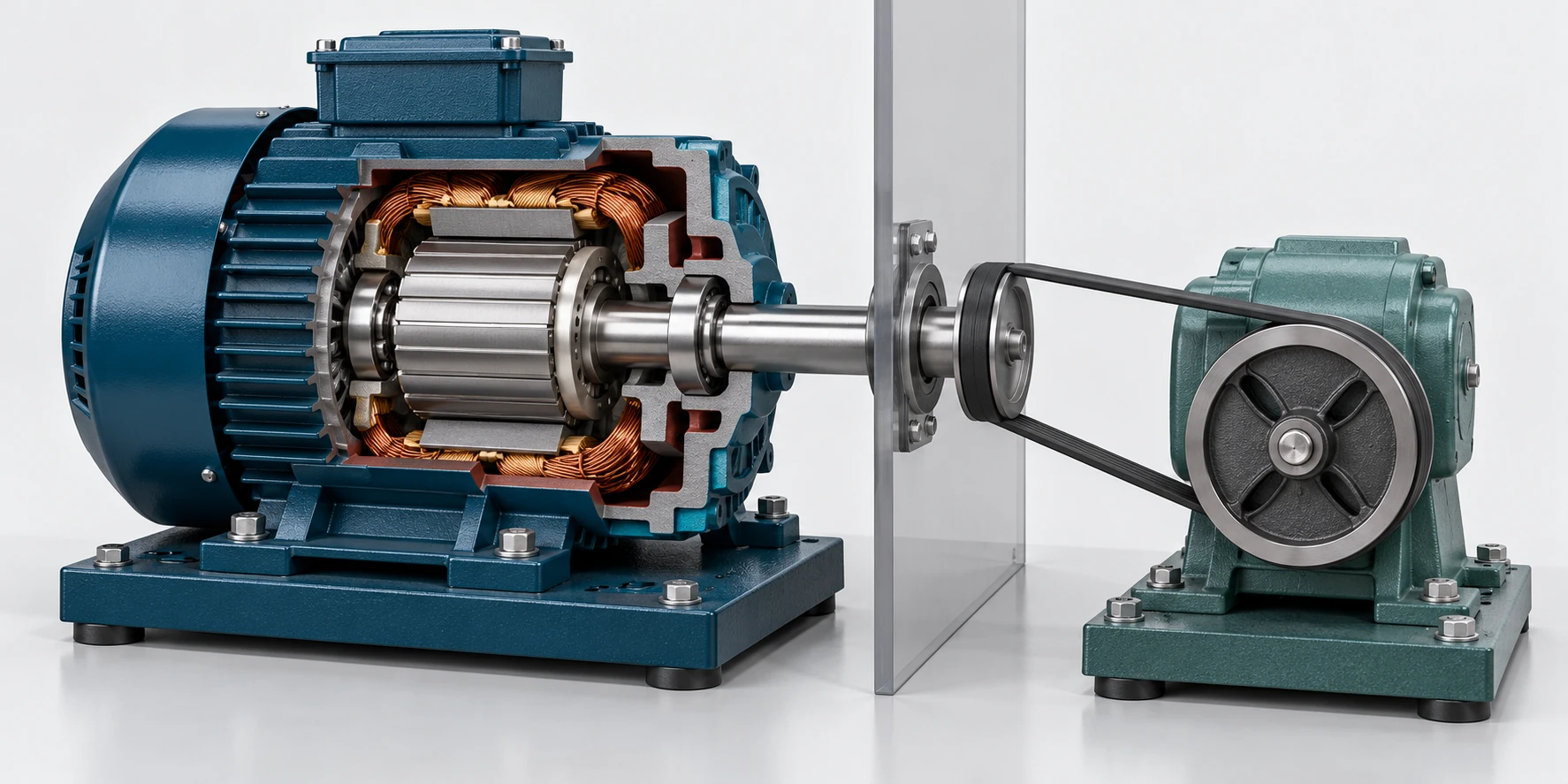
Electrical input · motor · driven equipment
The case uses measured electrical input; motor and shaft efficiencies are outside this calculation.
02 · Exam-style model
Energy is accumulated use; power is a rate. Use the worked-case givens and limits below.
Original teaching figure. The schematic and stated givens define the model; the 3D view illustrates the hardware. These are not actual examination exhibits.
Original teaching case
Work the decision, then cross-check it.
A fan draws 5 kW for 6 h. Lighting draws 2 kW for 3 h. The lighting operates during 3 of the fan operating hours. Both values are electrical inputs, with no other loads.
- Fan energy is 5 × 6 = 30 kWh.
- Lighting energy is 2 × 3 = 6 kWh.
- Total energy is 36 kWh. During the overlapping hours, demand is 5 + 2 = 7 kW.
Decision
Report 36 kWh of energy and 7 kW of coincident peak input; these answer different questions.
Independent check
For 3 overlapping hours, energy is 7 × 3 = 21 kWh; for 3 fan-only hours it is 5 × 3 = 15 kWh. The sum is again 36 kWh.
A fresh application
Use the concept under changed conditions.
Choose a response before inspecting the reasoning. This is a learning check, separate from scored diagnostic and mock attempts.
Connect this refresher to your program.
The Architectural handbook and specified codes and standards are supplied references. Build system understanding, a unit basis and coordination judgment before selecting a formula or code provision. This topic is classified as understanding and application; no individual reference omission has been verified.
Original ReasonSpan™ teaching material. AI-assisted checks are complete; independent specialist review remains pending.