PE Architectural Engineering · Complete public lesson
Critical-path changes: activity delay versus project delay
Calculate each required path, respect the installation merge and distinguish an activity-duration increase from its effect on project completion.
Critical-path changes: an activity delay versus project delay
Critical-path scheduling. A two-day increase in one activity does not automatically delay the whole project by two days. Trace this original design-to-installation network, identify available float, and recalculate the controlling path.
The narration and full worked method use the same original givens. Quiet gaps between sections let you inspect the diagrams and try the changed condition.
Read the video transcript
ReasonSpan™. P E Architectural Engineering. Critical-path changes.
A two-day increase in one activity does not automatically delay the whole project by two days. Trace this original design-to-installation network, identify available float, and recalculate the controlling path.
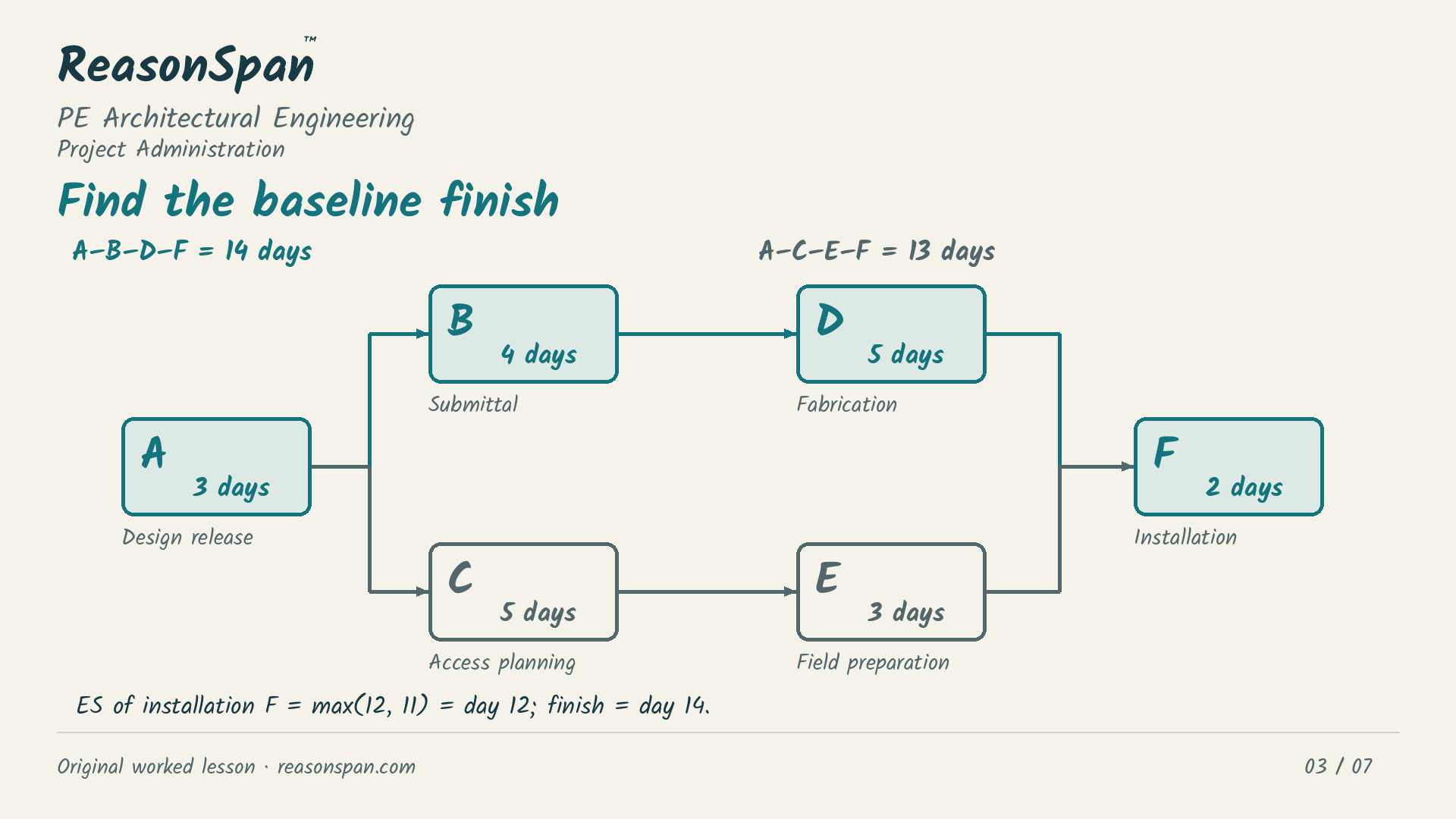
All durations use the same working-day calendar. Dependencies are finish-to-start with zero lag, no resource constraints, and elapsed time starts at day zero. Design release A takes three days. After A, equipment submittal B takes four days and access planning C takes five. Fabrication D takes five days after B. Field preparation E takes three days after C. Installation F takes two days and must wait for both D and E.
The path A, B, D, F takes three plus four plus five plus two, or fourteen working days. The path A, C, E, F takes three plus five plus three plus two, or thirteen days. Installation cannot start when only its earlier predecessor finishes. D finishes at elapsed day twelve and E at day eleven, so F starts at the later value, day twelve, and finishes at day fourteen. The shorter path has one day of float. The earliest completion is governed by the longest required path.
Now field preparation E increases from three to five working days. All other durations and dependencies remain unchanged. Its full path becomes three plus five plus five plus two, or fifteen days. The other path remains fourteen. Installation now starts at day thirteen and finishes at day fifteen. Project completion increases by one day, and the controlling path changes to A, C, E, F. One day of the activity increase was absorbed by the path's available float.
Instead increase E from three to four working days. Keep everything else at the baseline. Would the project finish later, and which full paths would be critical?
Both paths now take fourteen working days. The original one-day float has been fully consumed, but completion remains at day fourteen. Both paths are critical. Float on this shared path is not a separate allowance that can be added for every activity. Another delay on either controlling path may now affect completion, so update the whole network rather than protecting only the originally critical branch.
The useful sequence is dependencies, full paths, available float and revised completion. Define whether a reported delay changes duration, start time or a dependency before recalculating. A valid schedule also needs actual calendars and resource constraints. Open the complete ReasonSpan lesson for the forward pass and changed-condition check, then try different free Architectural questions. The links are in the description.
The situation and givens
An original design-to-installation network has two parallel branches after design release. Installation waits for both branches. First find the baseline finish, then increase field-preparation duration from 3 to 5 working days and recalculate the entire network.
- Same working-day calendar; finish-to-start dependencies with zero lag; no resource constraints; elapsed time starts at day 0.
- A design release = 3 days. B equipment submittal = 4 days after A. C access planning = 5 days after A.
- D fabrication = 5 days after B. E field preparation = 3 days after C.
- F installation = 2 days after both D and E. Changed case: E duration becomes 5 days, with all other facts unchanged.
Complete worked method
1. Calculate both full paths
A-B-D-F takes 3 + 4 + 5 + 2 = 14 days. A-C-E-F takes 3 + 5 + 3 + 2 = 13 days. The longest required path controls the earliest baseline completion.
2. Respect the predecessor merge
Baseline forward pass: A 0–3, B 3–7, C 3–8, D 7–12, E 8–11. F starts at max(12, 11) = 12 and finishes at 14. It cannot start when only E has finished.
3. Identify shared float
The shorter branch has 1 day of total float. C and E share that allowance; they do not each provide a separate day that can be added to a branch-wide budget.
4. Recalculate the duration increase
E now runs from day 8 to day 13. A-C-E-F takes 3 + 5 + 5 + 2 = 15 days; the other path remains 14. F starts at 13 and finishes at 15. A 2-day increase in E consumes 1 day of float and delays the project 1 day. The controlling path changes to A-C-E-F.
Common errors and why they fail
- Starting F after the earlier predecessor ignores its requirement to wait for both D and E.
- Automatically adding a 2-day activity increase to the baseline finish ignores float.
- Treating each shorter-branch activity's float as additive double-counts their shared allowance.
- Rechecking only the originally critical branch can miss a changed controlling path.
Apply the method
After E duration increases from 3 to 5 working days, what is the revised outcome?
Change one condition
Instead increase E only from 3 to 4 days. Keep all other baseline facts unchanged. What is the finish and which paths are critical?
Reveal the worked transfer
A-C-E-F becomes 3 + 5 + 4 + 2 = 14 days, matching A-B-D-F. F starts at day 12 and finishes at day 14. Both full paths are critical. The shared 1-day float is consumed, but the baseline project finish does not change.
Put the method to work
Try different questions to check whether you can identify the governing condition and explain the next action. The free sampler includes answers and worked explanations.