ARE 5.0 PPD · Complete public sample
Convert site slope into the horizontal space it needs
Read percent slope as a ratio and check whether a route can fit the site's supplied constraints.
Understand the governing concept.
Percent slope is 100 times rise divided by horizontal run. Match the units first, then solve for the missing geometric quantity. A small percentage can require a long route when the change in elevation is substantial; multiplying rise by the percentage reverses the relationship.
Use the calculation as a feasibility screen, then incorporate the actual route, landings and site obstructions. The horizontal run is not the diagonal distance along the sloping surface. If the available corridor is too short, a different route or coordinated elevation change is needed before detailing the solution.
By the end of this refresher
- Explain the basis or assumption controlling this decision.
- Apply the method within its stated limits.
- Check the result and choose a related study task.
Use the percent as a fraction when solving for minimum horizontal run.
| Symbol | Meaning | Unit or basis |
|---|---|---|
| Percent slope | % | |
| Vertical rise | ft | |
| Horizontal run | ft | |
| Supplied maximum percent slope | % |
When the method applies
- The slope limit is a supplied hypothetical project criterion. This calculation is not a complete accessibility or site-drainage design.
- The examples ignore landings, cross slope and transition lengths only because the supplied exercise defines a continuous idealized sloping segment.
Original teaching case
Work the decision, then cross-check it.
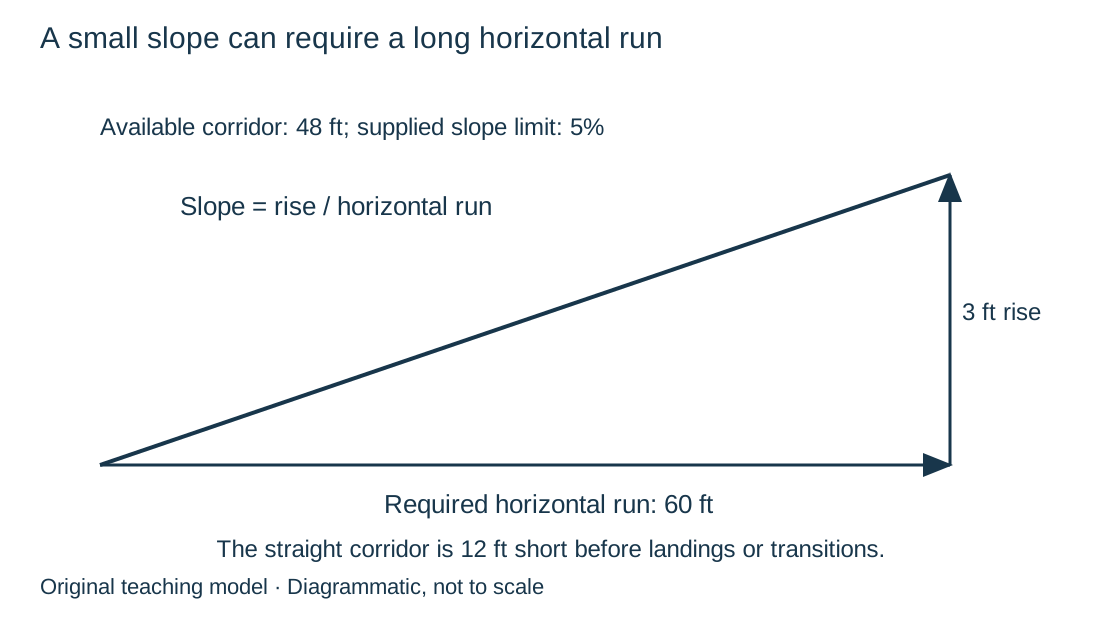
An idealized continuous path must rise 3 ft. The project's supplied slope limit is 5%, and the available straight horizontal corridor is 48 ft. Ignore landings and transitions for this feasibility exercise.
- Express 5% as 0.05 and solve the required run: 3/0.05 = 60 ft.
- Compare 60 ft with the 48 ft corridor; another 12 ft of horizontal run is needed.
- Check the existing corridor directly: 3/48 × 100 = 6.25%, which exceeds the supplied limit.
Decision
Revise the route or elevations; the 48 ft straight corridor cannot satisfy the supplied 5% criterion.
Independent check
More run at the same rise lowers the slope. A run shorter than 60 ft must produce a slope greater than 5%.
A fresh application
Use the concept under changed conditions.
Choose a response before inspecting the reasoning. This is a learning check, separate from scored diagnostic and mock attempts.
Connect this refresher to your program.
NCARB provides examination formulas, structural resources and case-study material. Refresh site response, system selection and tradeoffs before comparing design alternatives. The full PPD program is in invited development review; paid enrollment remains closed. This topic is classified as understanding and application; no individual reference omission has been verified.
Original ReasonSpan™ teaching material. AI-assisted checks are complete; independent specialist review remains pending.