PE Civil Construction · Complete public sample
Soil quantities and moisture bases
Keep dry solids separate from water when converting borrow quantities into compacted fill.
Understand the governing concept.
Loose, bank, and compacted cubic yards describe different volumes of the same material. Without loss of solids, the conserved quantity is dry soil mass, not volume. A wet unit weight includes water; dividing by one plus the decimal water content gives the dry unit weight needed for a solids balance.
Gravimetric water content is water mass divided by dry-solids mass. To change moisture content, multiply the change in that ratio by the dry-solids mass. A four-percentage-point increase is 0.04 times dry mass, not four percent of the original wet mass. State the volume condition and moisture basis beside every quantity.
By the end of this refresher
- Explain the basis or assumption controlling this decision.
- Apply the method within its stated limits.
- Check the result and choose a related study task.
Convert to a dry-solids basis before calculating compacted volume or water adjustment.
| Symbol | Meaning | Unit or basis |
|---|---|---|
| Dry unit weight | lb/ft³ | |
| Total moist unit weight | lb/ft³ | |
| Water mass / dry-solids mass | decimal | |
| Loose and compacted volumes | same volume unit | |
| Dry-solids weight | lb | |
| Additional water weight | lb |
When the method applies
- Assume no discarded material, solids loss, or change in the soil composition; account for such losses separately when they are specified.
- Added-water calculations here neglect evaporation, drainage, and absorption changes. Field conditioning may require additional water or drying.
01 · Equipment view
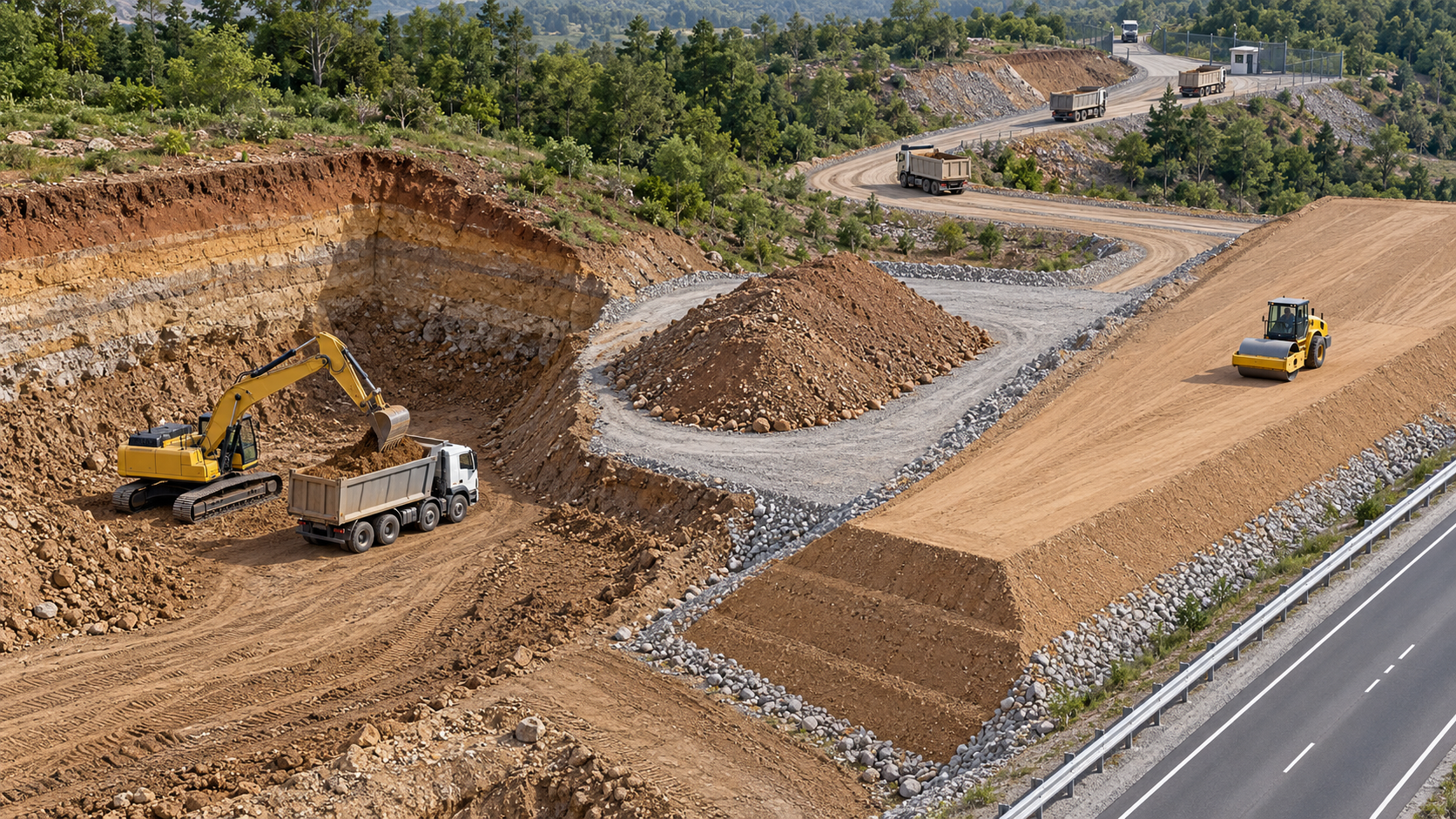
Excavation · borrow pile · hauling · compacted fill
Illustrative site context; no volume or density is inferred from the image.
02 · Exam-style model
Keep soil quantities on a stated mass and volume basis. Use the worked-case givens and limits below.
Original teaching figure. The schematic and stated givens define the model; the 3D view illustrates the hardware. These are not actual examination exhibits.
Original teaching case
Work the decision, then cross-check it.
There are 1,000 loose yd³ of soil at a moist unit weight of 108 lb/ft³ and water content of 8%. The target compacted dry unit weight is 125 lb/ft³. Raise water content to 12%. Use 27 ft³/yd³ and water weight of 8.34 lb/gal; assume no loss.
- Compute the loose dry unit weight: 108/1.08 = 100 lb/ft³.
- Compute dry-solids weight: 1,000 × 27 × 100 = 2,700,000 lb.
- Conserve dry solids to obtain compacted volume: 1,000 × 100/125 = 800 yd³.
- Additional water is (0.12 − 0.08) × 2,700,000 = 108,000 lb. Convert to gallons: 108,000/8.34 ≈ 12,950 gal.
Decision
Plan on 800 compacted yd³ from this borrow quantity under the stated assumptions; the separate moisture adjustment is approximately 12,950 gal.
Independent check
800 × 27 × 125 returns 2,700,000 lb of dry solids. Original water is 216,000 lb; after adding 108,000 lb, water/dry solids = 324,000/2,700,000 = 12%.
A fresh application
Use the concept under changed conditions.
Choose a response before inspecting the reasoning. This is a learning check, separate from scored diagnostic and mock attempts.
Connect this refresher to your program.
The NCEES Civil handbook and the standards listed in the specification are supplied references. Refresh the engineering behavior and assumptions that help you select and apply them. This topic is classified as understanding and application; no individual reference omission has been verified.
Original ReasonSpan™ teaching material. AI-assisted checks are complete; independent specialist review remains pending.