PE Civil Construction · Complete public sample
Load paths and compression-only support
Trace the force to its support, then test whether the assumed contact can actually carry it.
Understand the governing concept.
A load path includes every member, connection, and support between the applied load and the ground. Draw the supported body by itself and replace its surroundings with reactions. Force balance checks the resultant; moment balance checks where that resultant acts. A large downward load does not automatically prevent one edge from lifting.
For a rigid rectangular footing with a linear pressure distribution under one-axis bending, compare eccentricity with the middle-third limit before using the full-contact pressure equation. Soil contact carries compression. A calculated negative edge pressure signals that the full-contact model is invalid; it is not tensile capacity available from the soil.
By the end of this refresher
- Explain the basis or assumption controlling this decision.
- Apply the method within its stated limits.
- Check the result and choose a related study task.
Check the eccentricity limit before accepting the full-contact pressure distribution. B is the footing dimension in the bending direction.
| Symbol | Meaning | Unit or basis |
|---|---|---|
| Compressive vertical resultant | kip | |
| Moment about the footing centroid | kip·ft | |
| Footing dimension in the bending direction | ft | |
| Other footing dimension | ft | |
| Resultant eccentricity | ft | |
| Soil contact pressure | kip/ft² |
When the method applies
- The rectangular-footing relation assumes rigid behavior, one-axis eccentricity, and an initially linear full-contact pressure distribution.
- Positive contact pressure alone does not establish bearing capacity, sliding resistance, structural strength, or compliance with a required load combination.
01 · Equipment view
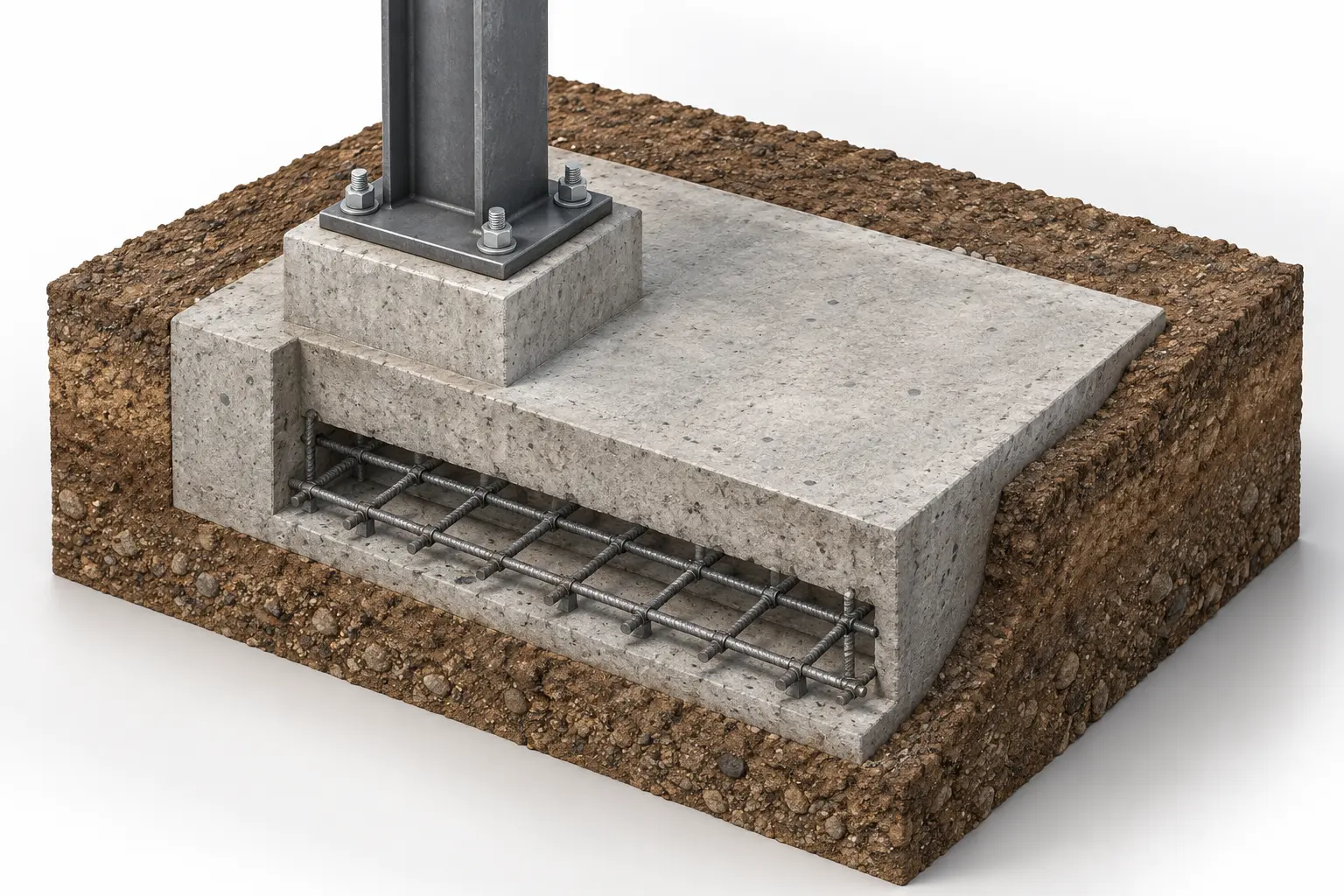
Column · footing · soil interface
Context illustration; dimensions and moment direction come from the schematic.
02 · Exam-style model
Contact behavior comes before the pressure formula. Use the worked-case givens and limits below.
Original teaching figure. The schematic and stated givens define the model; the 3D view illustrates the hardware. These are not actual examination exhibits.
Original teaching case
Work the decision, then cross-check it.
A rigid footing is 6 ft by 10 ft. Its service-load resultant is 120 kip downward with a 90 kip·ft moment about a centroidal axis parallel to the 10 ft side, creating eccentricity across the 6 ft width. Assume a compression-only soil interface and the stated linear contact model.
- Calculate eccentricity: 90/120 = 0.75 ft.
- Compare with B/6 = 6/6 = 1.00 ft. The resultant lies inside the middle third.
- Average pressure is 120/(6 × 10) = 2.00 kip/ft². Apply the edge-pressure multiplier: 6e/B = 0.75.
Decision
The full-contact assumption is consistent with this load case. Continue to the separate bearing, sliding, and strength checks.
Independent check
The average of 3.50 and 0.50 is 2.00 kip/ft²; multiplying by 60 ft² returns the 120 kip vertical resultant.
A fresh application
Use the concept under changed conditions.
Choose a response before inspecting the reasoning. This is a learning check, separate from scored diagnostic and mock attempts.
Connect this refresher to your program.
The NCEES Civil handbook and the standards listed in the specification are supplied references. Refresh the engineering behavior and assumptions that help you select and apply them. This topic is classified as understanding and application; no individual reference omission has been verified.
Original ReasonSpan™ teaching material. AI-assisted checks are complete; independent specialist review remains pending.