Free PE Civil Construction earthwork practice
PE Civil Construction Earthwork Practice Questions
Solve six original earthwork problems on bank, loose and compacted volume, average end area, haul production and costs, with worked explanations.
Reviewed for the current ReasonSpan™ exam profile · Updated October 6, 2026By the ReasonSpan™ editorial team · Our content standards
Choose a problem and work it before opening the solution
These six questions are free original ReasonSpan™ learning exercises. Each contains its own data and has one best answer. None appears in our protected diagnostics, mocks or paid question banks. They illustrate selected Construction decisions, not a complete NCEES exam or a readiness score.
BCY means bank cubic yards, LCY means loose cubic yards, and CCY means compacted cubic yards. Swell and shrinkage factors here are stated project assumptions. Use the stated volume basis instead of substituting a generic soil factor.
1. Excavation geometry and compacted yield
A rectangular excavation is 160 ft long, 90 ft wide and uniformly 6 ft deep. All excavated material is suitable for a nearby embankment. The compacted volume is 12% less than the bank volume. Neglect losses and over-excavation. How much compacted fill will this excavation supply?
Show answer and worked explanation
Answer B: 2,816 CCY
The excavation dimensions describe soil in place. Convert cubic feet to bank cubic yards using 27 cubic feet per cubic yard. The compacted yield factor is then applied to that bank quantity.
As a reasonableness check, the compacted volume must be smaller than the bank volume because the supplied relationship specifies a reduction.
Why each option does or does not fit
- A. 3,200 CCY
- This is the bank quantity from the excavation geometry. It does not apply the stated reduction to the compacted condition.
- B. 2,816 CCY · Correct
- Convert the geometric volume to BCY, then multiply by 0.88 because compacted volume is 12% less than bank volume.
- C. 3,584 CCY
- Multiplying by 1.12 increases volume. The question states shrinkage on compaction, so the result must be less than 3,200 BCY.
- D. 3,636 CCY
- Dividing by 0.88 would recover bank volume from a stated compacted quantity. Here the known quantity is bank volume, so multiply instead.
Remember the decision: Name the known and required soil states before selecting multiplication or division.
2. Borrow quantity and whole truckloads
An embankment requires 9,600 CCY of suitable borrow. The compacted yield is 0.80 CCY per BCY, and excavating the borrow produces 1.25 LCY per BCY. Each truck carries 15 LCY. Assume full loads except the final load and no material losses. What is the minimum number of truckloads?
Show answer and worked explanation
Answer D: 1,000 loads
Start from the required compacted quantity and reverse the yield relationship to find bank borrow. Apply swell to the bank volume to find what trucks actually carry.
The load count is an exact integer here. For a noninteger result, round upward because the remaining material requires another trip.
Why each option does or does not fit
- A. 640 loads
- This divides compacted demand directly by loose truck capacity. CCY and LCY are different bases.
- B. 800 loads
- This correctly finds 12,000 BCY but divides that bank volume by a truck capacity stated in LCY. The swell conversion is still needed.
- C. 960 loads
- Applying a 20% increase to the correctly found 12,000 BCY gives 14,400 LCY and 960 loads. This substitutes the compacted reduction percentage for the supplied 25% swell. Each factor relates a different volume state.
- D. 1,000 loads · Correct
- Recover 12,000 BCY from the compacted demand, convert to 15,000 LCY, then divide by 15 LCY per load.
Remember the decision: Compacted demand, bank excavation and loose haul capacity require two separate conversions.
3. Average end-area quantity
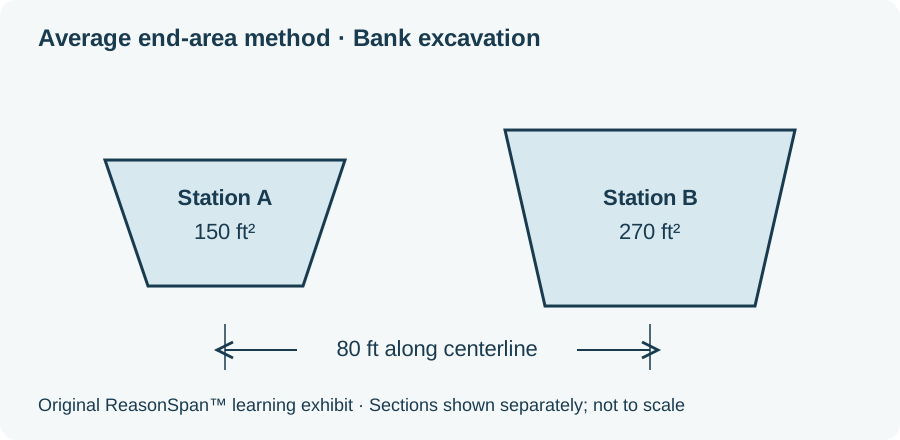
The bank excavation areas at two adjacent stations are 150 ft² and 270 ft². Their centerline separation is 80 ft. Using the average end-area method, what is the excavation quantity, rounded to the nearest whole bank cubic yard?
Show answer and worked explanation
Answer A: 622 BCY
The requested method is specified. Use the arithmetic mean of the end areas; do not substitute a prismoidal method without its required data or change the stated method.
The resulting quantity lies between the volumes obtained by extending either end section alone over 80 ft.
Why each option does or does not fit
- A. 622 BCY · Correct
- Average the two end areas, multiply by the separation, and divide cubic feet by 27.
- B. 1,244 BCY
- This adds the end areas without dividing by two, doubling the average end-area result.
- C. 444 BCY
- This uses only the smaller end section and ignores the second station.
- D. 800 BCY
- This uses only the larger end section and treats it as constant over the full length.
Remember the decision: Keep area, station spacing and the cubic-foot conversion as distinct checks.
4. Trench cross section and loose haul volume
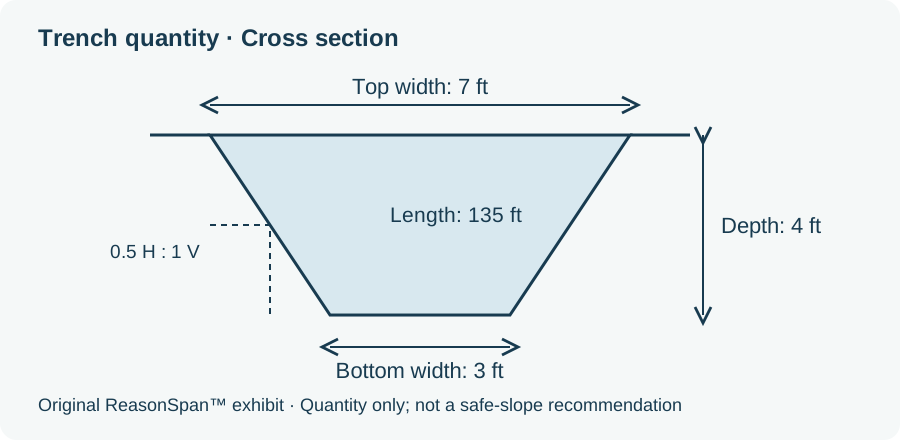
A 135-ft-long trench has a 3-ft bottom width and a uniform 4-ft depth. Each side extends 0.5 ft horizontally for every 1 ft vertically. Excavation increases soil volume by 30% from bank to loose condition. Neglect end slopes and losses. How much loose material must be hauled? This question concerns quantity only; excavation safety is not evaluated.
Show answer and worked explanation
Answer C: 130 LCY
Each side adds 2 ft of horizontal width over the 4-ft depth, so the top width is 3 + 2 + 2 = 7 ft. Use the trapezoid area before multiplying by length.
The geometric excavation is bank volume. Hauling requires the loose volume after applying the specified swell.
Why each option does or does not fit
- A. 100 LCY
- This is the bank excavation quantity before applying 30% swell.
- B. 78 LCY
- This uses only the rectangular bottom-width portion of the trench, omitting both side wedges, before applying swell.
- C. 130 LCY · Correct
- The top width is 7 ft, the trapezoid area is 20 ft², the bank volume is 100 BCY, and loose volume is 130 LCY.
- D. 182 LCY
- This multiplies the full top width by the depth, treating the trench as a 7-ft-wide rectangle rather than a trapezoid.
Remember the decision: Resolve the cross-sectional geometry before converting between soil states.
5. Haul fleet bottleneck
Four identical trucks each carry 18 LCY. For each truck, loading takes 6 minutes, loaded travel 10 minutes, unloading 2 minutes, return travel 8 minutes and spotting 4 minutes. Use 50 productive minutes per hour and assume no other delays. The loader can supply 105 LCY per hour after accounting for its own operating efficiency. Which hourly production governs the operation?
Show answer and worked explanation
Answer B: 105 LCY/h, governed by the loader
Add every part of the truck cycle, including loading and spotting. Determine one-truck production using the productive-hour allowance, then multiply by the four available trucks.
Compare the truck fleet with the independently supplied loader rate. Do not apply the productive-hour factor to the loader again because its rate already includes its efficiency. This is a simplified capacity comparison, not a queue simulation.
Why each option does or does not fit
- A. 120 LCY/h, governed by the truck fleet
- 120 LCY/h is the calculated fleet capacity, but the loader supplies less. The operation cannot exceed the available loading rate.
- B. 105 LCY/h, governed by the loader · Correct
- Fleet capacity is 120 LCY/h and loader capacity is 105 LCY/h. The lower capacity controls the linked operation.
- C. 144 LCY/h, governed by the truck fleet
- 144 LCY/h uses 60 productive minutes instead of the stated 50 and still ignores the loader limit.
- D. 30 LCY/h, governed by one truck
- 30 LCY/h is one truck's productive rate. All four trucks are available, so that is not the fleet limit.
Remember the decision: A haul system is constrained by its lower linked capacity, even when more trucks are available.
6. Cost items on different volume bases
A project removes 1,200 BCY of soil. The excavation charge is $8 per BCY, and disposal is $4 per LCY. Swell is 20% from bank to loose condition. Assume all excavated material is disposed of and neglect losses. These charges include all work stated here; no other costs apply. What is the total cost?
Show answer and worked explanation
Answer C: $15,360
A unit price must be paired with the quantity basis that defines it. Compute excavation using bank volume and disposal using loose volume, then add costs.
The cost per bank cubic yard is $12.80, which exceeds $12 because each bank cubic yard generates 1.20 loose cubic yards for disposal.
Why each option does or does not fit
- A. $14,400
- This applies both prices to bank volume. The disposal price is specifically per loose cubic yard.
- B. $17,280
- This applies both prices to loose volume. The excavation price is specifically per bank cubic yard.
- C. $15,360 · Correct
- Excavation is $9,600 for 1,200 BCY. Disposal is $5,760 for 1,440 LCY. Their sum is $15,360.
- D. $13,440
- This reduces the disposal quantity by 20%. The stated swell increases hauled volume rather than reducing it.
Remember the decision: Convert quantities for each pay item instead of combining unlike unit prices first.
Choose the next study action
If the soil-state conversions caused errors, review the reference-search guide and work a different bank-to-loose estimate. If geometry caused the error, draw the section before calculating. If fleet production or costs caused the error, identify the limiting capacity or pay-item basis first.
Viewing these solutions is a learning activity. For a separate format preview, try the five-question sampler; the complete program includes a broad diagnostic and protected practice for further study.
Sources and further reading
Exam requirements can change. Confirm current details with the organization that administers your exam and use the cited sources for the preparation principles summarized here.