PE Architectural Engineering practice exam
PE Architectural Practice Exam Questions
Try four original PE Architectural Engineering practice questions with diagrams, equations and worked answers across all four exam domains.
Reviewed for the current ReasonSpan™ exam profile · Updated October 15, 2026By the ReasonSpan™ editorial team · Our content standards
Four original PE Architectural Engineering practice questions
Try these independent learning questions across electrical, mechanical, structural and project administration work. Record your answer and confidence before opening each explanation. The examples are independently authored and separate from the free eight-question sampler and protected course assessments. Four questions cannot establish exam readiness.
1. Electrical systems: distinguish real and apparent power
01 · Equipment view
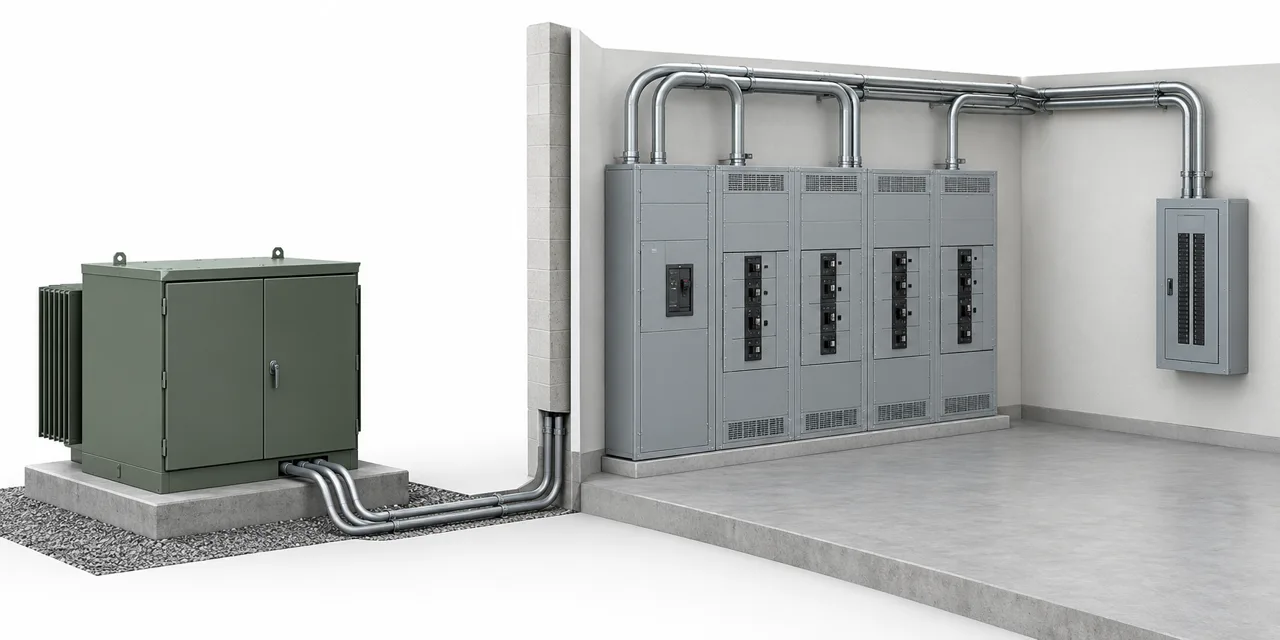
Three-phase electrical distribution equipment.
Illustrative equipment context. The separate schematic and question define the numerical model.
02 · Exam-style model
Read the supplied assumptions and units before selecting the governing relationship.
Original teaching figure. The schematic and stated givens define the model; the 3D view illustrates the hardware. These are not actual examination exhibits.
A balanced three-phase building load consumes 54 kW at a lagging power factor of 0.90. The line-to-line voltage is 480 V. Neglect losses upstream of the load. What is the approximate line current?
Show answer and worked explanation
Answer C: 72.2 A
The supplied 54 kW is real power, so first account for power factor. The apparent power is 60 kVA.
Use the balanced three-phase relationship with line-to-line voltage. This is a current calculation only; conductor and protective-device sizing require separate applicable provisions.
Why each option does or does not fit
- A. 65.0 A
- Using real power as apparent power omits the power-factor adjustment.
- B. 125 A
- Dividing by voltage and power factor without the square root of three treats the total three-phase load as a single-phase load.
- C. 72.2 A · Correct
- Convert 54 kW to 60 kVA, then divide 60,000 VA by the square root of three times 480 V.
- D. 41.7 A
- Using 3 instead of the square root of three with line-to-line voltage mixes phase and line relationships.
Remember the decision: Identify the power quantity and voltage basis before applying the three-phase relationship.
2. Mechanical systems: fan speed and power
01 · Equipment view
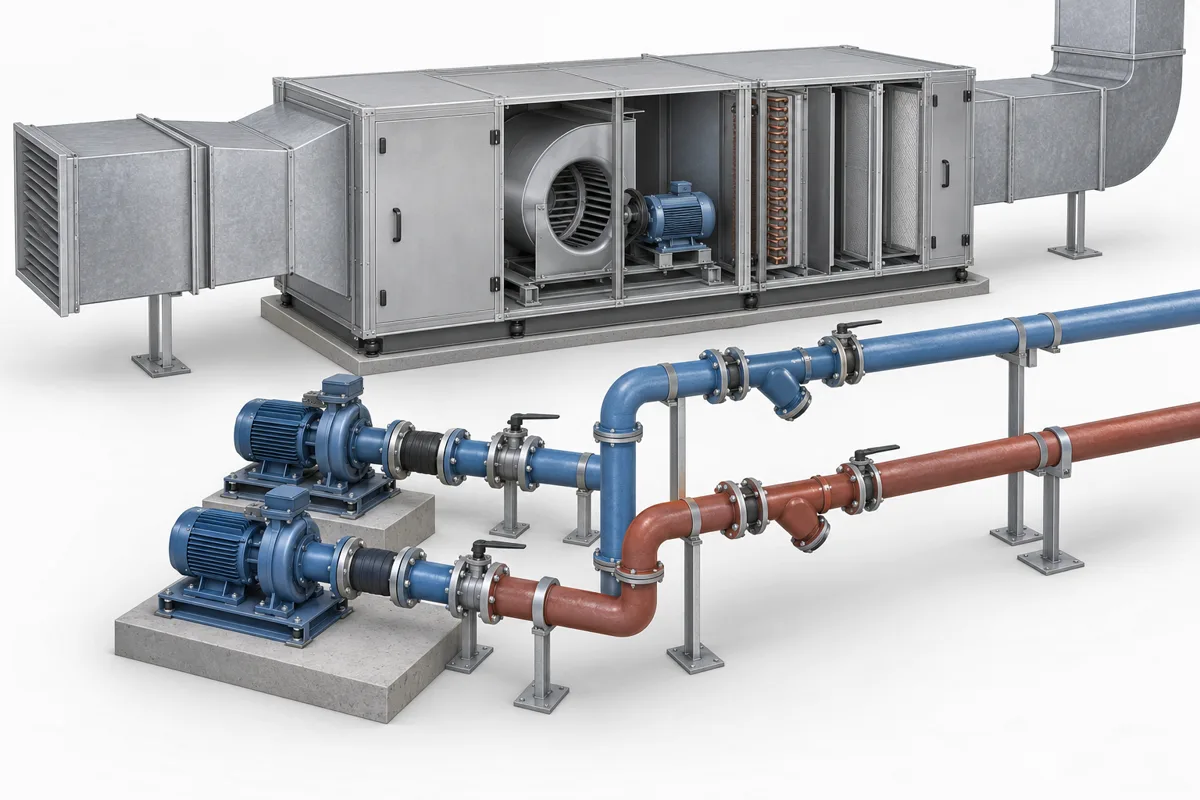
Mechanical equipment room illustrating air-handling hardware.
Illustrative equipment context. The separate schematic and question define the numerical model.
02 · Exam-style model
Read the supplied assumptions and units before selecting the governing relationship.
Original teaching figure. The schematic and stated givens define the model; the 3D view illustrates the hardware. These are not actual examination exhibits.
A fan initially delivers 12,000 cfm at 2.5 in. w.g. and requires 10 hp of shaft power. Speed is reduced to 80% of its original value. Assume the same fan diameter, unchanged air density, unchanged efficiency and operation on the same quadratic-resistance system curve with negligible fixed static pressure. Under the fan affinity relationships, what shaft power is required?
Show answer and worked explanation
Answer A: 5.12 hp
Flow scales to 9,600 cfm and pressure to 1.60 in. w.g. Shaft power scales with the cube of the speed ratio.
The assumptions matter. A different system curve, density or efficiency requires a more detailed operating-point analysis. These ideal ratios are not a substitute for manufacturer data in equipment selection.
Why each option does or does not fit
- A. 5.12 hp · Correct
- Power varies with the cube of speed: 10 times 0.80 cubed.
- B. 6.40 hp
- The square relationship applies to pressure under the stated assumptions, not shaft power.
- C. 8.00 hp
- The linear relationship applies to flow under the stated assumptions, not shaft power.
- D. 19.5 hp
- This inverts the speed ratio and predicts increased power when speed decreases.
Remember the decision: Match the exponent to the requested quantity and check the operating assumptions.
3. Structural systems: distribute an off-center load
01 · Equipment view
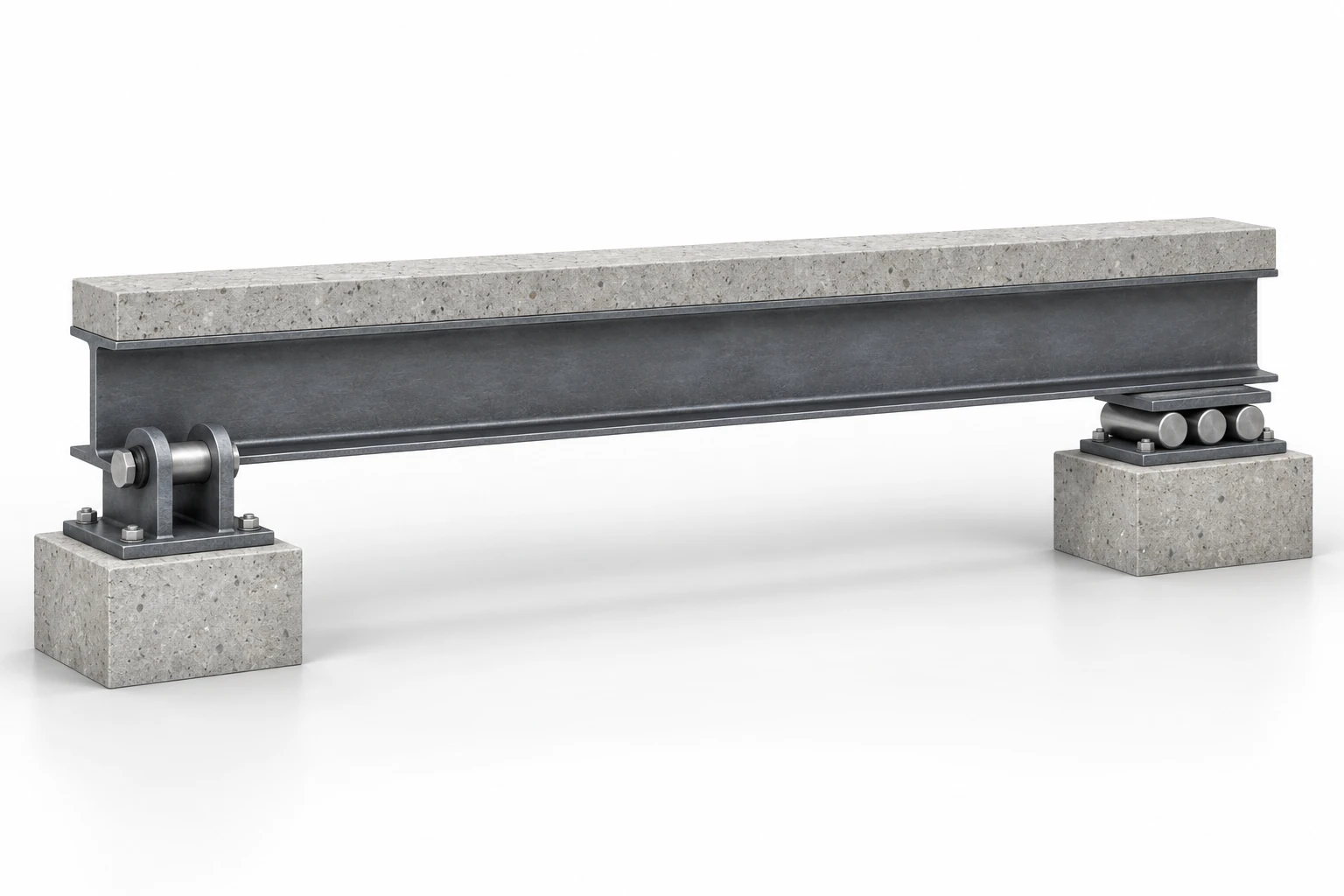
Simply supported beam illustrating a reaction load path.
Illustrative equipment context. The separate schematic and question define the numerical model.
02 · Exam-style model
Read the supplied assumptions and units before selecting the governing relationship.
Original teaching figure. The schematic and stated givens define the model; the 3D view illustrates the hardware. These are not actual examination exhibits.
A simply supported beam spans 24 ft. A uniform downward load of 1.2 kip/ft acts over the entire span, and a 6-kip downward point load acts 8 ft from the left support. All stated loads already include the applicable self-weight; do not add another load. What is the right support reaction?
Show answer and worked explanation
Answer D: 16.4 kip
Replace the uniform load by a 28.8-kip resultant at midspan. Taking moments about the left support isolates the right reaction.
The total downward load is 34.8 kip. Subtracting the right reaction gives 18.4 kip at the left support, which is larger because the point load is closer to that support. This checks the expected physical behavior.
Why each option does or does not fit
- A. 14.4 kip
- This includes only half of the uniform load and omits the point-load contribution.
- B. 18.4 kip
- This is the left reaction: 34.8 minus 16.4 kip.
- C. 20.4 kip
- This assigns the full 6-kip point load to the right support instead of distributing it by moment equilibrium.
- D. 16.4 kip · Correct
- Take moments about the left support: the uniform resultant acts at 12 ft and the point load at 8 ft.
Remember the decision: Use the correct moment arm and verify both force equilibrium and physical behavior.
4. Project administration: check both equipment interfaces
| Supplied project criterion | Existing or proposed condition |
|---|---|
| Panel capacity limit for this exercise | 225 A at 208 V, balanced three-phase |
| Existing apparent load after all required adjustments | 64 kVA |
| Added apparent load after all required adjustments | 18 kVA |
| Manufacturer service clearance requirement | 40 in. |
| Available service clearance | 36 in. |
A proposed replacement air-handling unit meets the specified airflow. The table supplies the project’s electrical and service-access criteria. The existing and added loads may be added directly; no further diversity or demand adjustments apply. Under the supplied review procedure, acceptance requires both criteria to be met. Which disposition is best supported?
Show answer and worked explanation
Answer B: Request coordinated revisions addressing electrical capacity and service clearance before acceptance.
The combined apparent load is 82 kVA. At the supplied voltage, it requires approximately 227.6 A, exceeding the stated project limit.
The installation also provides only 36 inches where 40 are required. Document both open items and route the proposed revisions through the affected design disciplines under the supplied procedure. This original exercise does not grant real-project approval authority.
Why each option does or does not fit
- A. Accept because the airflow matches.
- Meeting airflow does not establish compliance with the independent electrical and service-access criteria.
- B. Request coordinated revisions addressing electrical capacity and service clearance before acceptance. · Correct
- The combined load is about 227.6 A, above 225 A, and available clearance is 4 inches short.
- C. Request only a clearance revision because the panel is adequate.
- The supplied electrical calculation exceeds the panel limit as well.
- D. Reject this manufacturer permanently.
- The record establishes unresolved interfaces, not that every possible product from the manufacturer is unacceptable.
Remember the decision: A matching duty point does not resolve electrical capacity, physical clearance or review responsibility.
Use the mistakes to choose your next review
| Observed mistake | Focused repair | Fresh check |
|---|---|---|
| Confused kW and kVA | State the power quantity, power factor and line-voltage basis before calculating. | Solve a different three-phase load problem. |
| Used the wrong fan exponent | Write separate flow, pressure and power ratios with their assumptions. | Change the speed ratio and predict each direction of change. |
| Swapped support reactions | Take moments about one support and check vertical equilibrium. | Move a point load and predict which reaction grows. |
| Accepted a substitution from one favorable attribute | List each independent project interface and approval condition. | Review another system with different governing constraints. |
The score is only the first output
A practice-exam score does not explain whether a miss came from an electrical concept gap, a structural model-selection error, an overlooked mechanical condition, a project-administration responsibility, or a slow reference search.
Record confidence, time, flags, answer changes, and the source used before reviewing solutions. Those signals make the post-exam review more actionable.
Separate diagnosis from rehearsal
| Attempt type | Purpose | Best use |
|---|---|---|
| Baseline | Find weak decisions across all four domains. | Use early enough that the result can change the plan. |
| Focused verification | Test whether a repaired weakness transfers. | Use unseen problems after a separate review interval. |
| Full simulation | Rehearse pacing, switching, references, endurance, and break decisions. | Use after focused weaknesses are reasonably stable. |
Review every miss by cause
- Concept or governing relationship was unavailable.
- The wrong system model or code path was selected.
- A supplied reference was searched inefficiently or applied outside its limits.
- Units, arithmetic, or transcription failed after the correct method was chosen.
- A coordination consequence or professional responsibility was overlooked.
- Time pressure changed an otherwise reliable process.
Use official and independent practice together
The 2026 NCEES practice exam contains 85 questions and includes traditional and alternative item types. It is an important source for current format familiarity. Independent materials can add additional unseen application and explanation, but should not claim to reproduce the live exam.
ReasonSpan™ uses original content, including two distinct 85-question mock forms, and keeps the free eight-question sampler separate from the protected baseline and paid question banks.
Sources and further reading
Exam requirements can change. Confirm current details with the organization that administers your exam and use the cited sources for the preparation principles summarized here.