PE Civil · construction load application
Sling angle and leg force: measure the angle from the right axis
Resolve a symmetric two-leg bridle at 45° and 60° from horizontal. Separate calculated force demand from rated sling capacity.
Reviewed for the current ReasonSpan™ exam profile · Updated October 11, 2026By the ReasonSpan™ editorial team · Our content standards
Draw the force balance before choosing a trigonometric function
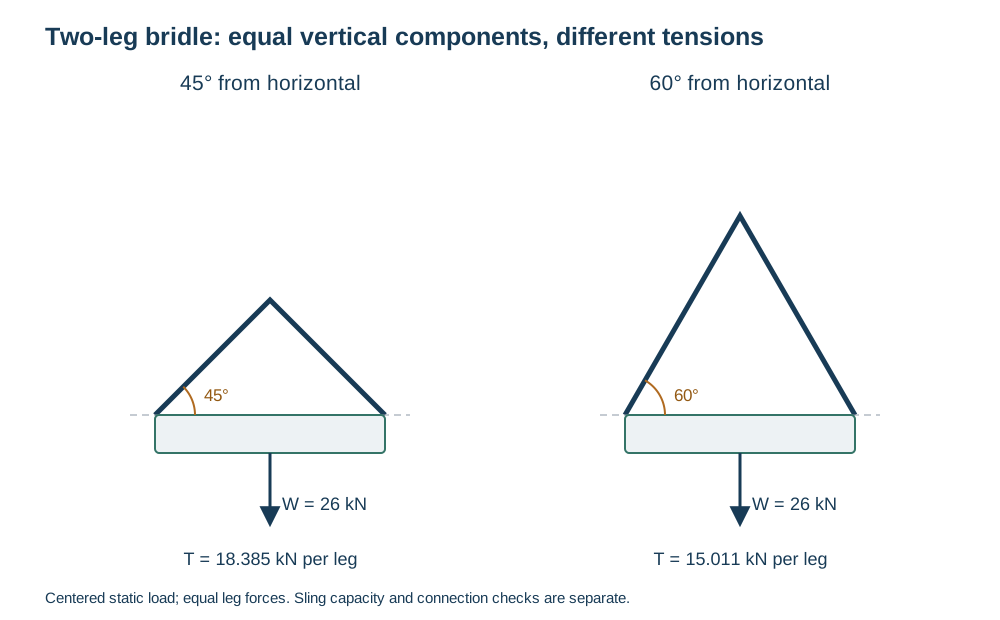
An ideal symmetric two-leg bridle supports a centered 26-kN vertical load. Each leg makes 45° with the horizontal. Neglect sling weight, acceleration, unequal load sharing and connection offsets. Each vertical component is T sin θ, so two components must total 26 kN. Each tension is 26/(2 sin 45°) = 18.385 kN.
The diagram below plots the stated angles. If an angle is instead measured from vertical, use the equivalent cosine form with that different angle. Do not mix an angle from horizontal with a vertical-axis formula.
Change the angle to 60°
At the same load, T = 26/(2 sin 60°) = 15.011 kN per leg. A steeper leg reduces the tension required to supply the same vertical component. A horizontal-angle decrease does the opposite; a near-horizontal sling can create very high force.
13 kN is only each leg's required vertical component. It is not the leg tension unless the legs are vertical. Dividing the load by two and ignoring angle understates demand at both shown angles.
Demand is only one input to selection
Check the manufacturer's rated-load data for the actual sling material, hitch, angle, fittings and configuration. Inspection, minimum allowed angle, dynamic loading and load balance remain separate. This equilibrium exercise does not approve a lift or establish that a nominal rating may be used at any angle.
These are original instructional givens, separate from timed mocks. State assumptions before calculating and check the source edition required for your exam or project.
Sources and further reading
Exam requirements can change. Confirm current details with the organization that administers your exam and use the cited sources for the preparation principles summarized here.