PE Civil Construction · Complete public lesson
Trench egress: maximum travel and post-rain inspection
Check lateral travel to safe egress, not ladder count, and reassess changing conditions.
Trench egress: check the farthest worker and changing conditions
Counting ladders does not establish an adequate access layout. Check the greatest lateral travel from a worker to safe egress, then reassess when the trench or site conditions change.
The narrated example and worked method use the same original givens. Quiet gaps between sections leave time to inspect the exhibit. The changed condition tests how the method transfers.
Read the video transcript
ReasonSpan™. P E Civil Construction. Trench egress and changing conditions.
Counting ladders does not establish an adequate access layout. Check the greatest lateral travel from a worker to safe egress, then reassess when the trench or site conditions change.
This occupied trench is ninety feet long and six feet deep. Stations are measured from its west end. Suitable protective systems and safe egress equipment are supplied for the exercise, and the lateral route is unobstructed. Employees may work along the full length. OSHA's cited trench-egress rule applies at depths of four feet or more and limits lateral travel to twenty-five feet.
The initial safe egress locations are at stations fifteen and seventy-five. Each end is fifteen feet from an egress. But the sixty-foot interval between them has its farthest point at station forty-five. A worker there travels thirty feet to either egress. Thirty exceeds twenty-five, so the proposed layout fails the cited distance criterion even though two egress points are present.
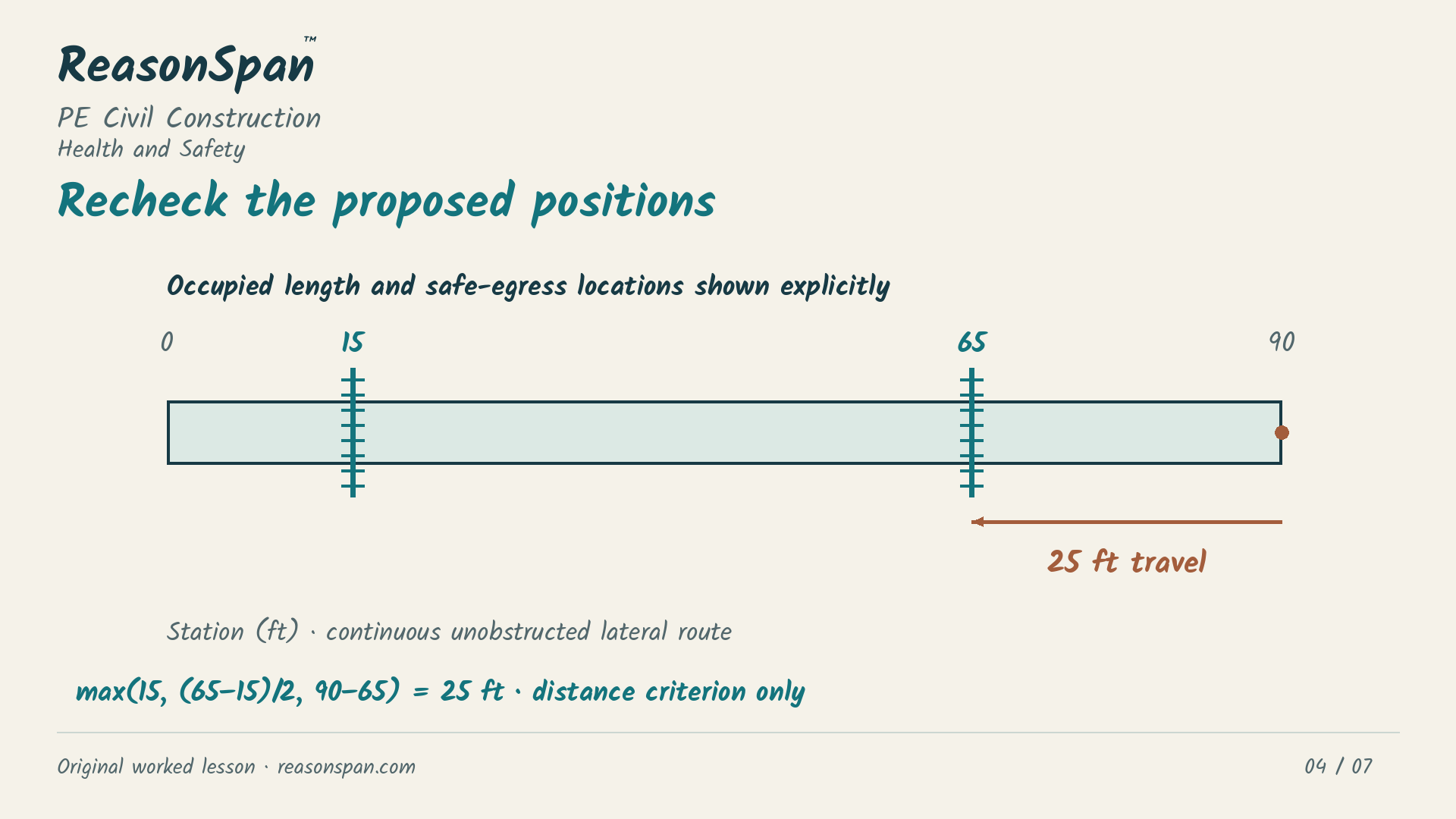
Move the east egress to station sixty-five. The west end remains fifteen feet away. The midpoint of the fifty-foot interval requires twenty-five feet of travel. The east end is also twenty-five feet away. Greatest travel is twenty-five feet. This satisfies only the supplied distance comparison; equipment suitability and the rest of the excavation protections remain separate requirements.
Now extend the east end to station one hundred and ten while keeping egress at fifteen and sixty-five. Workers may enter the entire extended trench. What is the new greatest travel, and would an additional safe egress at station one hundred correct the distance issue?
The extended east end is forty-five feet from station sixty-five, so the old layout fails. Add safe egress at station one hundred. The longest remaining travel is twenty-five feet between stations fifteen and sixty-five. A rainstorm before the next entry also requires the competent person's inspection when employee exposure is anticipated. If hazardous conditions are found, exposed employees must be removed until the necessary safety precautions are taken.
Verify the actual route, occupied limits and changing hazards. The cited distance limit does not select ladders, design protective systems or clear a trench for entry. Review the exact OSHA paragraphs alongside the plan in the complete ReasonSpan lesson, then try a different Civil practice decision. The links are in the description.
The situation and givens
An occupied trench is 90 ft long and 6 ft deep. Suitable protection and safe egress equipment are supplied. Check exit positions and required inspection after rain.
- The trench is 90 ft long and 6 ft deep; workers may occupy its full length.
- Stations are measured from the west end at station 0. Initial exits are at stations 15 and 75 ft.
- Assume a continuous unobstructed lateral route to the nearest safe egress, with suitable equipment and an applicable protective system supplied.
- A rainstorm occurs before the next entry, and employee exposure is reasonably anticipated.
- OSHA 1926.651(c)(2) applies to trenches at least 4 ft deep and limits lateral travel to safe egress to 25 ft.
Complete worked method
1. Apply the exact trigger and travel rule
The 6 ft trench meets the cited 4 ft trigger. The criterion limits travel to safe egress, not exit count.
2. Find the most distant worker
Ends are 15 ft from exits. The midpoint between stations 15 and 75 is 45, where either exit is 30 ft away.
3. Check revised exit positions
Moving the eastern exit to 65 gives 25 ft at both the interval midpoint and the eastern end.
4. Reassess after rain
Under 1926.651(k)(1), competent-person inspections are required before work, as needed throughout the shift and after rainstorms or other hazard-increasing events when exposure is reasonably anticipated. A distance calculation cannot replace inspection.
5. Act on hazard evidence
Under 1926.651(k)(2), exposed employees must be removed from hazardous areas until necessary precautions are taken. A compliant travel distance is not entry clearance.
Common errors and why they fail
- Two exits alone do not show compliance; station 45 is initially 30 ft from either one.
- Checking only trench ends misses the midpoint between distant exits.
- Confusing the 4 ft egress trigger with a separate protective-system threshold misapplies the cited rule.
- Treating 25 ft travel as complete entry clearance ignores other excavation requirements.
- Extending the trench can invalidate the old access calculation.
Apply the method
Does the initial layout at stations 15 and 75 meet the travel criterion for the full 90 ft trench?
Change one condition
Extend the east end to station 110, retaining revised exits at 15 and 65. Find maximum travel, then test adding a supplied safe exit at station 100.
Reveal the worked transfer
With exits only at 15 and 65, maximum travel is max(15, 25, 110 − 65) = 45 ft, which fails. With an added exit at 100, maximum is max[15, (65 − 15)/2, (100 − 65)/2, 110 − 100] = max(15, 25, 17.5, 10) = 25 ft. This meets only the travel criterion, with no distance margin. Reassess the route and all changed excavation conditions before exposure.
Put the method to work
Try different questions to check whether you can identify the governing condition and explain the next action. The free sampler includes answers and worked explanations.