PE Civil Construction · Complete public lesson
Mixed land cover: area-weighted Rational-method runoff
Weight runoff coefficients by contributing area, then convert rainfall and area consistently.
Mixed land cover: weight the runoff coefficient and carry SI units
Different surface types need a coefficient weighted by contributing area. A simple average gives the wrong result when those areas are unequal.
The narrated example and worked method use the same original givens. Quiet gaps between sections leave time to inspect the exhibit. The changed condition tests how the method transfers.
Read the video transcript
ReasonSpan™. P E Civil Construction. Area-weighted Rational-method runoff.
Different surface types need a coefficient weighted by contributing area. A simple average gives the wrong result when those areas are unequal.
The site drains to one inlet. Pavement covers two point four hectares with a supplied runoff coefficient of zero point eight five. Landscaping covers one point six hectares with a coefficient of zero point two five. The supplied time of concentration is fourteen minutes. Associated intensity is seventy-six millimeters per hour. Assume uniform intensity sustained through the time of concentration, with the full area contributing.
Total area is four hectares. Multiply each coefficient by its area, add the products, and divide by total area. Zero point eight five times two point four, plus zero point two five times one point six, divided by four gives a composite coefficient of zero point six one. The larger paved area has more influence than the smaller landscaped area.
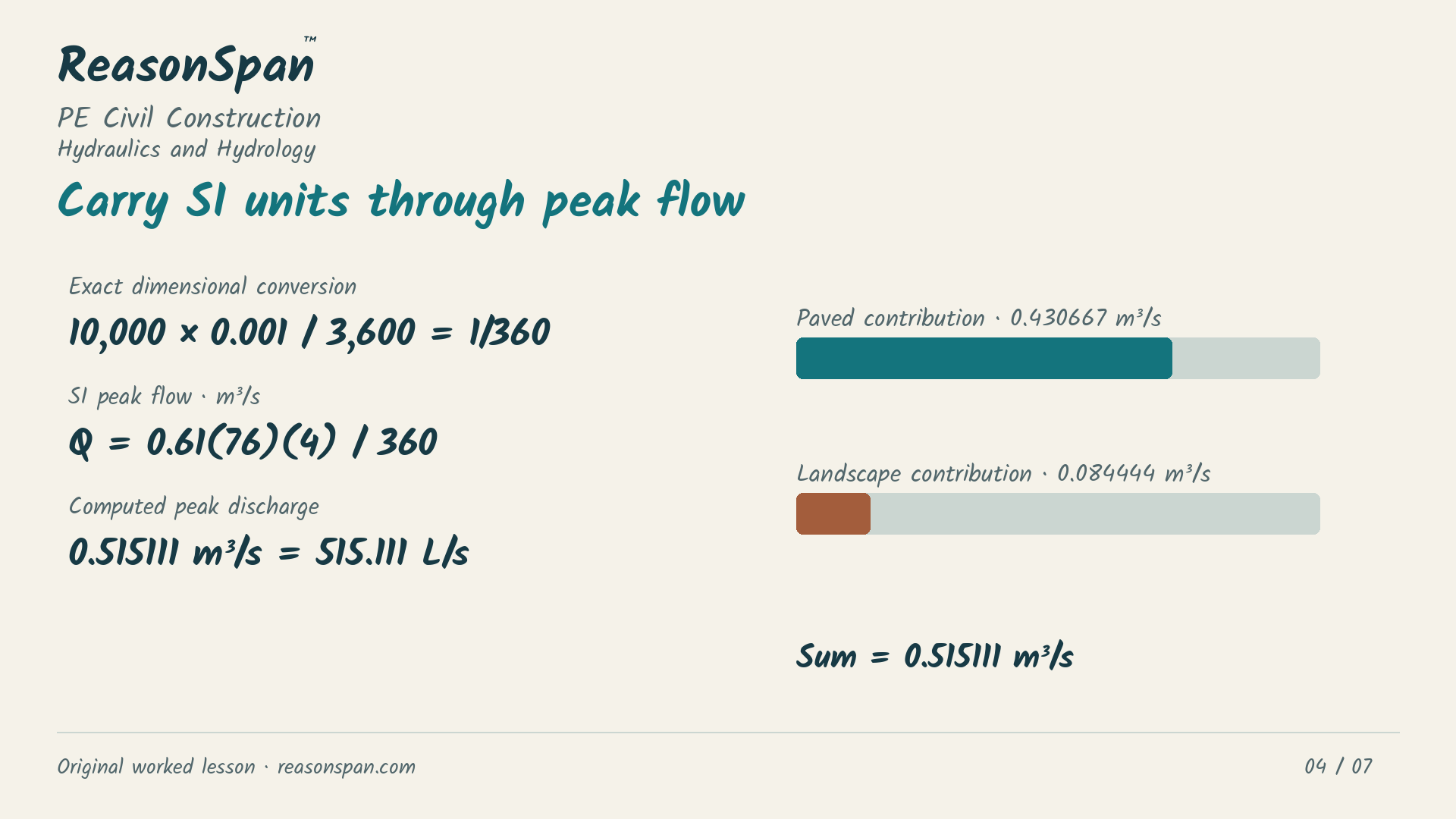
One hectare is ten thousand square meters. One millimeter per hour is zero point zero zero one meters divided by thirty-six hundred seconds. With area in hectares and intensity in millimeters per hour, discharge in cubic meters per second is coefficient times intensity times area divided by three hundred and sixty. The result is approximately zero point five one five one one one cubic meters per second, or five hundred and fifteen point one one liters per second. Summing the two surface discharges gives the same answer.
Now convert one hectare of landscaping to pavement. For this controlled comparison, expressly keep the supplied time of concentration and rainfall intensity unchanged. What composite coefficient and peak flow result from the changed areas?
Pavement becomes three point four hectares and landscaping zero point six. The composite coefficient becomes zero point seven six. Peak discharge becomes approximately zero point six four one seven seven eight cubic meters per second, an increase of about twenty-four point five nine percent. In a real redesign, recheck time of concentration and its associated intensity after changing the surface.
The unweighted coefficient would be zero point five five and would understate runoff. Supplied coefficients and rainfall are exercise inputs. This peak calculation does not route detention storage or verify inlet and pipe capacity. Open the complete ReasonSpan lesson for the drainage plan and unit conversion, then try a different Civil practice decision. The links are in the description.
The situation and givens
A small site drains to one inlet. For this instructional Rational-method application, intensity associated with the supplied time of concentration is provided.
- Pavement covers 2.40 ha with supplied runoff coefficient 0.85.
- Landscape covers 1.60 ha with coefficient 0.25; both contribute to the same outlet.
- Supplied time of concentration is 14 min and associated rainfall intensity is 76 mm/h.
- Assume uniform intensity sustained through the time of concentration and full contribution from the 4.00 ha site.
- For the comparison, convert 1.00 ha of landscape to pavement while expressly retaining time of concentration and intensity.
Complete worked method
1. Add contributing areas
Use the combined unequal surface areas in the coefficient denominator.
2. Weight each coefficient by area
The two unequal areas must not receive equal influence in the composite coefficient.
3. Derive the SI conversion
One hectare is 10,000 m²; one mm/h is 0.001 m per 3,600 s. With i in mm/h and A in ha, divide the numeric CIA product by 360.
4. Find peak discharge
Use intensity for the supplied time of concentration. Multiply m³/s by 1,000 for L/s.
5. Sum surface flows independently
Using the same intensity, each surface contribution adds to the weighted-coefficient result.
Common errors and why they fail
- The unweighted coefficient 0.55 gives 0.464444 m³/s, understating this baseline by about 9.84%.
- Reporting the raw CIA product 185.44 as m³/s omits the hectare and rainfall conversion.
- Multiplying by 14 min as if finding runoff volume changes the requested peak-flow quantity.
- Automatically retaining time of concentration in a real land-cover redesign ignores possible changed travel times and associated intensity.
- Peak runoff alone does not verify inlet or pipe capacity.
Apply the method
Which peak discharge follows from the supplied SI data?
Change one condition
Convert 1.00 ha of landscape to pavement. Retain the supplied 14 min time of concentration and 76 mm/h intensity for this controlled comparison. Find C and peak-flow increase.
Reveal the worked transfer
Areas become 3.40 ha paved and 0.60 ha landscape. C = [0.85 × 3.40 + 0.25 × 0.60]/4.00 = 0.76. Q = 0.76 × 76 × 4.00/360 = 0.641778 m³/s, a 24.59% increase. A real redesign must reassess time of concentration and associated intensity.
Put the method to work
Try different questions to check whether you can identify the governing condition and explain the next action. The free sampler includes answers and worked explanations.