PE Civil Construction · Complete public lesson
Procurement delay: recover time on the controlling path
Recompute the merge and controlling path before selecting a recovery action.
A procurement delay: accelerate the path that actually controls
Accelerating an activity that used to control the schedule may recover no project time. Find the current controlling branch before selecting a recovery action.
The narrated example and worked method use the same original givens. Quiet gaps between sections leave time to inspect the exhibit. The changed condition tests how the method transfers.
Read the video transcript
ReasonSpan™. P E Civil Construction. Procurement delay and the critical path.
Accelerating an activity that used to control the schedule may recover no project time. Find the current controlling branch before selecting a recovery action.
Use working days, finish-to-start dependencies with zero lag, and elapsed time starting at day zero. Mobilization A takes one day. After A, clearing B takes three days and procurement C takes nine. Excavation D takes four days after B. Forms E take three days after D; inspection F takes one after E. Placement G takes two days and waits for both C and F. The supplied cure-and-release activity H takes five days after G.
Follow the field branch. A finishes at day one, B at four, D at eight, E at eleven, and F at twelve. Procurement finishes at day ten. Placement therefore starts at the later predecessor finish, day twelve, and ends at fourteen. H ends at nineteen. The full field path takes nineteen days; the procurement path takes seventeen. Procurement has two days of total float.
Now procurement C increases from nine to twelve days. It finishes at day thirteen. Placement moves to days thirteen through fifteen, and project completion moves to day twenty. The procurement path becomes critical. A three-day activity increase causes a one-day project increase because the first two days consumed available float. Declaring a three-day project delay would ignore the merge logic.
Keep that procurement delay in place. A recovery proposal reduces excavation D from four to two days. All other durations and dependencies remain unchanged. Would faster excavation bring the project finish back to day nineteen?
The field path shortens from nineteen to seventeen days. Inspection now finishes at day ten. But procurement still finishes at thirteen, so placement must still wait until thirteen. Project completion remains day twenty. The proposed acceleration recovers zero project days. It improves the earlier branch while leaving the branch that currently controls unchanged.
Recompute the merge before spending effort on schedule recovery. These calculations assume no resource constraints and one working-day calendar. The five-day release period is supplied schedule logic, not a universal concrete-strength requirement. Open the complete ReasonSpan lesson for the activity network and forward pass, then try a different Civil practice decision. The links are in the description.
The situation and givens
A foundation-placement schedule has procurement and field-preparation branches merging at concrete placement. Determine the impact of delayed inserts and whether faster excavation helps.
- Start at elapsed day 0. Use one working-day calendar, finish-to-start dependencies, zero lag and no resource constraints.
- A mobilize: 1 day. B clear site: 3 days after A. C procure inserts: 9 days after A.
- D excavate: 4 days after B. E build forms: 3 days after D. F inspect forms: 1 day after E.
- G place concrete: 2 days after both C and F. H cure before specified release: 5 days after G.
- Delayed case: C increases from 9 to 12 days. Proposed recovery: D decreases from 4 to 2 days.
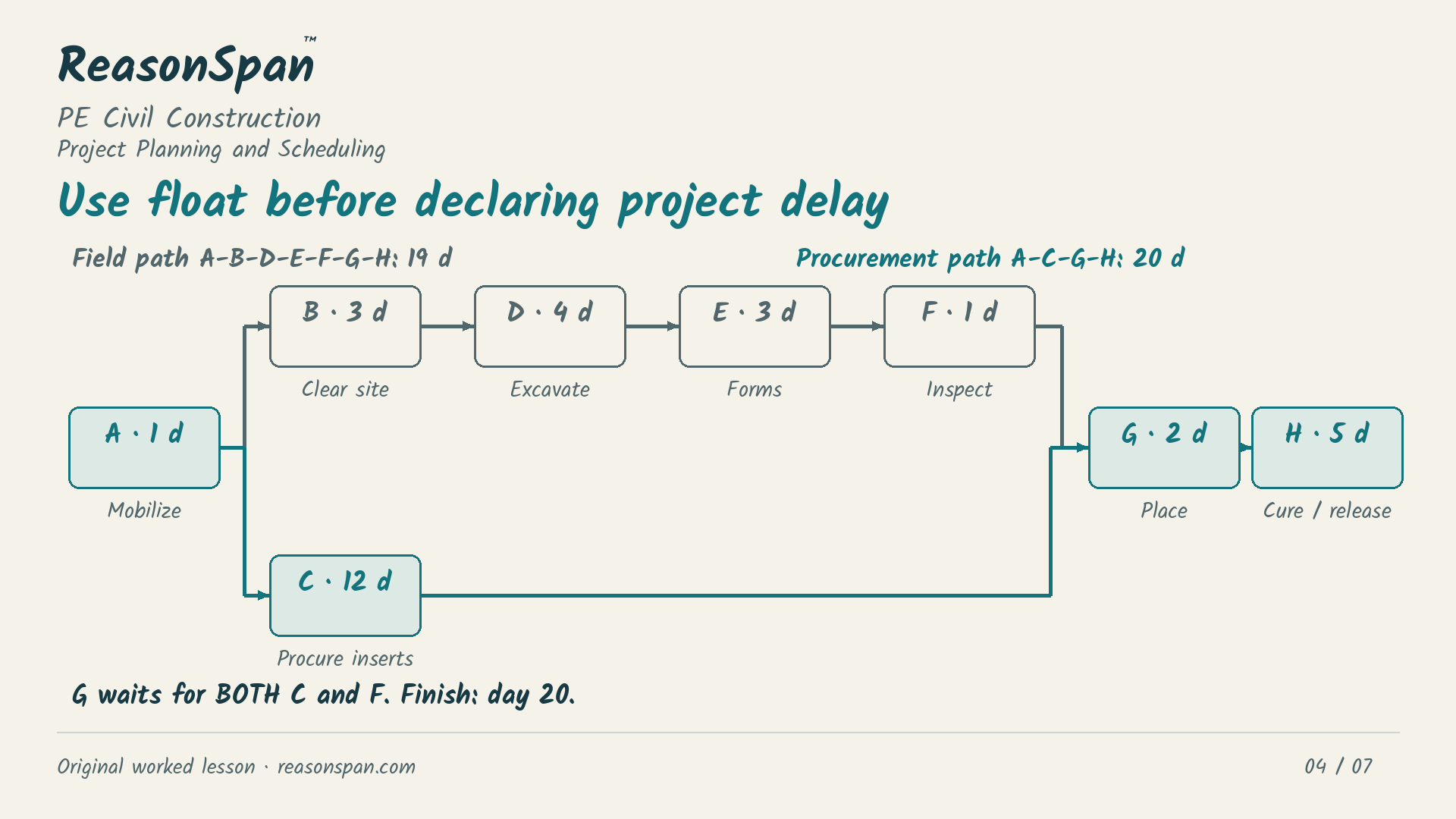
Complete worked method
1. Run the baseline forward pass
A finishes at 1, B at 4, C at 10, D at 8, E at 11 and F at 12. Placement waits for both predecessors.
2. Compare both full paths
Field preparation initially controls completion.
3. Identify procurement float
C may finish at day 12 without delaying placement; its early finish is 10.
4. Recalculate procurement delay
C now finishes at 13. Placement runs 13–15 and H finishes at 20, with procurement controlling.
5. Test excavation acceleration
Shortening D moves F’s finish to day 10, but G still waits for C until 13.
Common errors and why they fail
- Adding all three procurement-delay days to baseline ignores two days of float and wrongly gives 22 days.
- Starting placement when only one predecessor finishes violates the merge requirement.
- Accelerating the former critical excavation branch does not shorten the new controlling procurement branch.
- Treating the supplied five-day release activity as a universal concrete-strength requirement misuses a schedule assumption.
Apply the method
After C becomes 12 days and D is shortened to 2 days, when does the project finish?
Change one condition
Retain procurement at 12 days and reduce excavation to 2 days. Recalculate both paths and recovered project time.
Reveal the worked transfer
The field path becomes 1 + 3 + 2 + 3 + 1 + 2 + 5 = 17 days; procurement remains 1 + 12 + 2 + 5 = 20 days. The later branch controls the merge, so completion remains day 20 and zero project days are recovered. Recovery must affect the current controlling path.
Put the method to work
Try different questions to check whether you can identify the governing condition and explain the next action. The free sampler includes answers and worked explanations.