PE Civil Construction · Complete public lesson
Moisture and density: use dry mass and total specimen volume
Water content uses dry-solids mass; dry density uses the full specimen volume.
Moisture and density: choose the correct mass basis
A heavier wet soil specimen does not necessarily contain a denser packing of solids. Separate water mass, dry-solids mass and total specimen volume before interpreting the reported properties.
The narrated example and worked method use the same original givens. Quiet gaps between sections leave time to inspect the exhibit. The changed condition tests how the method transfers.
Read the video transcript
ReasonSpan™. P E Civil Construction. Moisture content and density.
A heavier wet soil specimen does not necessarily contain a denser packing of solids. Separate water mass, dry-solids mass and total specimen volume before interpreting the reported properties.
A sealed sample has a wet mass of two thousand three hundred grams and an oven-dry solids mass of two thousand grams. Its total volume is one thousand two hundred and fifty cubic centimeters. The supplied solids specific gravity is two point six five. Take water density as one gram per cubic centimeter. These values describe the whole specimen.
Subtract dry-solids mass from wet mass. The specimen contains three hundred grams of water. Geotechnical water content uses dry-solids mass in the denominator: three hundred divided by two thousand gives zero point one five, or fifteen percent. Dividing by the wet mass instead would give about thirteen point zero four percent. That is a different quantity.
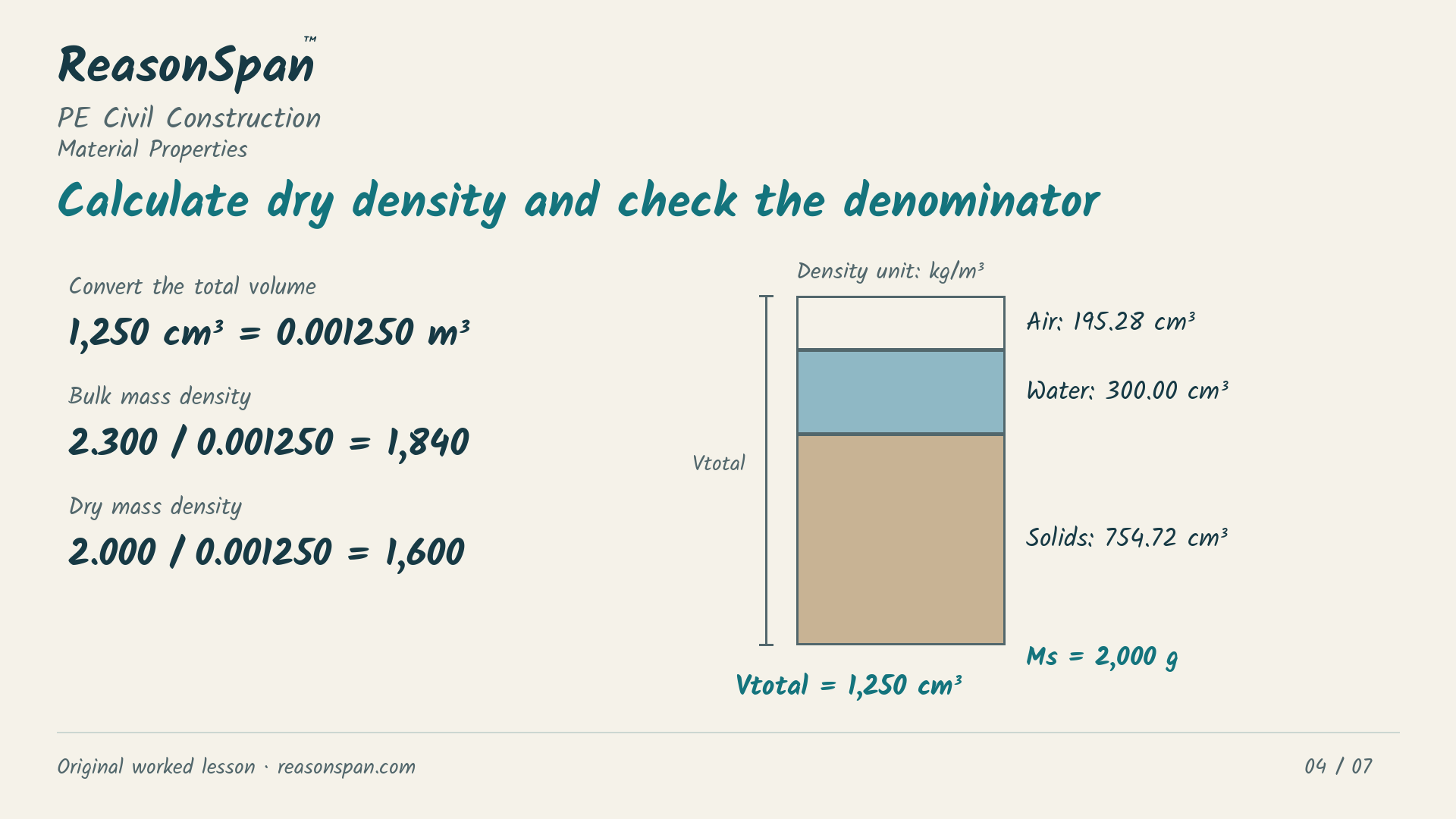
Convert the masses to kilograms and total volume to zero point zero zero one two five zero cubic meters. Bulk density is two point three divided by that volume, giving one thousand eight hundred and forty kilograms per cubic meter. Dry density is two point zero divided by the same total volume, giving one thousand six hundred. Independently, divide bulk density by one plus zero point one five to recover the dry density.
Now add one hundred grams of water while keeping solids mass and total volume fixed. Assume no swelling or leakage. What are the new moisture content, bulk density and dry density? Check that the added water can fit within the specimen's voids.
Water mass becomes four hundred grams, so moisture content becomes twenty percent. Wet mass becomes two thousand four hundred grams and bulk density becomes one thousand nine hundred and twenty kilograms per cubic meter. Dry density stays at one thousand six hundred. The solids occupy approximately seven hundred and fifty-four point seven two cubic centimeters. After adding water, approximately ninety-five point two eight cubic centimeters of air remains, so the controlled comparison is physically possible.
Dry density uses solids mass divided by total specimen volume, including voids. These are mass densities, not force-based unit weights. Field soil may change volume when wetted, so constant volume is an explicit assumption here. Open the complete ReasonSpan lesson for the phase diagram, then try a different Civil practice decision. The links are in the description.
The situation and givens
A technician receives a sealed cylindrical soil specimen with measured total volume. Compare the properties that change when water is added with the dry density that remains fixed under a controlled constant-volume comparison.
- Wet specimen mass is 2,300 g; oven-dry soil-solids mass is 2,000 g.
- Measured total specimen volume is 1,250 cm³, including solids, water and air.
- Soil-solids specific gravity is 2.65; supplied water density is 1.00 g/cm³.
- Report mass density in kg/m³. The changed condition retains the same solids mass and total volume with no swelling, loss or leakage.
Complete worked method
1. Separate water mass from solids mass
Wet mass contains solids and water. Its difference from oven-dry solids mass is the water mass.
2. Use the geotechnical water-content denominator
Divide water mass by dry-solids mass, not wet mass. Express the result as a decimal and a percentage.
3. Calculate bulk mass density in SI
Convert wet mass to kilograms and total volume to cubic metres. One cm³ equals 10⁻⁶ m³.
4. Calculate dry density on the same volume basis
Use dry-solids mass with the full specimen volume. Solids-only volume would instead give particle density.
5. Check the wet-to-dry relationship
Both densities use the same total specimen volume, so bulk density divided by 1 + w gives dry density.
Common errors and why they fail
- 300/2,300 = 13.04% is water as a fraction of wet mass, not geotechnical water content.
- Dividing dry mass by solids-only volume excludes the voids and changes the calculated property.
- Treating kg/m³ as kN/m³ confuses mass density with unit weight.
- Increased wet density alone does not prove better solids packing; check dry density and volume.
Apply the method
Which pair correctly gives the original water content and dry mass density?
Change one condition
Add 100 g of water, retaining 2,000 g of solids and total volume 1,250 cm³. Assume no swelling or leakage. Recalculate the properties and check whether water fits in the voids.
Reveal the worked transfer
Water mass is 400 g and wet mass is 2,400 g. Water content is 20.00%; bulk density is 2.400/0.001250 = 1,920 kg/m³. Dry density stays 1,600 kg/m³. Solids volume is 2,000/(2.65 × 1.00) = 754.717 cm³. The 400 cm³ of water leaves 1,250 − 754.717 − 400 = 95.283 cm³ of air, consistent with the controlled constant-volume model.
Put the method to work
Try different questions to check whether you can identify the governing condition and explain the next action. The free sampler includes answers and worked explanations.