PE Civil Construction · Complete public lesson
Level-loop closure: check a benchmark before using elevations
Add backsights, subtract foresights, and check the independent loop closure.
A leveling loop: close the benchmark before using elevations
A field book can contain convincing-looking elevations and still fail its closure check. Follow three instrument setups back to the same benchmark before accepting the transferred elevations.
The narrated example and worked method use the same original givens. Quiet gaps between sections leave time to inspect the exhibit. The changed condition tests how the method transfers.
Read the video transcript
ReasonSpan™. P E Civil Construction. Differential-leveling closure.
A field book can contain convincing-looking elevations and still fail its closure check. Follow three instrument setups back to the same benchmark before accepting the transferred elevations.
The benchmark elevation is one hundred and twenty-five point zero zero zero feet. Every reading uses feet and the same datum. Setup one has a backsight of three point four two five and a foresight of five point one seven zero. Setup two uses four point eight one zero and two point six four zero. Setup three uses two point nine five five and three point three six zero.
For setup one, add the backsight to the benchmark. The height of instrument is one hundred and twenty-eight point four two five feet. Subtract the foresight to obtain turning point one at one hundred and twenty-three point two five five. Repeat that sequence for setup two. Its height of instrument is one hundred and twenty-eight point zero six five; turning point two is one hundred and twenty-five point four two five.
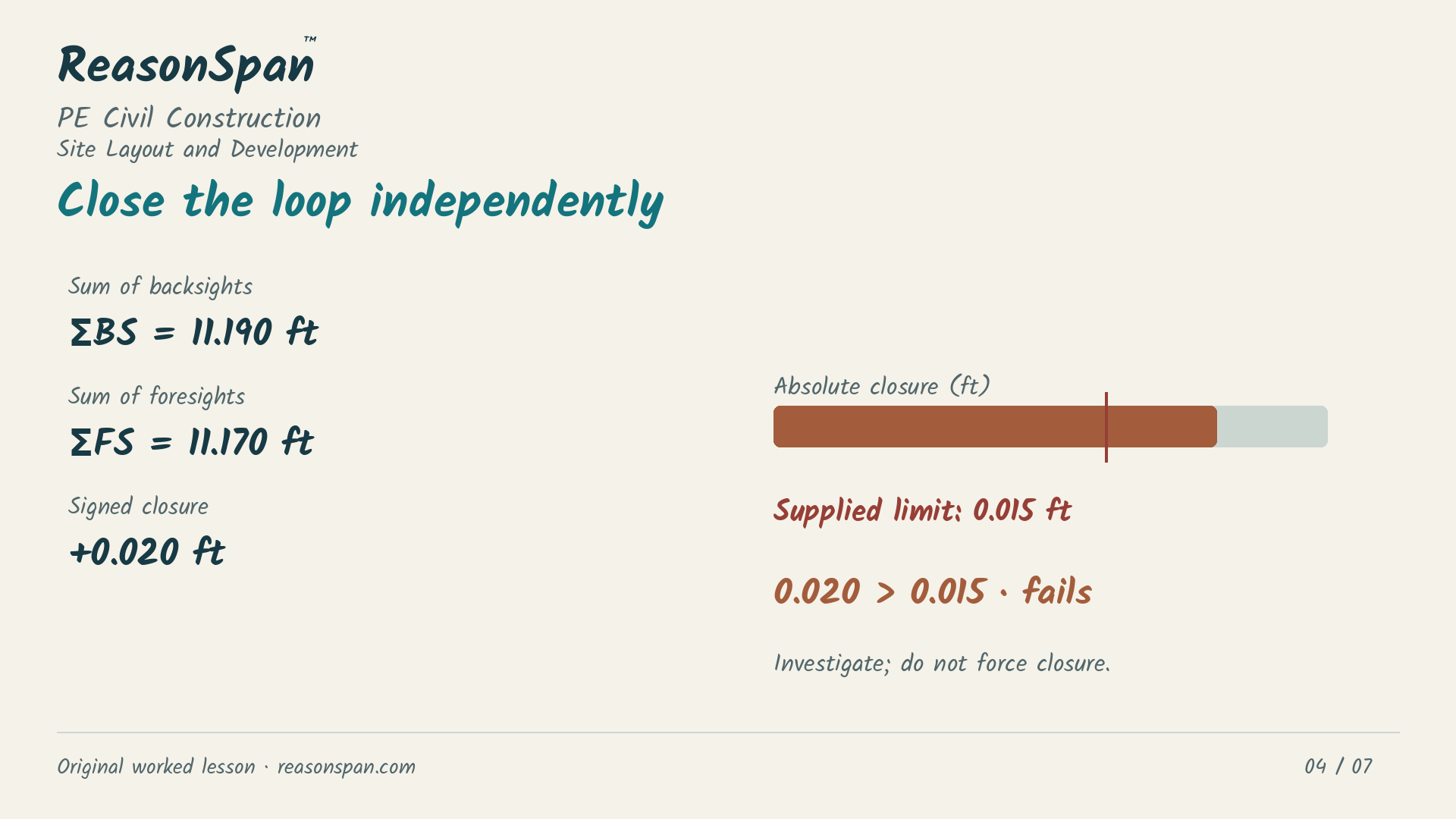
Setup three returns to the benchmark at one hundred and twenty-five point zero two zero feet. Independently, the backsights total eleven point one nine zero and the foresights eleven point one seven zero. Their difference is positive zero point zero two zero feet, matching the elevation closure. The supplied absolute limit is zero point zero one five. This loop fails that limit.
Investigate rather than forcing the elevations to close. A repeat survey validates the earlier observations and establishes the final foresight as three point three eight zero feet. What returned benchmark elevation and closure does that verified observation produce?
The final height of instrument remains one hundred and twenty-eight point three eight zero feet. Subtract three point three eight zero to return to one hundred and twenty-five point zero zero zero. The revised foresight total now equals the backsight total. Closure is zero. This new observation supports the correction; the original closure arithmetic alone could not identify which observation was wrong.
A rod reading measures downward from the line of sight, so adding a normal foresight gives the wrong elevation. Keep raw observations, checks and verified corrections traceable. The exercise's tolerance is supplied, not a universal survey standard. Open the complete ReasonSpan lesson for the field book, then try a different Civil practice decision. The links are in the description.
The situation and givens
A short level circuit transfers a construction benchmark through two turning points and returns to the same benchmark. A supplied closure limit determines whether the observations may be accepted.
- Start and finish at the same benchmark, whose accepted elevation is 125.000 ft.
- Setup 1: backsight 3.425 ft; foresight to turning point 1, 5.170 ft.
- Setup 2: backsight 4.810 ft; foresight to turning point 2, 2.640 ft.
- Setup 3: backsight 2.955 ft; foresight back to the benchmark, 3.360 ft.
- The supplied maximum absolute loop closure is 0.015 ft. All elevations and readings use the same datum and units.
Complete worked method
1. Find the first height of instrument and turning point
Add the backsight to the benchmark elevation to find the line-of-sight elevation. Subtract the foresight to find the new ground-point elevation.
2. Carry the turning point into the second setup
The first turning point becomes the known point for setup 2. The instrument moved, but the turning-point elevation did not change.
3. Return to the original benchmark
Use the second turning point to establish the last line of sight, then subtract the foresight back to the benchmark.
4. Check the loop independently
The backsight sum minus the foresight sum equals the measured elevation change. Returning to the same benchmark should give zero change within its supplied tolerance.
5. Apply the supplied acceptance criterion
The absolute closure exceeds the limit. Investigate and reobserve as needed; do not force the benchmark to its known value. Closure alone cannot identify a particular incorrect reading.
Common errors and why they fail
- Adding the first foresight to HI gives 131.595 ft instead of the correct 123.255 ft turning-point elevation.
- Subtracting a backsight when forming HI reverses the leveling relationship.
- Ignoring the known start and end benchmark loses the independent loop-closure check.
- Editing one reading solely to force closure supplies no observation evidence and does not locate the original error.
Apply the method
How should the original 0.020 ft loop closure be treated under the supplied 0.015 ft maximum?
Change one condition
A repeat survey validates the earlier readings and independently establishes the final foresight as 3.380 ft. What are the returned elevation and closure?
Reveal the worked transfer
The last HI remains 128.380 ft. The returned benchmark is 128.380 − 3.380 = 125.000 ft. The new foresight sum is 11.190 ft, matching the backsight sum, so closure is 0.000 ft and meets the supplied criterion. The repeat measurement supports the correction; the original closure arithmetic alone did not locate the error.
Put the method to work
Try different questions to check whether you can identify the governing condition and explain the next action. The free sampler includes answers and worked explanations.