PE Civil Construction · Complete public lesson
Water-table rise: total stress versus effective stress
Measure pressure head below the water table, then subtract pore pressure once.
Water-table rise: total stress is not effective stress
A rising water table changes the soil's total weight and its pore-water pressure. Keep those effects separate as we compare the stress at one point beneath a materials-storage yard.
The narrated example and worked method use the same original givens. Quiet gaps between sections leave time to inspect the exhibit. The changed condition tests how the method transfers.
Read the video transcript
ReasonSpan™. P E Civil Construction. Effective stress beneath a water table.
A rising water table changes the soil's total weight and its pore-water pressure. Keep those effects separate as we compare the stress at one point beneath a materials-storage yard.
The point is six meters below level grade. Initially, the water table is two meters below grade. Soil above the water table weighs eighteen kilonewtons per cubic meter. Saturated soil weighs twenty. Water weighs nine point eight one. A broad uniform surcharge adds twenty-five kilopascals at the point. Assume hydrostatic conditions and exclude capillary suction and excess pore pressure.
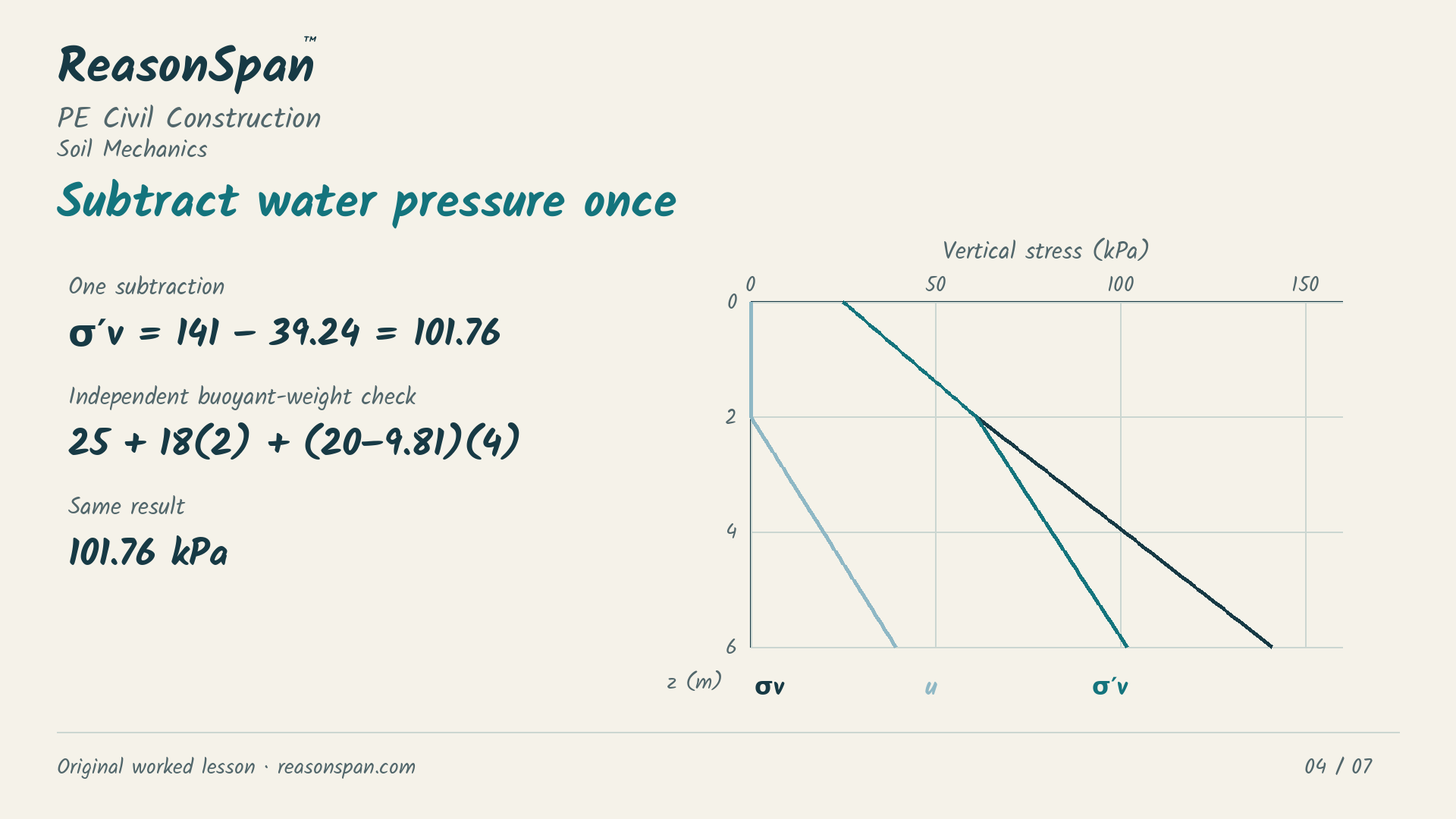
Total vertical stress includes the surcharge and the full weight of the overlying soil. Add twenty-five, eighteen times two, and twenty times four. The result is one hundred and forty-one kilopascals. For pore pressure, measure the vertical water head from the water table to the point. That distance is four meters. Nine point eight one times four gives thirty-nine point two four kilopascals.
Effective stress is total stress minus pore pressure. One hundred and forty-one minus thirty-nine point two four gives one hundred and one point seven six kilopascals. Check independently using saturated unit weight minus water unit weight below the water table. That approach gives the same answer. It already accounts for water, so subtracting pore pressure again would count the water effect twice.
Now raise the water table to one meter below grade. Keep the supplied unit weights, target depth and surcharge unchanged. How do total stress, pore pressure and effective stress change? Rebuild the profile before calculating.
The point now has one meter of moist soil and five meters of saturated soil above it. Total stress becomes one hundred and forty-three kilopascals. Pore pressure becomes forty-nine point zero five. Their difference is ninety-three point nine five kilopascals. Effective stress falls by seven point eight one kilopascals. It does not fall by the entire pore-pressure increase, because total stress also rose.
The useful sequence is profile, total weight, water head, and one subtraction. Measuring water head from grade would incorrectly include soil above the water table. This example calculates stress, not bearing capacity or slope safety. Open the complete ReasonSpan lesson for the profile and equations, then try a different Civil practice decision. The links are in the description.
The situation and givens
A materials-storage yard applies a broad uniform surcharge to a level soil profile. Compare the stress state at a point 6 m below grade before and after the water table rises.
- The point is 6.00 m below level ground; the initial water table is 2.00 m below ground.
- Moist soil above the water table has a supplied unit weight of 18.00 kN/m³; saturated soil below it has a supplied unit weight of 20.00 kN/m³.
- Water unit weight is 9.81 kN/m³. A broad uniform surcharge of 25.00 kPa is fully transmitted to the point in this one-dimensional model.
- Evaluate hydrostatic equilibrium after any excess pore pressure has dissipated. Exclude capillary suction and changes in ground elevation.
Complete worked method
1. Separate the two soil zones
The point lies below 2 m of moist soil and 4 m of saturated soil. Calculate each layer contribution separately, then include the supplied surcharge once.
2. Measure pressure head from the water table
The hydrostatic pressure head is 6 − 2 = 4 m. Soil above the water table does not add to this positive water head under the stated model.
3. Subtract pore pressure once
Effective vertical stress is total vertical stress minus pore pressure. It is the stress transmitted through the soil skeleton, rather than the total stress alone.
4. Check with buoyant unit weight
Alternatively, use saturated soil unit weight minus water unit weight for the submerged zone. That subtraction already accounts for water pressure; do not subtract u again.
Common errors and why they fail
- Using all 6 m as positive water head ignores the water table at 2 m and incorrectly gives 82.14 kPa effective stress.
- Subtracting pore pressure after already using buoyant unit weight counts the water effect twice.
- Treating the 141.00 kPa total stress as effective stress omits the 39.24 kPa pore pressure.
- Ignoring the supplied broad surcharge removes a stated load; hydrostatic equilibrium does not remove that surcharge from total stress.
Apply the method
At the original water-table elevation, which effective vertical stress follows from the stated hydrostatic model?
Change one condition
Raise the water table to 1.00 m below ground. Retain the point depth, supplied unit weights and surcharge. Recalculate all three stresses after hydrostatic equilibrium.
Reveal the worked transfer
Total stress becomes 25 + 18 × 1 + 20 × 5 = 143.00 kPa. Pore pressure becomes 9.81 × 5 = 49.05 kPa. Effective stress is 143.00 − 49.05 = 93.95 kPa, a decrease of 7.81 kPa. Total stress increases by 2.00 kPa while pore pressure increases by 9.81 kPa; subtracting only the pore-pressure change from the old effective stress would miss the changed soil weight.
Put the method to work
Try different questions to check whether you can identify the governing condition and explain the next action. The free sampler includes answers and worked explanations.