PE Civil Construction · Complete public lesson
Off-center construction load: reactions and peak bending
Solve both force and moment equilibrium; equal reactions occur when the total vertical-load resultant is at midspan.
An off-center construction load: solve reactions before judging the support
A centered load resultant produces equal reactions. This off-center bundle makes them unequal. Use the exact beam model to locate the load and solve the reactions.
The narrated example and worked method use the same original givens. Quiet gaps between sections leave time to inspect the exhibit. The changed condition tests how the method transfers.
Read the video transcript
ReasonSpan™. P E Civil Construction. Off-center construction loads.
A centered load resultant produces equal reactions. This off-center bundle makes them unequal. Use the exact beam model to locate the load and solve the reactions.
The fourteen-foot beam has a pin at A and a roller at B. Its uniform dead line load is zero point one eight kips per foot. A nine-kip bundle is modeled as a vertical point load four feet from A. Loads are static and unfactored. The line load includes self-weight.
For equilibrium, replace the uniform load with two point five two kips at midspan, seven feet from A. Take moments about A. The reaction at B times fourteen equals nine times four, plus two point five two times seven. Reaction B is approximately three point eight three one kips. Vertical forces then give reaction A as approximately seven point six eight nine kips. Their sum is eleven point five two, matching the total applied load.
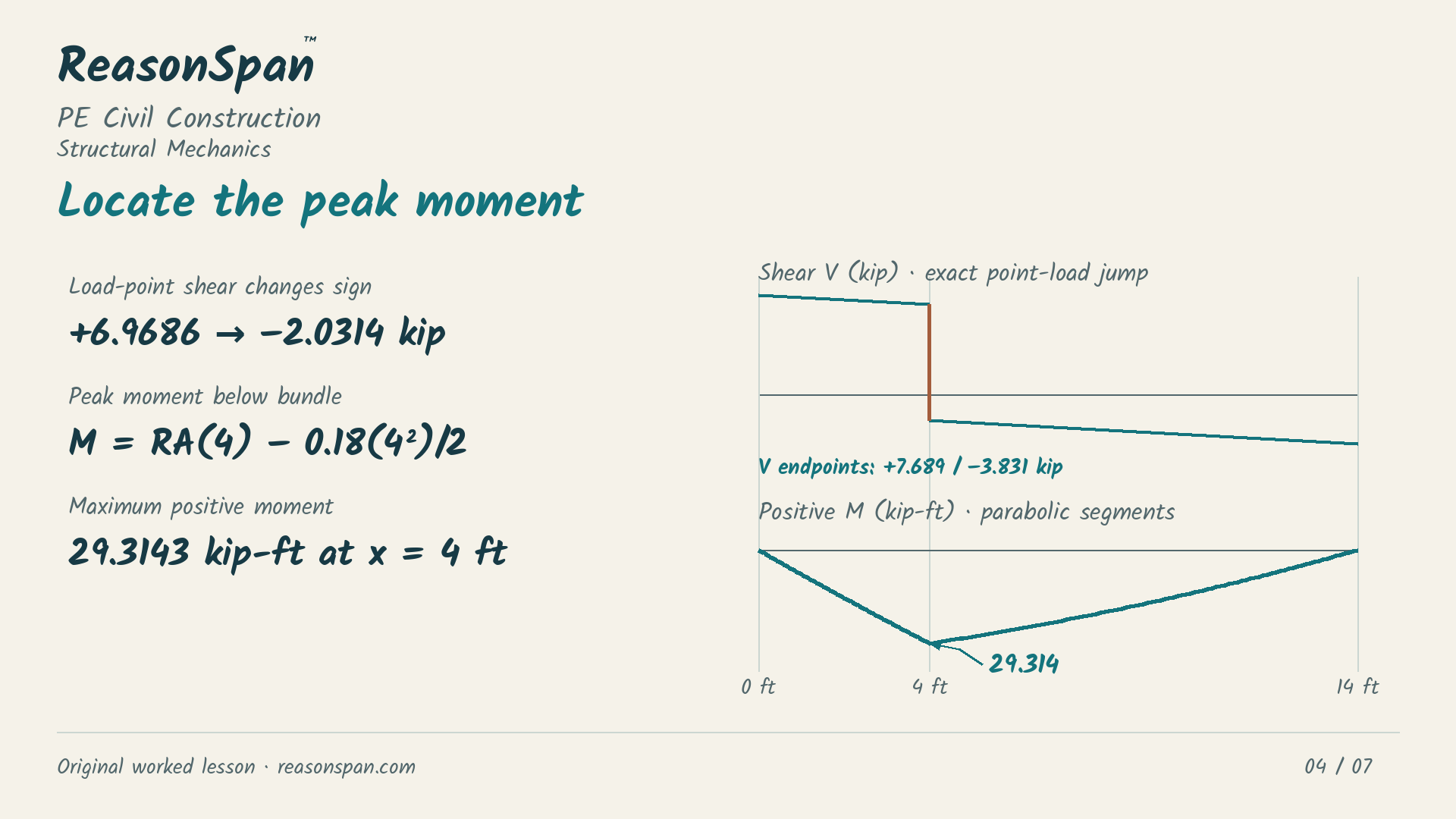
Check moments about B to confirm reaction A. The nine-kip load has a ten-foot arm about B. For the moment diagram, retain the distributed load. Shear changes from positive to negative as the bundle load is crossed, so peak moment occurs beneath it. Reaction A times four, minus zero point one eight times four squared divided by two, gives approximately twenty-nine point three one four kip-feet. Dividing total load equally would satisfy the force sum but fail moment equilibrium.
Move the same bundle to ten feet from A, the mirrored position. Keep the beam length and uniform load unchanged. How do the two reactions and the maximum bending moment change? Use the new lever arm rather than averaging the load.
Reaction B now becomes approximately seven point six eight nine kips, while reaction A becomes three point eight three one. The reactions swap. Peak moment occurs beneath the bundle at ten feet from A and remains approximately twenty-nine point three one four kip-feet. The mirrored arrangement preserves the moment magnitude while shifting which support carries more load.
These results establish demand under the supplied model. Member strength, deflection, support resistance, impact and lateral stability require additional information and checks. Keep the free-body diagram and load position visible. Open the complete ReasonSpan lesson for the exact beam, shear and moment diagrams, then try a different Civil practice decision. The links are in the description.
The situation and givens
A simply supported temporary platform beam carries a uniform dead load and an off-center material bundle. Calculate reactions and peak moment, then mirror the bundle location.
- Span is 14 ft, with a pin at A and a roller at B.
- Uniform dead line load is 0.18 kip/ft along the full span, already including the supplied self-weight.
- A vertical 9.00 kip point load is 4 ft from A and 10 ft from B.
- Loads are static and unfactored. No section, support capacity, impact or lateral-stability data are supplied.
- In the changed condition, move the same bundle to 10 ft from A without changing other facts.
Complete worked method
1. Form the free-body diagram
Replace the uniform load by its midspan resultant for reaction equilibrium. Keep the actual distributed load for internal shear and moment.
2. Take moments about A
Include each load’s distinct lever arm. Taking moments removes the unknown reaction at A.
3. Apply vertical force equilibrium
Reactions sum to the downward load. The original bundle location gives a larger reaction at A.
4. Check moments independently about B
The bundle has a 10 ft lever arm about B; the uniform-load resultant has a 7 ft arm.
5. Locate maximum moment from the shear jump
Shear changes from positive to negative beneath the bundle. The continuous moment peaks there; the nonzero uniform load gives two parabolic segments joined at the load.
6. Calculate peak bending
Use the left reaction and actual uniform-load contribution over the first 4 ft. The whole-span equivalent point load cannot replace the UDL in the internal moment diagram.
Common errors and why they fail
- Dividing total 11.52 kip equally gives 5.76 kip per support, satisfying force equilibrium but violating moment equilibrium. Equal reactions require the total resultant at midspan; symmetry is sufficient, not necessary.
- Swapping the 4 ft and 10 ft lever arms reverses the support assignment.
- Using wL²/8 alone omits the off-center point-load contribution.
- Putting the UDL’s whole-span resultant into the internal moment diagram changes the actual loading.
- Adding self-weight again double-counts the supplied 0.18 kip/ft; demand alone cannot prove adequacy.
Apply the method
Which reactions satisfy the original free-body diagram?
Change one condition
Move the bundle to 10 ft from A. Find both reactions and the location and magnitude of maximum moment.
Reveal the worked transfer
R_B = [9 × 10 + 2.52 × 7]/14 = 7.68857 kip; R_A = 11.52 − R_B = 3.83143 kip. Shear is +2.03143 kip immediately before the bundle and −6.96857 immediately after, so the peak is at x = 10 ft. Using the unrounded reaction, M = R_A × 10 − 0.18 × 10²/2 = 29.31429 kip-ft. Mirroring swaps the reactions while preserving peak moment.
Put the method to work
Try different questions to check whether you can identify the governing condition and explain the next action. The free sampler includes answers and worked explanations.