PE Civil Construction · Complete public lesson
Concrete takeoff: net volume, waste and purchased cost
Keep net installed volume, waste allowance and purchased quantity separate.
Concrete takeoff: deduct openings, then order the correct quantity
Keep three quantities separate: the volume installed in the slab, the waste allowance, and the amount actually ordered. Rounding belongs at the supplier-order step.
The narrated example and worked method use the same original givens. Quiet gaps between sections leave time to inspect the exhibit. The changed condition tests how the method transfers.
Read the video transcript
ReasonSpan™. P E Civil Construction. Concrete takeoff and purchase cost.
Keep three quantities separate: the volume installed in the slab, the waste allowance, and the amount actually ordered. Rounding belongs at the supplier-order step.
The equipment-yard slab measures forty-two by thirty feet and is six inches thick. Three rectangular openings, each four by three feet, extend through its full depth. Allow seven percent waste. The supplier accepts orders in quarter-cubic-yard increments, rounding upward. Concrete costs one hundred and ninety-eight dollars per cubic yard, with a fixed six hundred and twenty dollar pump charge.
Start with the plan area. Forty-two times thirty gives one thousand two hundred and sixty square feet. The three openings remove thirty-six square feet, leaving one thousand two hundred and twenty-four. Convert six inches to zero point five feet. Net installed volume is six hundred and twelve cubic feet. Divide by twenty-seven cubic feet per cubic yard to obtain twenty-two point six six six seven cubic yards.
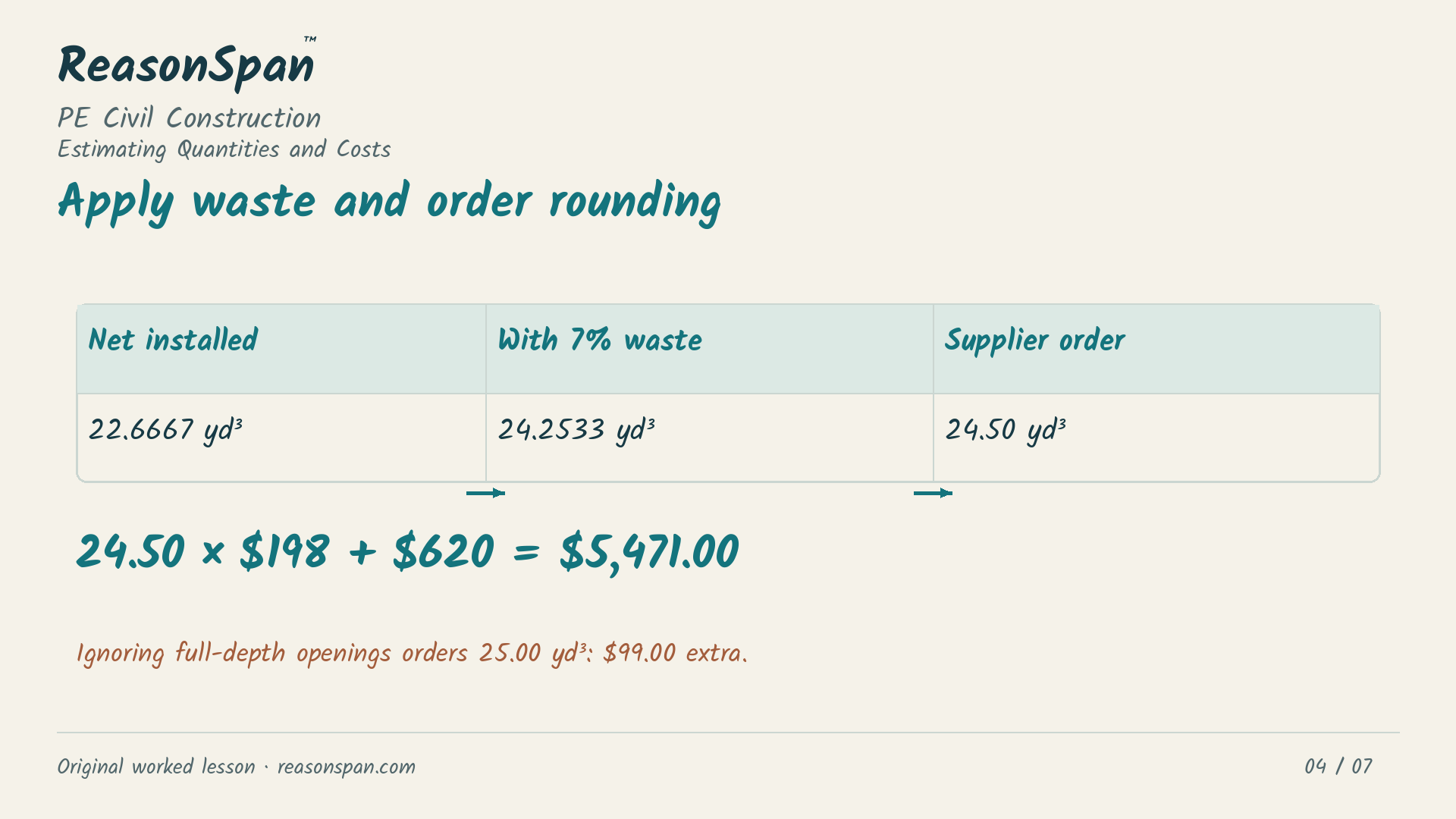
Multiply that net volume by one point zero seven to include the supplied waste allowance. The result is approximately twenty-four point two five three three cubic yards. Round upward to the next quarter-yard increment: order twenty-four point five zero. Concrete plus the fixed pump charge costs five thousand four hundred and seventy-one dollars. Ignoring the openings would raise the order to twenty-five cubic yards and overstate this cost by ninety-nine dollars.
Now increase the slab thickness from six to seven inches. Keep the openings, waste allowance, supplier increments and prices unchanged. What quantity should be ordered, and how much does this concrete-and-pump purchase cost?
Use seven divided by twelve feet for thickness. Net volume becomes approximately twenty-six point four four four four cubic yards. With waste, it becomes twenty-eight point two nine five six. Round upward to twenty-eight point five zero cubic yards. The purchase costs six thousand two hundred and sixty-three dollars, an increase of seven hundred and ninety-two dollars. The pump charge stays fixed.
Deduct full-depth openings, convert thickness, calculate net volume, apply waste, then round the order. This supplied estimate covers concrete and pumping; reinforcement, forming, labor, tax and other bid costs are outside it. Open the complete ReasonSpan lesson for the exact plan and cost breakdown, then try a different Civil practice decision. The links are in the description.
The situation and givens
Estimate an equipment-yard slab with three full-depth rectangular openings. The supplier bills delivered concrete in quarter-cubic-yard increments plus one fixed pump charge.
- Slab dimensions are 42 ft by 30 ft with 6 in thickness.
- Three openings are each 4 ft by 3 ft and extend through the full slab depth.
- Add a supplied 7% waste allowance to net volume.
- Round upward to the supplier’s 0.25 yd³ purchase increments.
- Concrete price is $198 per purchased yd³; one fixed pump charge is $620. These are supplied exercise prices.
Complete worked method
1. Deduct full-depth openings
Remove all three opening areas before multiplying by slab depth.
2. Convert thickness and find net volume
Use thickness in feet with plan area in square feet.
3. Convert to cubic yards
One cubic yard contains 27 cubic feet. Retain unrounded intermediates.
4. Apply waste before order rounding
24.2533 yd³ lies just above 24.25 yd³. Round upward once to 24.50 yd³.
5. Price the purchased quantity
Use the supplier-rounded quantity and add the fixed pump charge.
Common errors and why they fail
- Ignoring openings leads to 25.00 yd³ and $5,570, overstating this purchase by $99.
- Using 6 as thickness in feet multiplies volume by twelve.
- Dividing cubic feet by 9 uses an area conversion; the volume divisor is 27.
- Rounding 24.2533 down to 24.25 yd³ fails the stated purchase requirement.
- Calling this a complete installed bid omits other costs such as forms, reinforcement and labor.
Apply the method
Which order and concrete-and-pump amount meet the supplied baseline requirements?
Change one condition
Increase only thickness to 7 in. Retain openings, waste, increments and prices. Find the order, purchase cost and increase.
Reveal the worked transfer
Net volume is 1,224 × (7/12)/27 = 26.4444 yd³. With waste, 28.2956 yd³ requires a 28.50 yd³ order. Cost is 28.50 × $198 + $620 = $6,263.00, an increase of $792.00. The order increases by 4.00 yd³ after rounding; the pump fee is unchanged.
Put the method to work
Try different questions to check whether you can identify the governing condition and explain the next action. The free sampler includes answers and worked explanations.