PE Civil Construction · Complete public lesson
Compaction acceptance: compare dry density and moisture separately
A wet-density reading cannot be compared directly with a dry laboratory maximum.
Compaction acceptance: compare dry values to the supplied specification
A field wet-density reading cannot be compared directly with a laboratory maximum dry value. Put both values on the same basis, then check the separate moisture requirement.
The narrated example and worked method use the same original givens. Quiet gaps between sections leave time to inspect the exhibit. The changed condition tests how the method transfers.
Read the video transcript
ReasonSpan™. P E Civil Construction. Compaction acceptance.
A field wet-density reading cannot be compared directly with a laboratory maximum dry value. Put both values on the same basis, then check the separate moisture requirement.
The field wet unit weight is one hundred and twenty-seven pounds per cubic foot, with twelve percent moisture content on a dry-solids basis. The matching laboratory maximum dry unit weight is one hundred and twenty pounds per cubic foot. The supplied specification requires at least ninety-five percent compaction. Optimum moisture is ten percent, with an allowable deviation of two percentage points either way.
Write moisture as zero point one two. Divide field wet unit weight by one plus that decimal. One hundred and twenty-seven divided by one point one two gives approximately one hundred and thirteen point three nine pounds per cubic foot dry. Divide by the laboratory maximum and multiply by one hundred. Relative compaction is approximately ninety-four point four nine percent.
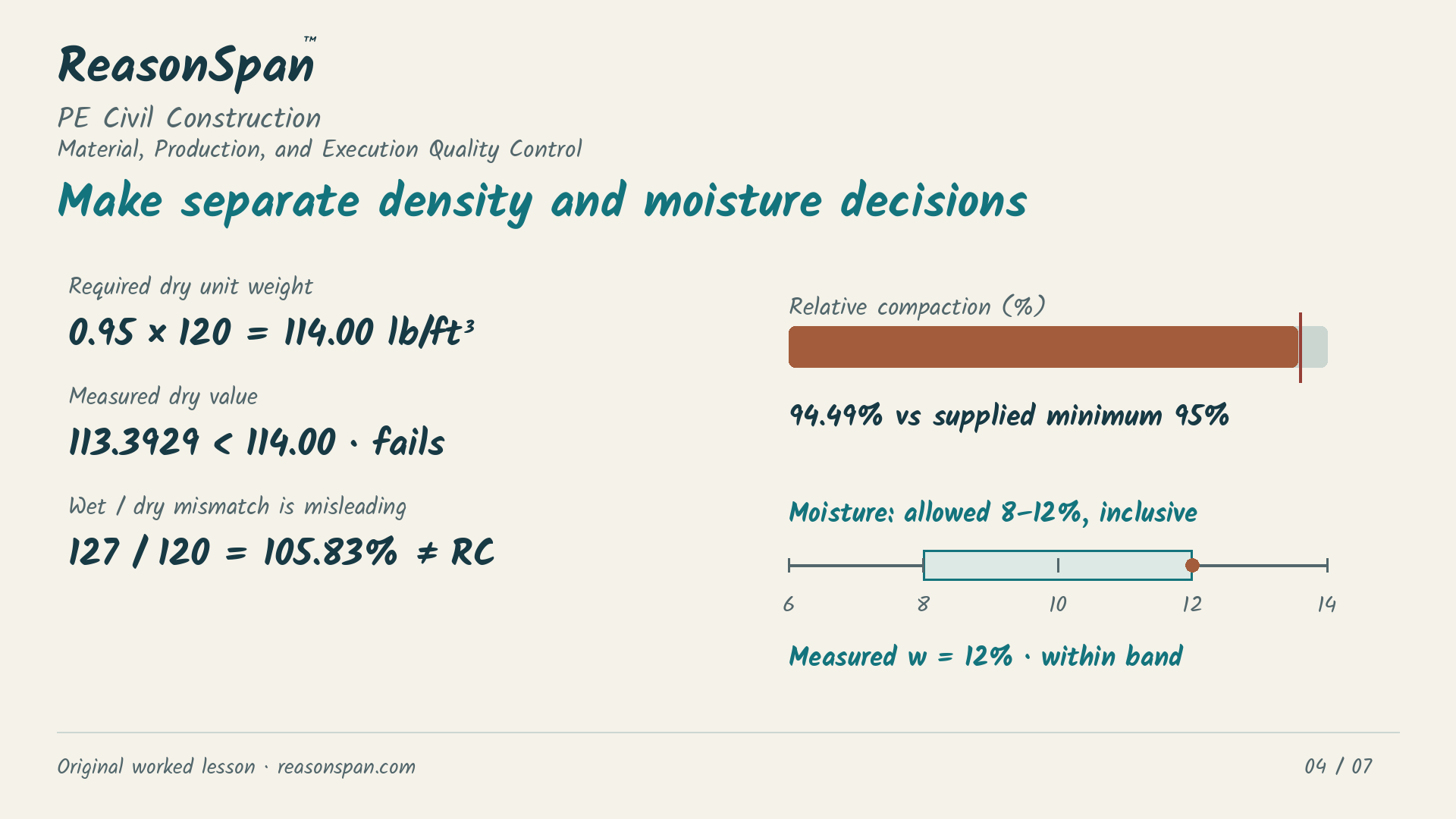
Independently, ninety-five percent of the laboratory maximum is one hundred and fourteen pounds per cubic foot. The measured dry unit weight is lower, so density fails. The allowed moisture band is eight through twelve percent, inclusive. Moisture passes at the upper boundary. Both supplied requirements must pass. Comparing the wet reading with the dry laboratory maximum would misleadingly produce about one hundred and five point eight three percent.
After reworking the lift, a new valid test measures a wet unit weight of one hundred and twenty-nine pounds per cubic foot, again at twelve percent moisture. Keep the matching laboratory reference and specification unchanged. Does the retest satisfy both numerical criteria?
Divide one hundred and twenty-nine by one point one two. The retest dry unit weight is approximately one hundred and fifteen point one eight pounds per cubic foot. Relative compaction is approximately ninety-five point nine eight percent. Density now exceeds the supplied minimum, and twelve percent moisture remains within the allowed band. The retest satisfies both stated numerical conditions.
Do not round an initial ninety-four point four nine percent up to a ninety-five-percent acceptance claim. Confirm the material and testing basis, then follow the project's representative-testing and acceptance process. The percentages here are supplied requirements. Open the complete ReasonSpan lesson for the test comparison, then try a different Civil practice decision. The links are in the description.
The situation and givens
A fill lift has measured wet unit weight and moisture content. Apply a supplied density threshold and moisture band using the matching laboratory reference.
- Initial field wet unit weight is 127 lb/ft³ with 12% water content on a dry-solids basis.
- Matching laboratory maximum dry unit weight is 120 lb/ft³; minimum required relative compaction is 95%.
- Optimum moisture is 10%; allowed deviation is ±2 percentage points, including the endpoints.
- Field and laboratory values concern the same material, compatible test basis and applicable corrections.
- A valid retest after reworking gives 129 lb/ft³ wet unit weight and 12% moisture; laboratory reference and criteria are unchanged.
Complete worked method
1. Convert water content to a decimal
The water-to-dry-solids mass ratio is 0.12, not 12.
2. Calculate field dry unit weight
Remove the water contribution by dividing wet unit weight by 1 + w.
3. Compare dry field and laboratory values
Relative compaction uses matching dry values. This is not the relative-density index for granular soils.
4. Check the dry threshold directly
The required dry unit weight is above the measured value. Retain precision rather than rounding into acceptance.
5. Evaluate moisture separately
The inclusive band is 8–12%. Moisture meets its upper boundary, while density fails; both criteria are required.
Common errors and why they fail
- 127/120 = 105.83% mixes wet field and dry laboratory quantities and is not valid relative compaction.
- Using 12 instead of 0.12 in 1 + w misuses a percentage.
- Rounding 94.4940% up to 95% conceals a failed comparison.
- Accepting density because moisture passes ignores the separate requirements.
- Using an unrelated laboratory maximum changes the material and test basis.
Apply the method
How does the initial field test compare with the two supplied requirements?
Change one condition
Reapply the unchanged reference and requirements to the retest of 129 lb/ft³ wet unit weight at 12% moisture.
Reveal the worked transfer
Dry unit weight is 129/1.12 = 115.1786 lb/ft³. Relative compaction is 115.1786/120 × 100 = 95.9821%, exceeding 95%. Moisture remains at the included 12% boundary. The retest meets both supplied numerical conditions; representative testing and the project acceptance process still determine acceptance of the lift.
Put the method to work
Try different questions to check whether you can identify the governing condition and explain the next action. The free sampler includes answers and worked explanations.
Continue your preparation
- Study the Material, Production, and Execution Quality Control chapter →
- Explore complete worked lessons →